
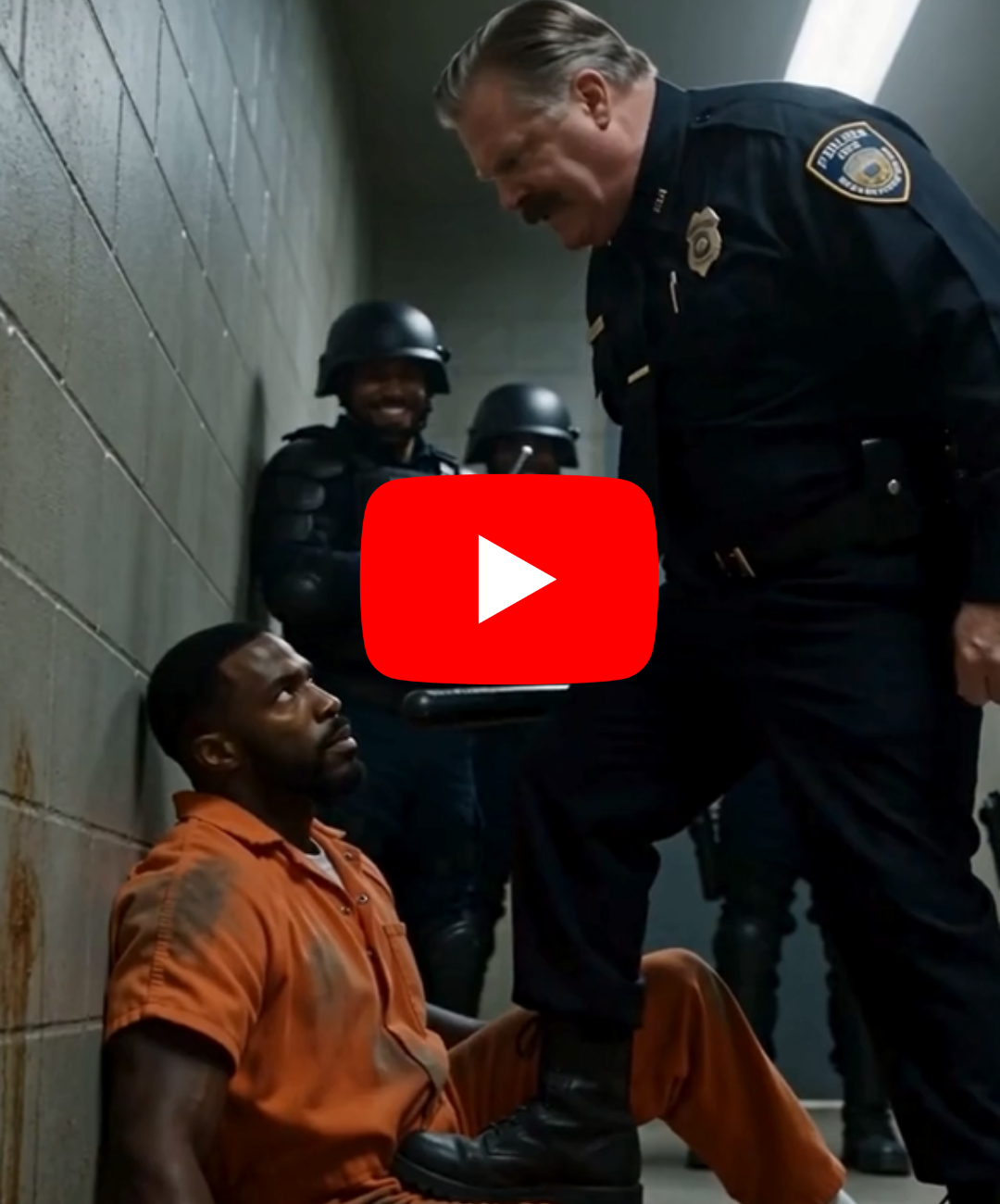
“LICK THAT SOUR SLOP OFF THE SEWER GRATE WITH YOUR TONGUE, OR I’LL CRACK YOUR RIBS WITH A NIGHTSTICK AND BURY YOU IN SOLITARY!”
Captain Julian Vance wanted everyone in Cellblock Delta to hear him.
That was part of the punishment.
Humiliation did not work as well without witnesses.
The metal feeding tray hit the concrete and spun once before stopping beside the drainage trench.
Rotting cornmeal mush spilled across the grate.
The smell filled the isolation cell.
I stayed on the floor.
Not because Vance had broken me.
Because I needed him to believe he had.
My prescription glasses lay beneath his boot.
CRUNCH.
The thick plastic frame snapped.
One lens cracked.
A broken edge scraped the bridge of my nose and left a thin line of blood.
Vance looked down at me and smiled.
Behind him stood five corrections officers in riot gear.
None of them seemed uncomfortable.
That told me almost as much as the files I had spent weeks collecting.
Vance kicked the empty feeding tray away.
“You’ve got thirty seconds.”
I looked toward the slop on the floor.
Then back at him.
“You spent three days refusing to sign over your veteran disability pension,” he said.
His voice had the relaxed confidence of a man who had used the same threat before.
“You think because you wore a uniform, you’re special?”’
One of the guards laughed.
Vance stepped closer.
“In my prison, I decide who eats.”
Another step.
“Who sleeps.”
His boot pressed against my chest.
“Who gets medical care.”
The pressure increased.
“And who disappears.”
I kept my breathing slow.
That was not courage.
It was discipline.
There is a difference.
Vance thought I was another inmate who had reached the point where fear and exhaustion became indistinguishable.
That was what I needed.
He had spent years surrounded by men who were powerless to challenge him.
He had forgotten what caution felt like.
That made him dangerous.
It also made him predictable.
The privately operated Lone Star Correctional Facility sat far enough from anything important that people could pretend not to notice what happened behind its walls.
Officially, the place housed difficult inmates under a state contract.
Unofficially, it had become something else.
Money disappeared.
Disability payments moved into accounts inmates did not recognize.
Maintenance budgets grew while essential systems failed.
Medical complaints vanished from records.
Prisoners who challenged deductions suddenly accumulated disciplinary reports.
Men were moved.
Names disappeared from ordinary rosters.
And certain work assignments seemed to generate revenue nobody could explain.
I had not entered Lone Star as a convicted prisoner.
My name was Marcus Cole.
I was a senior federal investigator operating undercover.
For weeks, I had worn the same uniform, eaten from the same trays, followed the same count procedures, and waited for the people running the facility to stop seeing me as a threat.
They did.
That was their mistake.
The first indication of the pension scheme came from three veterans whose disability deposits had been redirected after entering Lone Star.
The paperwork described voluntary maintenance contributions.
The men described threats.
Different wording.
Same signatures.
That discrepancy opened the door.
Then came other allegations.
Extortion.
Forced financial transfers.
Manipulated work records.
Possible trafficking tied to outside contractors.
The more investigators looked, the more the same names appeared.
At the center of them was Julian Vance.
So I went inside.
Not to confront him.
To document him.
That required patience.
You do not expose an operation like his by making speeches.
You watch.
You listen.
You let arrogant men believe you are beneath their notice.
For the first two weeks, I cleaned.
Worked.
Waited.
Vance barely knew my name.
By the third week, he had started testing me.
Small things.
A meal withheld.
A medical request delayed.
An officer ordering me to sign paperwork I claimed not to understand.
I refused.
Carefully.
Enough to become irritating.
Not enough to become suspicious.
That was how I learned about the pension transfers.
Vance liked coercion to feel administrative before it became physical.
First came the forms.
Then warnings.
Then isolation.
By the time I reached Cellblock Delta, he believed he had placed me exactly where he wanted me.
No witnesses outside his own people.
No ordinary cameras he worried about.
No sympathetic staff.
Just concrete.
Steel.
Drainage.
And fear.
The guard nearest me spat beside the food.
“Lick it up.”
The others laughed.
Vance looked down.
“You hear him?”
I did not move.
One of the men behind him tapped a baton against his palm.
Slowly.
Almost rhythmically.
Vance enjoyed that.
Every prison develops sounds.
Doors locking.
Keys.
Intercoms.
Boots.
Metal trays.
Men who live inside them learn to distinguish ordinary noise from warning.
The repeated tap of wood against a palm was not ordinary.
It was theater.
Vance wanted me imagining what came next before it happened.
He wanted me to surrender first.
That made everything cleaner for him.
A coerced signature looked better than an unexplained injury.
“I asked you a question,” Vance said.
I raised my eyes.
His boot remained against my chest.
Blood from the damaged glasses reached the corner of my mouth.
“You’ve got five seconds to step off me.”
For a moment, nobody spoke.
Then Vance laughed.
Not because the sentence was funny.
Because it sounded impossible to him.
The other guards followed.
One of them shook his head.
“Listen to this guy.”
Vance leaned down.
“You still think somebody is coming for you?”
That question mattered.
I wondered whether he realized it.
My broken glasses lay beside his boot.
To him, they were nothing.
Cheap plastic.
A humiliation.
A way to make a prisoner more dependent.
He did not know what had been built into the frame.
When the hinge broke, a covert distress system activated.
The signal left the facility.
After that, my job changed.
Survive.
Keep Vance talking.
And wait.
He straightened.
“Boy, I own the dirt you’re bleeding on.”
Then he raised the baton.
“Break both his arms.”
The guards moved.
That was when the building changed.
The first sound was not the explosion.
It was vibration.
Deep.
Structural.
The kind you feel through concrete before your ears understand it.
Vance stopped.
Every guard looked upward.
Then came the impact.
BOOM.
The ceiling above Cellblock Delta erupted.
Concrete dust filled the air.
Lights flickered.
Metal screamed somewhere overhead.
The guards stumbled backward as the block disappeared into noise, alarms, and confusion.
I rolled away from the center of the cell.
Not toward freedom.
Toward cover.
Training survives even when the plan changes.
Vance hit the bars.
One of the guards lost his shield.
Another fell to one knee.
Then voices cut through the smoke.
“FEDERAL AGENTS!”
Everything about the room changed.
Vance had spent years controlling who could enter his prison.
Now that control was gone.
Armed federal personnel flooded the cellblock.
Commands came hard and clear.
The guards who had been laughing seconds earlier were suddenly dropping their batons.
Hands visible.
Bodies against the floor.
No jokes.
No casual cruelty.
No one calling Vance a god.
I stayed down until an operator reached me.
Then another figure appeared behind the tactical team.
Older.
Uniformed.
The kind of presence that made even people carrying rifles shift slightly when he entered.
Major General Arthur Hayes.
Alongside him came the United States Attorney for the Western District of Texas.
That was when Vance understood this was not an emergency extraction alone.
It was a seizure.
A federal operation aimed at the institution itself.
He scrambled across the debris.
“What is this?”
Nobody answered him.
“This is a state-contracted private prison!”
His voice cracked.
“You cannot come in here like this!”
The U.S. Attorney stepped around him.
Vance pointed toward the breach above.
“Who authorized this?”
General Hayes kept walking.
He did not look at Vance.
That insult landed harder than shouting would have.
The man who demanded everyone acknowledge his authority had suddenly become irrelevant.
Hayes stopped outside my cell.
One of the tactical officers cleared the doorway.
The general looked down at me.
For a second, neither of us spoke.
Then his eyes moved to my wrists.
The restraints were removed.
I stood carefully.
My chest hurt.
My knees hurt.
Blood had dried along the bridge of my nose.
But I was standing.
Across the block, federal agents were securing the guards.
Evidence teams were already moving toward administrative corridors.
Vance stared at me.
Not at the uniform.
At my posture.
That was when he finally understood.
“You…”
He looked around.
Then back.
“No.”
I wiped blood from my face.
He shook his head harder.
“You’re an inmate.”
I said nothing.
“You came in through county intake.”
Still nothing.
“I saw your file.”
That one almost made me smile.
Of course he had.
The file had been built for him.
Vance took one step back.
The general faced me.
“Agent Cole.”
The name landed across the block.
Every captured guard heard it.
So did Vance.
His face changed.
The U.S. Attorney opened a document folder.
“Senior Special Agent Marcus Cole.”
Vance stared.
For weeks, he had insulted me.
Threatened me.
Tried to force financial signatures from me.
Placed me in isolation.
And now he was replaying every one of those moments with new information.
I had not been helpless.
I had been documenting him.
“You set me up.”
His voice came out low.
I finally answered.
“No.”
I looked at the slop beside the grate.
“You did that yourself.”
He shook his head.
“You came in here under false pretenses.”
The U.S. Attorney spoke.
“We came in under federal authority.”
“I want counsel.”
“You’ll have counsel.”
“I want the state notified.”
“They’re being notified.”
Vance pointed toward me.
“He infiltrated my facility!”
The word my stayed in the air.
The U.S. Attorney looked at him.
“That may be part of the problem.”
Federal personnel moved through the wing with speed.
Not random speed.
Purpose.
Administrative offices.
Server rooms.
Medical records.
Financial systems.
Vance watched them.
His panic increased with every direction they took.
“Stay out of my office.”
Nobody listened.
“You need a warrant.”
The attorney held up a sealed packet.
“We have one.”
Vance’s eyes moved across the page as though he could somehow erase it by refusing to understand.
“What are you looking for?”
No one answered.
He already knew.
That was obvious.
The guards had stopped speaking entirely.
One kept his face turned toward the floor.
Another stared at Vance.
Not loyalty.
Fear.
Fear of what might be found.
General Hayes stepped closer to me.
“Perimeter secured.”
His voice remained controlled.
“The Department of Justice has control of the operational servers.”
Vance’s face went pale.
There.
Not when the ceiling opened.
Not when armed agents entered.
Not when my identity was revealed.
The servers.
That was what frightened him.
I noticed.
So did the United States Attorney.
She turned toward him.
“Something on those systems we should be worried about, Captain?”
Vance recovered too slowly.
“No.”
“You looked concerned.”
“You just attacked a secure facility.”
“No one attacked your records.”
His jaw tightened.
The distinction mattered.
People protect what can expose them.
His eyes had told us where to look.
I picked up one half of my broken glasses.
The frame hung crookedly.
The tiny device inside the hinge had done its job.
Vance stared at it.
Then at me.
Understanding arrived piece by piece.
“The glasses.”
I said nothing.
His eyes widened.
“You son of a—”
An agent moved between us.
“Careful.”
Vance laughed once.
It sounded hollow.
“You think you won?”
I looked around the isolation block.
Concrete dust hung in the air.
Federal agents photographed the floor.
The feeding tray.
The broken glasses.
The guards.
Vance himself.
“This isn’t about winning.”
“What is it about?”
“Records.”
That shut him up.
For the first time since I had met Julian Vance, he had no speech ready.
He had always depended on isolation.
Every threat existed inside a closed system.
A prisoner said one thing.
His officers said another.
The administration controlled the paperwork.
Complaints disappeared.
Video failed.
Forms changed.
An injury could become noncompliance.
Extortion could become a voluntary deduction.
A missing man could become a transfer.
Vance had built power from the difference between what happened and what the record said happened.
Now the records belonged to people outside his control.
That was why he was afraid.
The U.S. Attorney moved toward the corridor.
An agent stopped her.
“We have the finance mirror.”
“Complete?”
“Initial pull looks intact.”
Vance swore.
Everyone turned.
The agent looked at him.
“Something you’d like to add?”
“No.”
The attorney smiled without humor.
“Good.”
Another team announced they had secured the executive office.
A third reported evidence from accounting.
Then came the first mention of restricted housing.
That was when one of Vance’s guards started crying.
Quietly.
He turned his face toward the floor and said:
“I want a lawyer.”
Vance snapped toward him.
“Shut your mouth.”
The room went still.
Federal agents looked between them.
The guard swallowed.
Then repeated:
“I want a lawyer.”
Vance shouted his name.
An HRT operator stepped closer.
“Captain, do not speak to him.”
Vance’s authority was collapsing faster than he could understand.
Minutes earlier, five men had been ready to beat me because he told them to.
Now one of those same men was afraid enough to stop protecting him.
That was how organizations like his broke.
Not all at once.
One frightened person at a time.
One file.
One transfer.
One account.
One witness deciding the powerful man beside him was no longer powerful enough to save him.
The U.S. Attorney returned to Vance.
“You threatened an inmate over a financial transfer.”
He said nothing.
“You ordered physical force.”
Nothing.
“You maintained unauthorized financial accounts connected to inmate payments.”
His eyes narrowed.
“That is an accusation.”
“Yes.”
“You don’t have proof.”
She glanced toward the secured administrative wing.
“We’ll see.”
Vance looked at me again.
“You recorded me?”
I did not answer.
His attention moved to the remnants of my glasses.
His expression became worse.
He was now wondering what else had been recording.
Which conversations.
Which rooms.
Which signatures.
Which people.
That uncertainty was useful.
I let him have it.
General Hayes stepped beside me.
“You need medical attention.”
“I’m fine.”
He looked at my face.
“That wasn’t a question.”
Despite everything, I almost smiled.
A medic checked my eyes.
Then my chest.
My ribs hurt but appeared intact.
The cut from the glasses was superficial.
I had been lucky.
A few more seconds might have changed that.
Across from me, Vance was finally placed in restraints.
He stared down at the cuffs.
That image stayed with me.
Not because I enjoyed it.
Because he seemed genuinely surprised that metal could close around his wrists too.
People like Vance build their identities around asymmetry.
They command.
Other people obey.
They search.
Other people are searched.
They punish.
Other people absorb punishment.
The first time the structure reverses, they often react as though reality itself has violated an agreement.
Vance looked at the federal agents.
“I run this facility.”
Nobody responded.
He tried again.
“I am the ranking authority here.”
The U.S. Attorney looked at him.
“Not anymore.”
His mouth tightened.
“You don’t know what you’re dealing with.”
I watched him carefully.
Maybe a threat.
Maybe desperation.
Maybe one last attempt to sound important.
The attorney answered:
“That is exactly why we seized the servers.”
Vance stopped talking.
Evidence technicians passed us carrying sealed drives.
Boxes.
Files.
A stack of inmate account records.
I recognized the forms.
Same format Vance had tried to force me to sign.
Voluntary deductions.
Maintenance contributions.
Administrative reimbursement.
Words designed to turn coercion into paperwork.
One federal analyst opened a binder.
Dozens of names.
Amounts.
Transfer dates.
Some repeated.
Veterans.
Older prisoners.
Men with no outside family.
People Vance believed nobody would notice.
I thought about every inmate who had told me quietly that something was wrong.
The ones who lowered their voices before mentioning money.
The ones who refused to write grievances because previous grievances had made their lives worse.
I had come to Lone Star looking for a financial scheme.
What I found was a culture built around the assumption that certain people could be exploited because the public had already decided not to care about them.
Vance relied on that.
So did everyone who helped him.
He looked at me from the floor.
“Cole.”
I met his eyes.
“You think those men are going to thank you?”
He nodded toward the cells.
“Half of them hate the government more than they hate me.”
“Maybe.”
“You think you’re their hero?”
“No.”
That seemed to confuse him.
“I don’t need to be.”
His jaw tightened.
“Then what are you?”
“Evidence.”
He stared at me.
That was the point.
Undercover work is not about becoming the center of the story.
It is about getting close enough to make the truth impossible to erase.
I did not need prisoners to admire me.
I needed investigators to find the records.
Accounts.
Victims.
Witnesses.
And whatever Vance had hidden behind the language of routine prison administration.
The attorney returned holding another folder.
“Agent Cole.”
I looked over.
“They have the maintenance accounts.”
Vance reacted.
Tiny.
But visible.
I saw it.
“So did he,” she said.
He looked away.
The facility maintenance fund had always sounded ordinary.
That was why it worked.
Money entered under harmless labels.
Repairs.
Supplies.
Emergency infrastructure.
Security upgrades.
But inmates had been pressured to sign payments into the same system.
That alone made no sense.
Veteran disability income did not belong in a prison maintenance account.
Yet Vance had personally demanded mine.
Now the paper trail was being pulled apart.
The attorney turned to him.
“You know what the interesting thing about financial records is?”
He said nothing.
“They don’t care how loudly you shout.”
Vance’s eyes hardened.
She continued.
“Numbers don’t get intimidated in solitary.”
An agent nearby almost smiled.
Vance did not.
Neither did I.
Because beneath the satisfaction of finally watching his control collapse was something much heavier.
If the allegations were correct, real people had spent years living under this system.
Some would never get the time back.
No raid fixes that.
No arrest restores it.
Justice, when it comes late, still arrives late.
That mattered.
The general looked toward the damaged ceiling.
“Extraction route is secure.”
I glanced at the prison block.
“So are the records?”
“Enough to begin.”
That was the better answer.
Begin.
Not finished.
Not solved.
Begin.
Vance heard it too.
He laughed again.
“You think this ends with me?”
The attorney looked at him.
“Nobody said it did.”
His face changed.
Because that was another fear.
The investigation did not necessarily stop at the warden’s office.
If money moved outside the prison, people outside had received it.
If records were manipulated, others might have signed them.
If prisoners were moved improperly, someone authorized transportation.
Systems like Vance’s rarely survived on one man’s cruelty alone.
They required paperwork.
Silence.
Convenient blindness.
The U.S. Attorney looked toward the corridor where additional agents were disappearing into the administrative wing.
Then back at Vance.
“For years, you apparently believed nobody would examine how this place operated.”
He said nothing.
“You may have been right for years.”
She stepped closer.
“But you’re wrong today.”
Vance looked at me one last time.
His expression carried hatred now.
Not fear.
Hatred was easier for him.
“You walked in here pretending to be weak.”
I shook my head.
“No.”
“What?”
“I walked in here knowing what weakness looks like to men like you.”
He stared.
“Anybody without power.”
I looked toward the cells.
“That was your mistake.”
Somewhere above us, the last of the entry noise had faded.
The block settled into an unfamiliar silence.
No guard laughter.
No baton tapping.
No Vance giving orders.
Just radios.
Evidence tags.
Federal voices.
Procedure.
Vance had spent years turning procedure into a weapon.
Now procedure belonged to someone else.
General Hayes stepped in front of him.
The warden lifted his chin.
Still trying to salvage something.
Pride, maybe.
“You have no idea who I know.”
Hayes barely reacted.
“You should save that for counsel.”
“I’ll be out before sunset.”
No one answered.
“You hear me?”
Silence.
Vance looked around desperately.
His officers were restrained.
His keys had been taken.
His office was being searched.
His servers were gone.
The isolation wing he controlled had become a federal crime scene.
I touched the broken frame of my glasses.
Three minutes earlier, Vance had crushed them because he wanted to make me feel helpless.
Instead, that single act had triggered the moment he could no longer contain.
He saw me holding the frame.
Then understood the irony.
His face went still.
Hayes turned toward me.
“Agent Cole.”
I straightened as much as my ribs allowed.
“Perimeter secured.”
He glanced toward the seized equipment moving down the corridor.
“The Department of Justice has the operational servers.”
Vance slowly lowered his head.
For the first time, he looked less like a warden than a man realizing every locked door he trusted had opened at once.
I looked down at the sour food still spread over the sewer grate.
Then at the broken glasses.
Then at the man who had told me he was the law, the judge, and the undertaker.
A few minutes earlier, he had threatened to erase me inside his prison.
Now the institution he treated like his private kingdom was being photographed, copied, logged, and sealed by people he could not order away.
General Hayes faced him.
And the words that followed left Vance staring at the concrete.
“Now let’s see what God does for you when you’re serving thirty years in ADX Florence.”
