
John Kennedy and Ilhan Omar Face Explosive Allegations in Viral Hearing Story as Financial Records Reveal a More Complicated Reality
The story began with a leather portfolio, a crowded congressional hearing room, and an accusation that threatened to destroy a politician’s reputation.
According to the viral narrative, Senator John Neely Kennedy arrived carrying financial documents that would supposedly expose Representative Ilhan Omar.
The account described federal campaign records, suspicious consulting payments, secret financial intelligence, and a whistleblower prepared to testify under oath.
It portrayed Omar as surrounded by advisers while Kennedy methodically dismantled her explanations through a sequence of devastating revelations.
The alleged confrontation sounded like a political thriller, complete with hidden evidence, dramatic silences, and an extraordinary criminal referral.
But the most important question was not whether the story sounded convincing or whether its accusations generated intense reactions.
It was whether the congressional hearing, financial disclosures, sworn testimony, and supposed referral could be verified through reliable public records.
That distinction mattered because the allegations involved serious claims of financial misconduct, foreign influence, and potential criminal violations.
Presenting those accusations as established facts without supporting evidence could fundamentally mislead readers about the status of the controversy.
The first step in examining the story was identifying whether the described Senate Judiciary Committee hearing actually occurred.
A genuine congressional hearing ordinarily leaves an identifiable record involving its date, subject, witnesses, committee materials, and official proceedings.
The viral account supplied dramatic descriptions of Kennedy’s gestures but did not establish a verifiable hearing matching its central allegations.
It described Omar answering questions under oath without identifying an authenticated transcript documenting that particular exchange.
The absence of such documentation did not settle every question about Omar’s finances or other investigations involving her.
It did, however, prevent the dramatic confrontation from being responsibly presented as a confirmed event.
The story also claimed that Kennedy had obtained Federal Election Commission records showing enormous campaign payments through questionable businesses.
Federal campaign finance records are publicly accessible, allowing researchers to examine reported contributions, expenditures, recipients, and enforcement proceedings.
But the existence of campaign payments to consulting firms does not independently establish that those payments involved criminal concealment.
Determining misconduct requires examining the services provided, applicable reporting requirements, supporting documents, and findings by authorized investigators.
The distinction is particularly important when political accusations describe consulting businesses as shell companies without demonstrating their actual operations.
A company may have limited employees or unusual financial arrangements without automatically violating campaign finance law.
Likewise, payments to a business associated with someone personally connected to a candidate require scrutiny but do not automatically prove fraud.
The relevant questions concern whether services were legitimate, disclosures were accurate, and campaign funds were used according to law.
One documented Federal Election Commission proceeding involved Omar’s campaign, E Street Group, and individuals connected to campaign consulting arrangements.
The commission reviewed allegations involving expenditure reporting and the possible conversion of campaign resources to personal use.
In December 2021, the agency closed that enforcement matter after examining the complaint and the respondents’ explanations.
The commission found no reason to believe certain alleged knowing and willful reporting violations had occurred.
It also dismissed another reporting allegation and directed the campaign to work with officials on necessary reporting amendments.
Regarding personal use, the commission found no reason to believe that the named respondents had violated the applicable prohibition.
Those findings did not resolve every later question concerning Omar’s financial affairs or all possible allegations involving her associates.
They did, however, contradict any suggestion that this particular enforcement record established the criminal scheme described in the viral narrative.
The distinction between an allegation and an agency finding is fundamental to understanding political financial controversies.
An allegation may justify examination, but its existence alone does not establish that the accused individual committed wrongdoing.
The viral story moved beyond public campaign filings by invoking Treasury documents and Financial Crimes Enforcement Network intelligence.
Those references gave the account an appearance of official authority because financial intelligence investigations can involve sensitive information.
But describing a document as a FinCEN file does not authenticate it or establish that its contents were publicly disclosed.
The story did not provide a verifiable document identifier, authenticated testimony, or official record supporting its claimed financial intelligence revelations.
Nor did it establish that Kennedy had presented classified counterintelligence assessments during the alleged congressional proceeding.
Such extraordinary claims would require evidence far stronger than an anonymous description circulating through social media.
The account also referred to a former staff member supposedly providing sworn testimony about concealed foreign-linked payments.
Sworn testimony in a public congressional hearing would ordinarily be identifiable through committee records or an authenticated transcript.
Without those materials, readers could not determine what the alleged witness actually said or whether the testimony existed.
The purported whistleblower therefore remained a central element of the story that had not been independently substantiated.
The absence of verification was especially consequential because the account attributed potentially criminal conduct to an identifiable public official.
The allegations involved more than a disagreement over policy or an exchange of harsh political criticism.
They suggested financial concealment, improper foreign connections, and conduct potentially involving federal criminal statutes.
Such accusations require careful separation between documented investigations, unresolved suspicions, and findings supported by evidence.
The broader controversy surrounding Omar had developed through several distinct legal and political disputes.
Some concerned campaign finance reporting, while others involved personal financial disclosures and allegations about immigration paperwork.
Those subjects could overlap in public commentary without representing one unified investigation or a proven criminal scheme.
The viral account blurred these distinctions by combining references to multiple agencies into a single dramatic congressional confrontation.
That approach could make unrelated documents appear to support allegations they had never actually established.
Understanding the difference required examining the documented developments separately rather than treating every accusation as part of one conspiracy.
In 2026, questions about financial disclosures associated with businesses connected to Omar’s husband attracted additional scrutiny.
Reported valuations prompted inquiries concerning the accuracy of disclosures and the underlying financial circumstances of the businesses.
Omar’s office maintained that an accounting error had affected the reported figures and that corrected information had been submitted.
In September, her office reported that a congressional conduct review had dismissed allegations arising from the disclosure issue.
That statement was an important part of the public record, although it did not automatically resolve every separate investigative question.
Later reporting described federal investigators examining additional issues involving Omar’s financial disclosures and other matters.
The existence of those inquiries showed that some questions remained under examination despite the earlier reporting correction.
But an investigation is not a conviction, and scrutiny of financial information does not establish intentional wrongdoing.
Investigators must evaluate documents, witness statements, applicable laws, and evidence concerning the conduct of the people involved.
The legal significance of any particular transaction depends upon facts that cannot be determined through speculation alone.
The distinction became even more important when federal investigators searched Omar’s Washington residence in October 2026.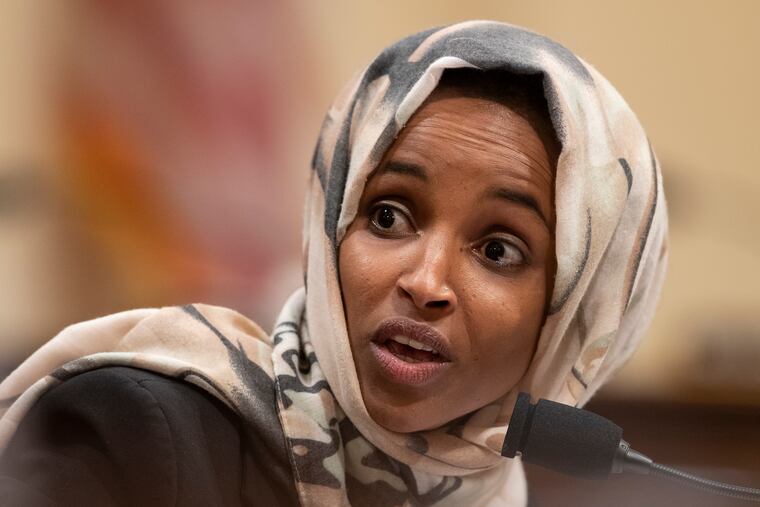
News organizations reported that the search formed part of an investigation involving allegations about immigration and citizenship documentation.
The investigation also generated legal disputes concerning access to materials and constitutional protections applicable to members of Congress.
Omar rejected the allegations and characterized the investigation as politically motivated.
Government officials defended their actions as part of a legitimate effort to investigate potential violations of federal law.
Those competing positions reflected a real controversy, but neither established the sensational Senate confrontation described in the viral story.
The search of a residence and the presentation of evidence at a congressional hearing are different events requiring separate verification.
A federal search warrant does not demonstrate that a senator personally discovered evidence or publicly questioned the subject.
Likewise, an investigation involving immigration records cannot automatically substantiate claims about campaign payments or foreign financial influence.
Each allegation must be evaluated through the documents and legal standards relevant to that specific matter.
The viral account instead presented the supposed hearing as though every allegation had already been connected through decisive evidence.
It described Kennedy reading transfers and emails while Omar’s prepared answers allegedly collapsed before the committee.
Yet the story supplied no authenticated record showing that those exchanges occurred in the manner described.
The imagined sequence was compelling precisely because it transformed complicated investigative questions into an apparently simple public victory.
But genuine legal proceedings rarely resolve complex financial allegations through a single dramatic confrontation.
They require careful examination of records, opportunities for response, and decisions made under established legal procedures.
The story’s description of a Justice Department referral created another important verification problem.
A congressional referral can communicate allegations or evidence to federal investigators without determining whether a crime occurred.
Such a referral would require an identifiable action or reliable documentation before being presented as an established event.
The viral narrative did not provide a verifiable official record showing Kennedy transmitted the described package to prosecutors.
Even if a referral were documented, it would not independently establish the accuracy of the accusations contained within it.
Investigators would still need to determine whether the evidence supported additional inquiries, charges, or other legal action.
The distinction between referring an allegation and proving a crime is essential to fair reporting.
The account also claimed that counterintelligence assessments connected Omar’s public statements to national security concerns.
That allegation was particularly serious because political speech and evidence of improper foreign influence are fundamentally different matters.
A public official may express controversial positions about foreign governments without acting on behalf of those governments.
Determining improper influence would require evidence concerning conduct, relationships, obligations, or violations of applicable law.
The content of political statements alone does not establish the existence of a secret financial or intelligence relationship.
The viral story did not supply authenticated assessments demonstrating the alleged connections.
Without that evidence, the counterintelligence claim remained unsupported rather than a verified finding.
The controversy illustrated how references to national security could intensify political accusations without necessarily strengthening their evidentiary foundation.
Readers encountering such claims needed to distinguish documented official actions from dramatic descriptions attributed to unnamed sources.
The same caution applied to references to sealed records, confidential intelligence, and unidentified whistleblowers.
Those terms could describe genuine investigative material, but they could also be used to make unsupported allegations sound authoritative.
The reliability of a claim depends upon verifiable evidence rather than the apparent seriousness of the institutions mentioned.
The account’s final assertion concerned a supposedly viral clip that continued circulating because of the whistleblower’s extraordinary testimony.
A video can document an event only when its origin, context, participants, and contents can be reliably established.
Short edited segments may omit important context, while synthetic or miscaptioned footage can misrepresent what occurred.
In this case, the available reporting did not establish an authenticated recording of the specific confrontation described.
That limitation prevented the story from being treated as a verified account of a Senate Judiciary Committee hearing.
It also raised questions about why such a detailed narrative circulated without the basic identifiers expected for official proceedings.
A real hearing would have a date, committee subject, witness list, and materials that could be independently examined.
A dramatic account that omits those details should not be accepted merely because it names federal agencies.
The larger political dispute nevertheless involved genuine questions about transparency, financial reporting, and government accountability.
Members of Congress are subject to disclosure requirements intended to reveal certain financial interests and potential conflicts.
Campaign committees must also report contributions and expenditures under applicable federal election laws.
Those systems provide opportunities for oversight, although they cannot eliminate every disagreement about the meaning of reported information.
The public can examine filings, compare amendments, and evaluate official findings without assuming that every allegation is true.
Such examination can also identify genuine discrepancies deserving further clarification.
But the discovery of an unusual transaction does not independently prove intentional concealment or a criminal agreement.
Financial records must be interpreted according to their purpose, reporting rules, and supporting documentation.
The controversy surrounding Omar demonstrated why corrections and subsequent investigations should be described separately.
An amended disclosure may explain a reporting error without necessarily resolving unrelated questions concerning different transactions.
Likewise, the existence of a continuing investigation does not erase findings made in an earlier administrative proceeding.
Each development has its own legal significance and evidentiary limitations.
The viral narrative compressed those distinctions into a single supposed moment of political humiliation.
Its storytelling depended upon the idea that one senator possessed a complete financial dossier capable of resolving every dispute.
But the documented record did not establish that Kennedy had produced such a package during a hearing.
Nor did it verify the alleged sworn testimony, confidential intelligence presentation, or criminal referral.
The absence of those confirmations was not a minor technical detail.
It was the difference between reporting a documented event and repeating an unsupported accusation about a public official.
The case also raised questions about the role of partisan expectations in shaping responses to political allegations.
Readers who strongly opposed Omar might find the confrontation plausible because it matched their existing views.
Those who supported her might reject every financial question because they distrusted the political figures making the accusations.
Neither reaction could substitute for examining the underlying evidence and the status of official proceedings.
A consistent standard would require verification regardless of the politician’s party, public statements, or personal popularity.
It would also distinguish criticism of an official’s conduct from assumptions based upon nationality, ethnicity, or political affiliation.
The same standards should apply to accusations against Republicans, Democrats, and officials serving outside either major party.
The importance of financial transparency did not depend upon accepting a sensational narrative as true.
The importance of fair treatment did not require dismissing every documented investigation as illegitimate.
Both principles could be upheld by examining specific evidence and acknowledging unresolved questions.
The investigation involving Omar’s immigration records illustrated the need for that distinction.
Federal authorities had pursued investigative steps, while Omar and her attorneys challenged the basis and handling of those actions.
Reporting also described separate scrutiny involving financial disclosures associated with her household.
Those developments were newsworthy without being transformed into a fictionalized courtroom-style victory for Senator Kennedy.
The relevant questions concerned what investigators had actually obtained, what legal standards applied, and whether any allegations could be substantiated.
Public reporting did not establish that the dramatic Kennedy hearing supplied answers to those questions.
The account’s most memorable details therefore remained precisely the details requiring the strongest verification.
The leather portfolio, the sequence of emails, the sworn whistleblower, and the purported criminal referral were not authenticated.
The claim that Omar’s defenses collapsed in real time was likewise unsupported by a verified hearing transcript.
These descriptions could not responsibly be presented as factual simply because they appeared in a widely shared political caption.
The controversy also demonstrated how the language of financial investigations could be misunderstood.
A suspicious transaction report is not equivalent to a criminal conviction or a judicial finding of wrongdoing.
A campaign expenditure involving an associate is not automatically evidence of fraud.
An accounting correction does not necessarily establish deliberate concealment.
And an investigation does not establish that the subject committed the conduct being examined.
These distinctions are essential because public accusations can have serious consequences even when formal proceedings remain unresolved.
The burden of proving criminal allegations belongs to investigators and prosecutors operating under applicable legal standards.
Public commentators may raise questions, but they should not present speculation as established evidence.
The same principle applies when allegations are described through anonymous documents or supposed confidential assessments.
A source’s claimed access to secret information does not make the information reliable without corroboration.
The viral Kennedy narrative depended heavily upon precisely those kinds of unverified claims.
It invited readers to believe that a decisive confrontation had occurred while withholding the evidence necessary to confirm it.
The actual public record supported a more complicated account involving past administrative findings and separate ongoing investigations.
It did not support the conclusion that Kennedy had publicly demonstrated the alleged financial and national security violations.
The distinction mattered because the purpose of oversight is to establish facts rather than manufacture predetermined conclusions.
Congressional committees can investigate government conduct, examine financial records, and seek testimony under established procedures.
Federal agencies can review possible violations and determine whether evidence warrants further action.
Courts can evaluate legal claims and enforce applicable protections when disputes arise.
But none of those processes should be replaced by a dramatic narrative whose central events cannot be authenticated.
The strongest public interest lay in obtaining accurate information about the documented proceedings and their eventual outcomes.
That required identifying the relevant records, distinguishing separate allegations, and avoiding unsupported assumptions about guilt.
It also required recognizing that official investigations can change direction as new information emerges.
Evidence may substantiate allegations, undermine them, or reveal circumstances different from those initially suspected.
Responsible reporting must remain open to those possibilities rather than treating accusations as irreversible conclusions.
The story of Kennedy and Omar therefore ended somewhere very different from the confrontation promised by the viral headline.
There was no verified moment in which a leather portfolio conclusively established the sweeping criminal accusations described.
There was no authenticated record of the alleged whistleblower delivering the decisive testimony that supposedly silenced the room.
And there was no verified basis for claiming that Kennedy’s dramatic presentation resulted in the described Justice Department referral.
What remained was a genuine public debate about financial accountability, investigative authority, and the standards required to substantiate serious accusations.
The central question was not whether a senator could deliver a devastating political performance.
It was whether the evidence supporting an allegation could withstand independent examination.
That distinction separated compelling storytelling from reliable reporting about elected officials and federal investigations.
The most consequential detail was therefore not a secret statement supposedly made during an unidentified hearing.
It was the absence of authenticated records establishing that the alleged confrontation had happened at all.
Until reliable documentation supports the extraordinary claims, the viral story remains unverified rather than a proven political scandal.
And the question worth asking is simple: where are the hearing transcript, sworn testimony, financial exhibits, and official referral?
