
John Kennedy Confronts Ilhan Omar in Ethics Hearing as Questions About Campaign Finances, Immigration Records, and Accountability Intensify
The hearing room fell silent when Senator John Neely Kennedy entered carrying a worn leather briefcase and a carefully prepared set of questions.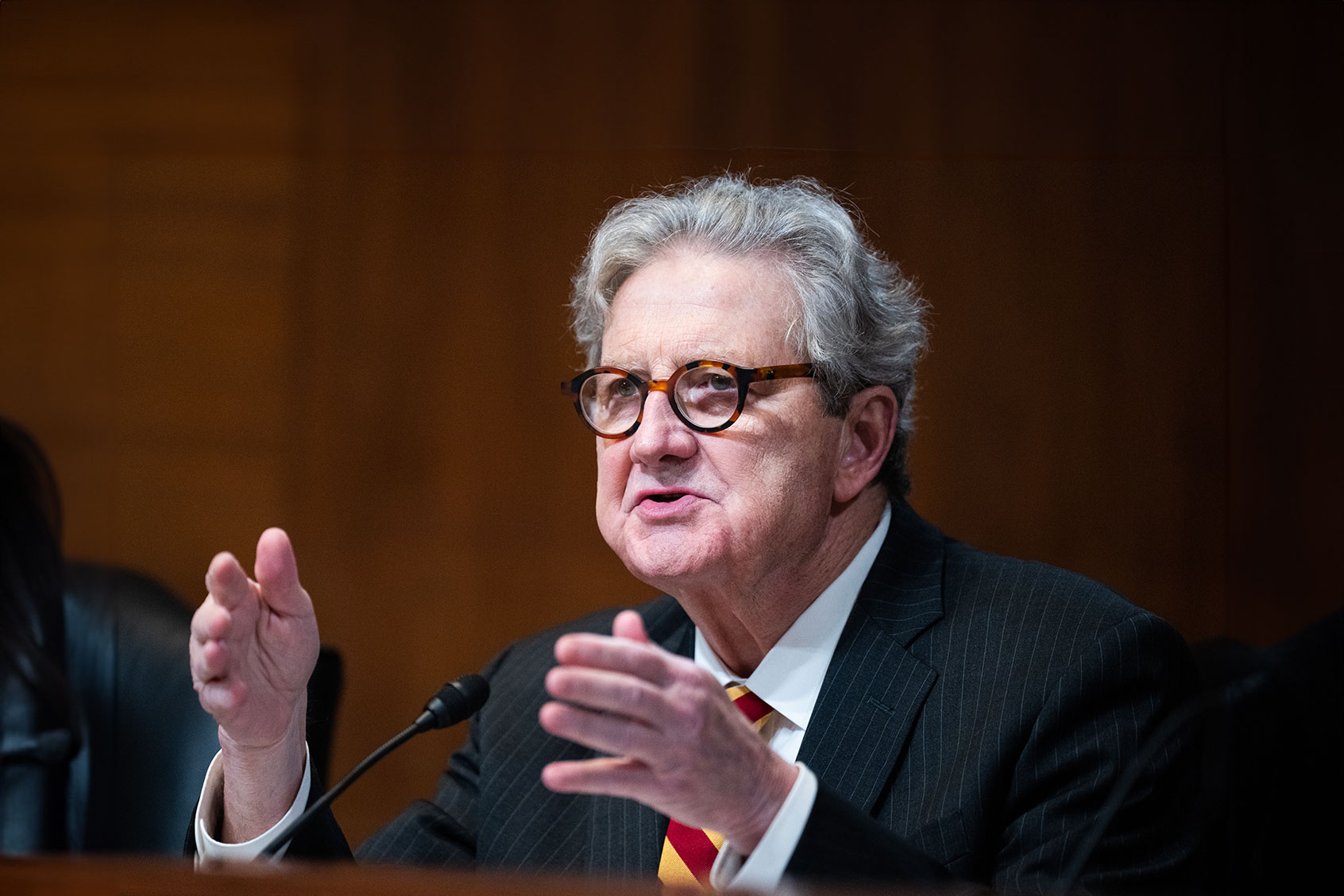
Across the table, Representative Ilhan Omar waited beneath the television lights, surrounded by advisers who understood the seriousness of congressional scrutiny.
In this entirely fictional confrontation, the Louisiana senator had requested a public discussion about financial transparency, immigration documentation, and government accountability.
The scene resembled the opening of a political thriller, but the accusations circulating around it required something far more demanding than drama.
Kennedy placed the briefcase on the table and announced that every public official deserved scrutiny under the same legal standards.
Omar responded that accountability should depend upon authenticated evidence rather than accusations repeated until they sounded like established facts.
The exchange immediately revealed the central disagreement between investigating legitimate questions and assuming wrongdoing before the relevant evidence had been examined.
Kennedy opened the first section of his fictional folder and introduced the subject of immigration records and the naturalization process.
He argued that government institutions depended upon accurate documentation and consistent application of the laws governing immigration and citizenship.
Omar answered that immigration records contained sensitive personal information and that discrepancies required careful interpretation rather than immediate accusations of deception.
The senator acknowledged that a missing document or inconsistent statement did not automatically establish an intentional violation of federal law.
He nevertheless maintained that credible allegations should be examined through appropriate investigative procedures whenever the evidence justified further inquiry.
The interviewer overseeing the imagined hearing asked whether the documents had been independently authenticated and legally obtained.
Kennedy explained that the fictional discussion concerned the standards investigators should apply, not a verified finding about Omar’s personal history.
Omar emphasized that public officials and private citizens alike deserved fair treatment when questions arose concerning immigration documentation.
The exchange exposed the importance of distinguishing administrative errors, conflicting recollections, and deliberate misrepresentations under applicable legal standards.
A discrepancy might warrant clarification, but its significance depended upon the circumstances surrounding the original statement and supporting documentation.
Likewise, a former government employee’s recollection could provide information without independently establishing the accuracy of an allegation.
Kennedy argued that investigators should compare testimony against official records before deciding whether any further action was warranted.
Omar responded that selective descriptions of personal documents could create misleading impressions when essential context remained unavailable to the public.
The discussion became more demanding when the senator turned toward the second section of his fictional materials.
This portion concerned campaign expenditures, consulting arrangements, and the responsibility of candidates to report political spending accurately.
Kennedy asked whether elected representatives should provide clear explanations when campaign committees paid businesses connected to their families.
Omar agreed that campaign finance reporting deserved transparency while emphasizing that a personal connection did not automatically establish improper conduct.
The senator maintained that disclosure requirements existed partly to help voters evaluate potential conflicts of interest involving political spending.
Omar responded that determining whether an expenditure was legitimate required examining contracts, services, invoices, and applicable reporting rules.
The interviewer asked whether large payments to a consulting company necessarily demonstrated that campaign funds had been misused.
Both participants acknowledged that the amount of an expenditure alone could not establish whether a campaign finance violation occurred.
A consulting firm might receive substantial compensation for legitimate work, depending upon the services provided and the agreement governing payment.
Conversely, investigators could examine transactions when credible evidence suggested inaccurate reporting, improper personal benefit, or violations of campaign finance law.
The imagined confrontation therefore shifted from sensational financial accusations toward the records needed to evaluate specific expenditures.
Kennedy argued that candidates should not dismiss reasonable questions about political spending merely because the inquiries originated with opponents.
Omar maintained that political scrutiny should not transform an allegation into a public verdict before investigators had established the facts.
The interviewer observed that transparency and the presumption of innocence served different purposes within the same system of accountability.
Financial disclosures allowed the public to examine reported transactions, while legal proceedings determined whether particular conduct violated applicable requirements.
Kennedy then introduced the question of personal travel and whether campaign resources could properly support certain expenses.
Omar responded that travel expenditures required examination of their actual purpose rather than assumptions based upon destinations or appearances.
The senator agreed that legitimate campaign activities could involve transportation, accommodation, and other expenses subject to relevant legal requirements.
He argued that any expenditure lacking an appropriate campaign purpose deserved scrutiny through established reporting and enforcement procedures.
The interviewer asked whether the fictional documents established that Omar had personally benefited from unlawful travel spending.
Neither participant presented authenticated evidence supporting that specific conclusion within the imagined proceedings.
The distinction mattered because accusations involving luxury travel could easily attract attention without establishing a campaign finance violation.
The discussion then turned toward foreign influence, the most serious subject raised by the sensational account surrounding the supposed hearing.
Kennedy asked whether lawmakers should face questions when credible evidence suggested improper financial relationships with foreign governments or organizations.
Omar agreed that foreign influence concerns deserved examination while rejecting the assumption that international connections automatically demonstrated misconduct.
The senator maintained that national security required appropriate safeguards against unauthorized foreign involvement in American political decision-making.
Omar responded that legitimate diplomatic engagement, constituent advocacy, and foreign policy positions should not be confused with improper financial arrangements.
The interviewer asked what evidence would be necessary to establish a prohibited foreign contribution or an unlawful financial relationship.
Kennedy identified authenticated financial records, applicable legal requirements, and evidence connecting a transaction to prohibited conduct.
Omar emphasized that accusations involving a particular foreign country required documentation rather than speculation about political statements or personal background.
The discussion revealed why allegations concerning foreign-linked organizations could not be resolved through labels alone.
An organization might operate internationally without every transaction involving it constituting unlawful foreign influence.
Likewise, a politician’s position on international affairs did not independently establish that the politician received improper financial support.
The interviewer asked whether the fictional dossier contained verified evidence establishing the alleged connections to organizations associated with Qatar.
The imagined participants acknowledged that the sensational narrative had not supplied authenticated records proving those specific accusations.
Kennedy maintained that credible information should be evaluated by authorized investigators rather than amplified as an established conclusion.
Omar responded that the same principle protected the integrity of investigations and the reputations of individuals facing serious allegations.
The exchange became more intense when the senator introduced the subject of classified information and the responsibilities of government officials.
Kennedy argued that unauthorized disclosure of protected national security information could create serious risks for government operations and personnel.
Omar agreed that classified information required appropriate safeguards but questioned whether any authenticated evidence connected her to the alleged disclosures.
The interviewer asked whether the supposed classified-information leaks had been documented through a verified investigation, indictment, or official finding.
No such evidence was established within the fictional hearing, and the accusation therefore remained unsupported rather than a demonstrated violation.
Kennedy acknowledged that national security allegations required particular caution because the consequences of inaccurate claims could be substantial.
Omar emphasized that invoking classified documents without producing verifiable evidence could make ordinary political disagreements appear connected to espionage.
The discussion illustrated the distinction between legitimate oversight and speculation presented through the language of intelligence investigations.
A serious accusation could justify examination when supported by credible information, but its seriousness did not make it automatically true.
The interviewer then asked whether political disagreement over foreign policy could reasonably be treated as evidence of disloyalty.
Kennedy responded that lawful disagreement and unauthorized assistance to foreign interests were separate matters requiring different forms of evidence.
Omar maintained that elected representatives could criticize American policies while remaining obligated to uphold the Constitution and applicable law.
The exchange revealed an important principle concerning the relationship between political speech and government accountability.
Public officials could be questioned about their decisions without assuming that controversial opinions demonstrated criminal conduct or foreign allegiance.
The fictional senator returned to his briefcase and removed a document describing the standards governing congressional ethics investigations.
He argued that ethics procedures existed to examine conflicts, disclosures, and conduct affecting public confidence in government institutions.
Omar responded that those procedures also required fairness, accurate information, and appropriate opportunities for individuals to answer allegations.
The interviewer asked whether an ethics inquiry should be considered equivalent to a criminal prosecution.
Both participants acknowledged that congressional ethics procedures and federal criminal investigations served different purposes under different legal frameworks.
An ethics investigation might examine conduct relevant to congressional standards without establishing that a federal criminal offense occurred.
Likewise, a referral to prosecutors would not independently prove wrongdoing or require authorities to bring criminal charges.
Kennedy maintained that credible evidence should be directed toward the appropriate institution rather than used exclusively for political theater.
Omar argued that investigators should make decisions based upon facts and law rather than pressure generated through televised accusations.
The conversation then shifted toward the role of public records in evaluating financial allegations against elected representatives.
Kennedy emphasized that campaign finance filings could provide information about expenditures, recipients, dates, and reported purposes.
Omar responded that those records required interpretation alongside supporting materials before anyone could determine whether a transaction was improper.
The interviewer asked whether the public should distinguish a documented expenditure from an allegation about the reasons behind it.
Both participants agreed that a payment could be verified without automatically validating every accusation concerning its purpose.
The distinction became central to the fictional confrontation as Kennedy questioned how political campaigns should explain payments involving associates.
Omar maintained that disclosure obligations should apply consistently and that personal relationships alone did not establish violations.
Kennedy argued that transparency could help resolve reasonable concerns before they developed into more serious public disputes.
The interviewer observed that neither transparency nor suspicion could replace the legal standards governing campaign finance investigations.
The fictional hearing then considered the consequences of combining several unrelated accusations into one dramatic narrative.
Kennedy acknowledged that immigration questions, campaign spending, foreign influence, and classified information involved different legal requirements.
Omar argued that presenting them together could create an impression of coordinated wrongdoing without demonstrating any connection between the allegations.
The interviewer asked whether evidence supporting one inquiry could automatically substantiate an entirely different accusation.
Both participants recognized that separate claims required separate evidence, even when the same public official appeared in each controversy.
The discussion illustrated why an allegation involving financial disclosures could not independently establish a violation involving classified information.
Likewise, questions about immigration documentation could not automatically demonstrate improper campaign spending or unlawful foreign influence.
The imagined senator argued that investigators should follow credible evidence wherever it led without assuming that every allegation was connected.
Omar maintained that the same discipline required abandoning accusations when available evidence failed to support them.
The interviewer then introduced the importance of procedural safeguards during investigations involving elected representatives.
Kennedy emphasized that holding public office did not exempt an individual from applicable laws or legitimate investigative scrutiny.
Omar agreed that legal obligations applied to officials while emphasizing that constitutional protections also remained relevant.
The discussion turned toward the difference between demanding accountability and declaring guilt before an investigation had reached a conclusion.
Kennedy argued that public confidence required officials to answer reasonable questions about conduct involving government responsibilities.
Omar responded that answering questions did not require accepting accusations unsupported by authenticated evidence.
The interviewer observed that both principles could coexist when investigators followed established procedures and respected legal protections.
The fictional confrontation became quieter as the participants considered the political consequences of highly publicized allegations.
Kennedy maintained that voters deserved accurate information about potential conflicts involving people entrusted with public authority.
Omar argued that false accusations could damage public trust just as genuine misconduct could undermine confidence in government.
The interviewer asked whether sensational headlines sometimes encouraged audiences to confuse the existence of an investigation with proof of wrongdoing.
Both participants acknowledged that political narratives could oversimplify legal proceedings and obscure important distinctions.
The discussion then returned toward the alleged emergency Senate Ethics hearing that had inspired the fictional account.
The interviewer noted that congressional ethics bodies had defined jurisdictions and procedures that differed between the House and Senate.
Omar served in the House of Representatives, making the described Senate proceeding an especially important detail requiring verification.
Kennedy’s fictional appearance therefore could not be treated as evidence that the alleged official hearing had actually taken place.
The dramatic description of live television cameras and an emergency proceeding supplied atmosphere without establishing an authentic congressional record.
The interviewer asked whether a genuine hearing would ordinarily have identifiable dates, committee materials, and official documentation.
Kennedy agreed that public proceedings should be evaluated through reliable records rather than anonymous descriptions circulating online.
Omar maintained that the absence of authenticated proceedings mattered when a narrative attributed serious accusations to identifiable public officials.
The discussion shifted toward the importance of distinguishing fictional political commentary from documented events.
A dramatized exchange could explore questions about transparency and accountability without claiming that the imagined dialogue had occurred.
But presenting invented testimony, confidential documents, or criminal allegations as verified facts could mislead readers about real people.
The interviewer emphasized that the distinction became especially important when the narrative involved potential crimes or national security concerns.
Kennedy’s fictional argument returned to the principle that public officials should remain accountable under the Constitution.
Omar responded that constitutional accountability also required fair procedures and evidence supporting allegations before conclusions were announced.
The imagined senator then prepared his final statement, returning to the question of whether anyone holding public office stood above the law.
He maintained that government authority carried responsibilities extending beyond political popularity, personal relationships, or partisan loyalty.
Omar agreed that elected representatives should obey applicable laws while insisting that accusations must be examined through established legal processes.
The interviewer observed that these statements expressed compatible principles despite the disagreement surrounding the alleged evidence.
No official possessed immunity from legitimate scrutiny simply because voters had entrusted that person with public responsibilities.
At the same time, holding public office did not eliminate protections against unsupported accusations or improper investigative procedures.
The fictional confrontation approached its conclusion without establishing the sensational criminal allegations that had framed the original narrative.
The imagined folder contained questions about documentation, reporting requirements, conflicts of interest, and government accountability.
It did not establish that Omar had committed immigration fraud, accepted unlawful foreign financing, or disclosed classified information.
Nor did the fictional proceedings demonstrate that Kennedy had uncovered a verified conspiracy involving the different accusations.
The interviewer asked whether the public should judge the confrontation by its dramatic final sentence or the quality of its evidence.
Kennedy maintained that accountability required facts capable of surviving careful examination rather than accusations designed solely to attract attention.
Omar responded that the same standard should apply to every elected official, regardless of political affiliation or public reputation.
The discussion ended with a distinction between demanding answers and claiming that guilt had already been established.
A dramatic briefcase could create anticipation, but the appearance of official documents could not substitute for their authentication.
A powerful closing statement could express a constitutional principle without proving the accusations that preceded it.
And a silent hearing room could reflect many circumstances without demonstrating that an individual had admitted wrongdoing.
The fictional confrontation therefore ended without a verified career-ending revelation or an established criminal finding.
Instead, it raised questions about the responsibilities of public officials and the standards governing serious allegations.
The importance of congressional oversight remained clear, as did the need to distinguish documented conduct from unsupported political claims.
The strongest measure of accountability was not the volume of an accusation or the intensity of the reaction it produced.
It was whether the evidence could withstand scrutiny under the rules designed to protect both public institutions and individual rights.
The final question remained whether political audiences would demand authenticated records before accepting extraordinary claims about elected representatives.
And that question extended far beyond Kennedy, Omar, or any single controversy involving the responsibilities of American public office.
