
During a November 12 appearance on CNN, Kennedy delivered an unusually forceful warning about the national security implications of Huang’s reported relationship with a Chinese businesswoman suspected of having intelligence connections.
The Louisiana Republican questioned whether the Trump administration had properly protected sensitive American technology, particularly as Nvidia expanded its commercial relationship with companies operating across China and Southeast Asia.
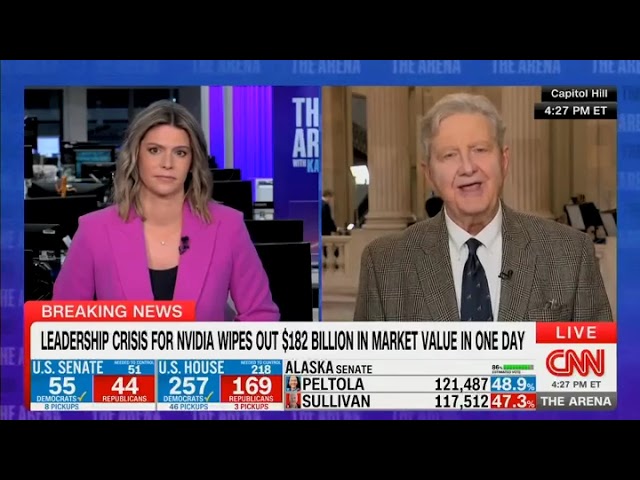
Kennedy’s concerns extended beyond Huang’s personal conduct. He demanded explanations from Commerce Secretary Howard Lutnick and Treasury Secretary Scott Bessent, placing senior members of President Donald Trump’s administration under scrutiny.
The controversy intensified following Huang’s resignation from Nvidia, the semiconductor company he co-founded in 1993 and transformed into one of the world’s most influential technology corporations.
Nvidia announced that Huang was stepping down amid reports concerning his relationship with Alice Huang, a former executive associated with Singapore-based technology company Megaspeed International.
American authorities have investigated whether Megaspeed helped restricted artificial intelligence chips reach Chinese customers, while intelligence officials have examined Alice Huang’s possible connections to Beijing.
But the investigation remains complicated. Federal officials have not publicly established that Alice Huang was definitively acting as a Chinese intelligence agent or that Jensen Huang knowingly transferred sensitive information.
That uncertainty did little to diminish Kennedy’s determination to obtain answers, particularly concerning the Commerce Department’s handling of advanced semiconductor exports.
Asked whether Huang should testify before Congress, Kennedy delivered an immediate answer that left little doubt about his position: Yes, and emphatically so.
His response established the central issue of the interview: Whether American officials had allowed commercial interests and influential personal relationships to overshadow legitimate national security concerns.
For Kennedy, the matter was not simply another Washington controversy involving a powerful executive. It was a test of the government’s ability to protect American technological advantages.
The interview also exposed growing divisions inside the Republican Party, as Kennedy challenged administration officials while questioning the economic message that had accompanied Republicans’ recent midterm election defeats.
The confrontation began when CNN anchor Kasie Hunt asked Kennedy whether Huang should appear before lawmakers to explain what he knew about the suspected intelligence operation.
Kennedy responded that his disbelief remained difficult to describe, despite his many years observing political scandals, financial controversies, and questionable conduct among powerful public figures.
He acknowledged that personal relationships can become complicated, but argued that executives handling technology central to American national security must exercise extraordinary caution.
Kennedy delivered one of the interview’s most memorable remarks when discussing the reported relationship, sarcastically suggesting that executives should investigate potential romantic partners before becoming involved.
His reference to checking someone’s LinkedIn profile reflected his familiar use of humor, but the senator quickly emphasized that the underlying allegations were no laughing matter.
The dispute became considerably more serious when Kennedy turned toward approximately $4 billion in advanced semiconductor transactions that he said the Commerce Department had permitted.
He questioned whether American officials had adequately examined the ultimate destination of Nvidia processors purchased through Megaspeed and whether some technology could have reached restricted Chinese entities.
The $4 billion figure was presented as Kennedy’s characterization of the transactions, rather than an independently established finding that all those chips were illegally transferred or knowingly diverted.
The senator wanted to know why the transactions had been permitted, what monitoring procedures existed, and whether federal authorities could verify the technology’s final destination.
His concern reflected a larger problem facing American export regulators: Advanced artificial intelligence processors can be acquired through international intermediaries and potentially redirected beyond their authorized destinations.
Nvidia’s chips power enormous data centers used to train sophisticated artificial intelligence systems, making restrictions on certain semiconductor exports a critical component of Washington’s technology competition with Beijing.
Federal authorities have sought to prevent China’s military and intelligence organizations from acquiring particular high-performance processors that could strengthen advanced computing capabilities or accelerate sensitive research.
The challenge is especially complicated when companies outside China acquire American chips and subsequently provide access to computing resources through cloud services or international commercial relationships.
Megaspeed became a central focus because investigators had examined whether its business arrangements enabled customers to circumvent restrictions governing access to advanced American technology.
The company has denied violating export-control rules and has maintained that it takes compliance seriously, including cooperating with American authorities and arranging an independent examination of its semiconductor holdings.
Those statements are important because suspicion surrounding a company does not establish that it committed an export-control offense or that every transaction involving Nvidia products was unlawful.
Nevertheless, Kennedy argued that the federal government needed stronger explanations about the oversight procedures that had permitted the company’s substantial purchases.
His questions moved directly toward Commerce Secretary Howard Lutnick, whose department oversees the Bureau of Industry and Security, the federal agency responsible for administering important export restrictions.
Kennedy suggested that Lutnick should publicly explain what his department knew, how officials evaluated the relevant transactions, and why additional restrictions had not been imposed earlier.
When Hunt asked whether the commerce secretary should lose his position, Kennedy resisted delivering an immediate judgment, explaining that he had not yet obtained sufficient information.
Instead, he argued that Lutnick should already have held a news conference and offered to answer questions from reporters and the American public.
Kennedy acknowledged that the secretary might have legitimate reasons for delaying a public response, including the need to consult advisers and attorneys about ongoing investigations.
But he made clear that congressional scrutiny should proceed regardless, warning that Lutnick could be called to testify about the department’s handling of the matter.
The senator also named Treasury Secretary Scott Bessent, suggesting that disagreements or concerns among senior administration officials deserved examination as part of the broader inquiry.
The scrutiny has extended beyond Kennedy. Republican congressional leaders have demanded Huang’s testimony, while Democratic senators have requested preservation of documents involving Nvidia, Megaspeed, and administration export decisions.
On November 12, House Republican committee chairmen pressed Huang to appear for a closed-door interview on December 1, warning that congressional subpoena authority could be used if necessary.
Senator Tim Scott also sought testimony from Huang and Lutnick, emphasizing the importance of determining whether American national security interests had been compromised.
Democratic lawmakers Ron Wyden and Richard Neal separately requested records concerning the administration’s decisions allowing certain Nvidia chip sales and the economic arrangements surrounding those transactions.
The emerging investigation therefore crossed party lines, with Republicans and Democrats questioning different aspects of the same relationship between commercial influence and federal national security policy.
Kennedy’s next concern brought the controversy even closer to the White House, particularly reports about what Trump had been told before traveling to China earlier in 2026.
Hunt asked whether the president should have allowed Huang to accompany him aboard Air Force One if he had received warnings about the executive’s relationship with a suspected intelligence operative.
Reports indicated that Secretary of State Marco Rubio had briefed Trump about intelligence concerns before Huang joined the presidential delegation during a stop in Alaska.
Trump initially denied having known about the alleged relationship at the relevant time, although subsequent statements acknowledged the possibility that intelligence officials had mentioned the matter.
Kennedy declined to accuse the president of knowingly disregarding national security warnings, emphasizing that he could not personally confirm the accuracy of the reporting.
He nevertheless suggested that the detailed accounts deserved serious examination, particularly because the underlying allegations involved senior officials responsible for protecting sensitive national interests.
That careful distinction was important: The senator expressed concern about the reporting without claiming that Trump had knowingly participated in wrongdoing or approved an intelligence compromise.
The question of Alice Huang’s alleged espionage activities remains unresolved. Attorney General Todd Blanche said on November 12 that federal authorities had not reached a definitive conclusion about her status.
CNN also reported disagreements among American intelligence officials concerning whether the available information demonstrated that she knowingly operated on behalf of China’s intelligence services.
Those uncertainties make it essential to distinguish the acknowledged personal relationship, the continuing investigation, and allegations about intelligence activity that have not been conclusively established.
Kennedy nonetheless wanted congressional investigators to move quickly, emphasizing that the matter should not disappear into months or years of unanswered questions.
His demand reflected the strategic importance of Nvidia, whose technology has become deeply embedded in artificial intelligence development, cloud computing, and advanced research infrastructure.
Huang’s departure created additional uncertainty for the company, with Chief Financial Officer Colette Kress assuming interim leadership as Nvidia’s board considered longer-term succession arrangements.
The resignation also affected investor confidence, with Nvidia shares falling sharply amid concerns about leadership stability, regulatory scrutiny, and the implications for America’s artificial intelligence industry.
But the company has maintained that it has no reason to believe its proprietary technology or American national security has been compromised through the reported relationship.
That position remains separate from the questions congressional investigators must resolve about export licensing, customer verification, and the potential diversion of restricted technology.
As the interview continued, Hunt shifted attention toward another political development: The Republican Party’s sweeping losses in the November 3 midterm elections.
The subject was particularly relevant to Kennedy because Democrat Scott Colom had just defeated Republican Senator Cindy Hyde-Smith in Mississippi, a state long associated with conservative electoral strength.
Colom’s victory made him Mississippi’s first Black United States senator since Reconstruction and contributed to Democrats’ substantial gains across the country.
Kennedy acknowledged the significance of the result and argued that Republicans needed to understand why voters who previously supported their party had changed direction.
He rejected the idea that the election could be explained entirely through Republican turnout, suggesting instead that some traditionally conservative voters had actively chosen Democratic candidates.
The senator identified economic hardship as a central concern, arguing that national growth figures meant little to families struggling with inflation, wages, and everyday expenses.
He observed that even when the economy expands, many workers may not experience corresponding improvements in purchasing power, particularly when essential expenses continue rising.
Kennedy also challenged the argument that Trump could blame current inflation entirely on the previous Biden administration, insisting that governing responsibility eventually belongs to the incumbent president.
His analogy was characteristically memorable: A president might not have created every economic problem, but once in office, he still bears responsibility for addressing it.
The remarks represented an unusually direct acknowledgment from a Republican senator that voters had legitimate grievances about economic conditions under his own party’s leadership.
Kennedy argued that Republicans needed to listen more carefully to ordinary families rather than dismiss electoral defeats as the product of insufficient enthusiasm or unfavorable political circumstances.
The conversation then turned toward Vice President JD Vance, who had attributed much of the Republican defeat to the continuing American military conflict with Iran.
Vance argued after the election that voter dissatisfaction with the war had contributed substantially to Republican losses, particularly among Americans concerned about foreign intervention and rising living costs.
Kennedy disagreed with treating the war as the principal explanation, saying the party’s difficulties extended further into domestic economic frustrations and broader public dissatisfaction.
He questioned whether Republican defeats across multiple states could plausibly be explained solely through opposition to military involvement overseas.
The distinction highlighted a developing disagreement within Republican leadership over whether the party should concentrate primarily on foreign policy or the economic pressures affecting American households.
Hunt then raised Kennedy’s own political future, asking whether the election results had increased the possibility that he might seek the Republican presidential nomination in 2028.
The question followed Kennedy’s earlier appearance at a Politics and Eggs event in New Hampshire, a traditional gathering that often attracts politicians considering national campaigns.
Kennedy emphasized that he planned to seek reelection to the Senate, but he did not categorically rule out considering a presidential campaign under different circumstances.
His response reinforced the uncertainty surrounding Republican leadership after the midterm defeats, particularly as Vance’s political future attracted growing speculation.
The interview therefore revealed two separate pressures facing the Republican Party: Demands for accountability over sensitive technology exports and dissatisfaction with the administration’s broader governing record.
Kennedy’s willingness to question senior Trump officials demonstrated that national security oversight could become a significant congressional priority even among lawmakers aligned with the president.
His economic criticism simultaneously suggested that Republican leaders would need more than explanations about the Iran conflict to address voters’ concerns about affordability and government performance.
Yet the most immediate consequences centered on Nvidia, where lawmakers were preparing to seek testimony about executive relationships, export-control decisions, and the administration’s handling of reported intelligence warnings.
The investigation could clarify whether existing safeguards failed, whether government officials disregarded credible warnings, or whether some allegations have exceeded what the available evidence actually establishes.
Until investigators obtain the relevant documents and testimony, accusations concerning deliberate technology transfers, espionage, or official misconduct remain allegations rather than proven conclusions.
Kennedy’s central demand was that those distinctions be resolved through timely congressional examination, not speculation or political messaging that substitutes certainty for evidence.
The interview concluded with questions about Republican leadership and the party’s future, but its most urgent national security issue remained unanswered.
What did American officials know about Megaspeed, Alice Huang, and Nvidia’s chip transactions, when did they learn it, and what actions did they take?
For a company central to the global artificial intelligence industry and an administration responsible for protecting sensitive technology, those questions carry consequences far beyond a single corporate resignation.
And for Kennedy, the immediate test of accountability will be whether Congress can obtain credible answers from Huang, Lutnick, Bessent, and other officials before the controversy becomes another unresolved Washington investigation.
