
Senator John Kennedy confronted a prominent tax policy advocate during a congressional hearing on offshore corporate profits, turning a debate over billions in potential federal revenue into a pointed dispute about evidence.
The Louisiana Republican repeatedly challenged Zorka Milin, policy director of the Financial Accountability and Corporate Transparency Coalition, to identify major American companies she believed were violating federal tax laws.
Milin maintained that multinational corporations were exploiting weaknesses in international tax enforcement, but Kennedy pressed her to distinguish suspected wrongdoing from aggressive tax planning permitted under existing rules.
The April 10, 2024, Senate Budget Committee exchange became a revealing example of Washington’s disagreement over corporate taxation, particularly practices associated with powerful technology and pharmaceutical companies.
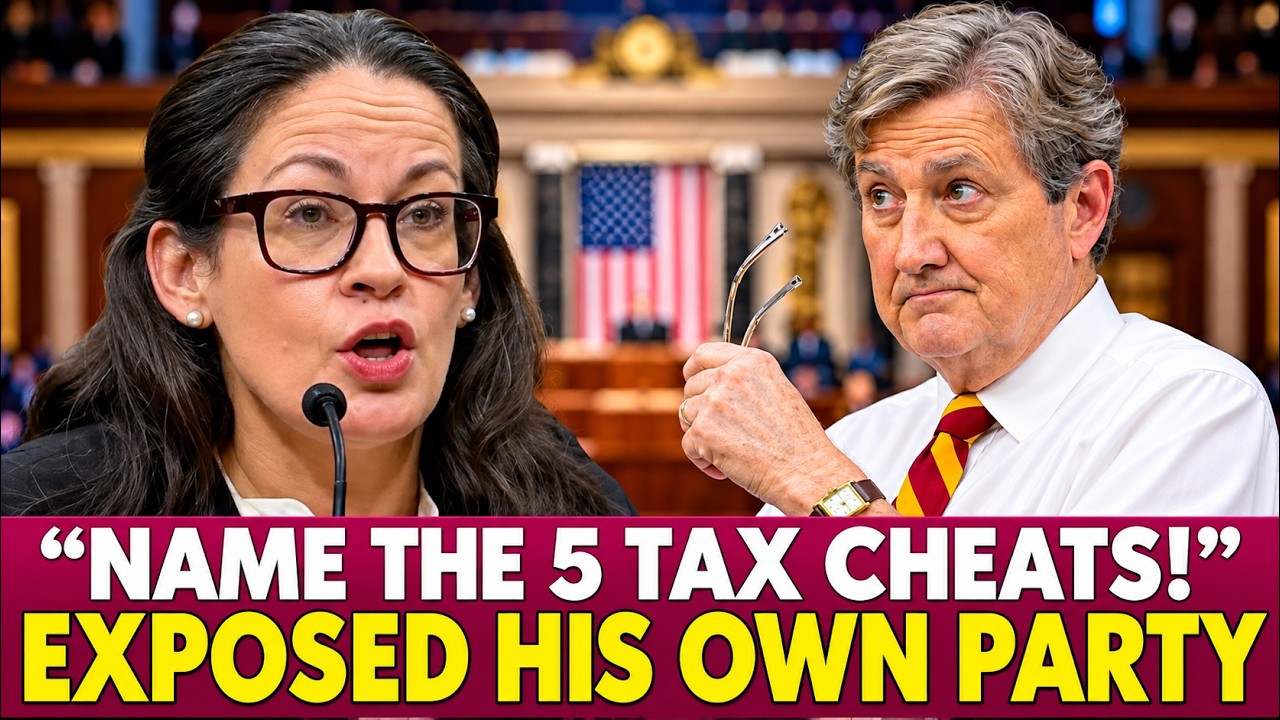
Yet the confrontation unfolded differently from sensational accounts suggesting that a tax expert delivered an eleven-word rebuke that silenced Kennedy and left lawmakers visibly shaken.
The official hearing transcript instead documents Kennedy repeatedly questioning Milin, who struggled to provide the definitive corporate ranking he demanded while defending her broader concerns about offshore tax practices.
That distinction matters because the hearing exposed two genuine policy disagreements: whether corporations were escaping legitimate tax obligations and whether advocates had sufficient evidence to accuse particular businesses of violating federal law.
At stake was a complicated international tax system through which multinational companies can report substantial profits in countries where their actual business operations may be comparatively limited.
Critics argue that such arrangements deprive the United States of revenue needed for public services, while defenders of existing international tax rules emphasize lawful investment decisions and global competitiveness.
Kennedy’s questioning unfolded during a hearing titled Sunny Places for Shady People: Offshore Tax Evasion by the Wealthy and Corporations, chaired by Rhode Island Democratic Senator Sheldon Whitehouse.
Whitehouse opened the proceedings by arguing that the wealthiest taxpayers and largest multinational corporations possessed financial resources unavailable to ordinary Americans attempting to navigate the federal tax system.
He cited Internal Revenue Service estimates placing the gross federal tax gap at approximately $688 billion for tax year 2021, illustrating the scale of unpaid liabilities across the economy.
That figure represented the difference between taxes legally owed and taxes paid on time, rather than an estimate attributable exclusively to offshore corporate arrangements.
Whitehouse nevertheless argued that international profit shifting contributed substantially to federal revenue losses and that enforcement agencies were struggling against sophisticated corporate tax strategies.
He pointed to multibillion-dollar tax disputes involving Microsoft, Meta, and pharmaceutical businesses, emphasizing how intellectual property arrangements could move reported profits into lower-tax jurisdictions.
The cases illustrated why multinational taxation has become a politically contentious subject, especially when corporations generate substantial American revenue while reporting significant taxable income overseas.
The committee invited three witnesses offering different perspectives: Milin, international tax researcher Stephen Curtis, and Tax Foundation president Daniel Bunn, who emphasized the economic trade-offs of international tax policy.
Curtis presented research suggesting that aggressive transfer-pricing arrangements could expose corporations to enormous additional tax liabilities if authorities successfully challenged their accounting methods.
His estimates included approximately $600 billion potentially recoverable from a group of major corporations under his interpretation of existing regulations and the underlying transactions.
Those figures were research estimates, not final IRS assessments or court judgments establishing that the entire amount was legally owed.
Bunn urged lawmakers to separate illegal tax evasion from legal tax avoidance, arguing that Congress should carefully evaluate how different rules affect investment, compliance, and federal revenue.
That distinction became central to Kennedy’s questioning because determining whether a corporation has violated tax law requires more than identifying a low effective tax rate.
Businesses may lawfully use deductions, credits, foreign subsidiaries, and other mechanisms established by Congress, even when critics argue that the resulting tax burden is unfair.
A corporation may also face a legitimate IRS dispute without having committed criminal tax evasion, since complicated transfer-pricing cases frequently involve competing interpretations of law and economic value.
Milin acknowledged that corporate tax avoidance and evasion sometimes overlap in difficult ways, particularly when companies operate near the boundaries established by statutes and regulations.
Kennedy immediately focused on that ambiguity, asking whether she believed major American corporations were actually cheating on their taxes rather than merely taking advantage of available provisions.
Milin answered that some companies appeared to be violating transfer-pricing requirements, pointing toward Curtis’s research and pending disputes involving prominent multinational businesses.
Kennedy then demanded something more specific: the names of the five American corporations she considered the worst tax offenders.
Milin initially responded that determining violations was the responsibility of the IRS, which possesses investigative powers unavailable to outside researchers and advocacy organizations.
Kennedy continued pressing, arguing that serious accusations against recognizable American businesses should be supported by specific evidence and clear identification of the alleged offenders.
The exchange grew increasingly tense as Milin attempted to describe the broader evidence while Kennedy repeatedly returned to his original demand for names.
She eventually mentioned Apple, Microsoft, Facebook, and Coca-Cola as companies associated with major tax controversies or arrangements examined by researchers and federal authorities.
Kennedy asked whether Apple was a tax cheat, prompting Milin to clarify that she would not apply that label without the appropriate legal determination.
Her response exposed the central evidentiary problem: a tax arrangement can be criticized as aggressive or potentially unlawful without a final adjudication establishing wrongdoing.
Kennedy argued that repeatedly accusing companies of cheating while declining to provide a definitive list made the allegations difficult to evaluate.
Milin maintained that evidence of potential violations existed and that weak enforcement resources made determining the full extent of misconduct unusually difficult.
She also acknowledged that she had not personally prepared a ranked list of the five worst corporate offenders, despite Kennedy’s repeated requests.
Near the conclusion of his questioning, Kennedy suggested that public accusations required greater specificity and ended with a familiar expression: “Talk’s cheap.”
The senator’s remark captured his argument that allegations of corporate misconduct should be accompanied by evidence capable of supporting meaningful enforcement or legal findings.
Milin’s position was that the documented practices and existing IRS disputes justified concern, even if she could not conclusively rank corporations by alleged violations.
The encounter did not establish that Kennedy defended every offshore tax arrangement or that Milin proved specific companies guilty of criminal evasion.
Instead, it revealed competing standards for discussing suspected corporate misconduct before courts and tax authorities have completed their work.
Immediately afterward, Senator Ron Wyden shifted the discussion toward a documented offshore banking investigation, emphasizing that congressional researchers had already identified individuals and institutions involved in serious tax controversies.
Wyden described an investigation involving Swiss bank Mirabaud and billionaire software entrepreneur Robert Brockman, whose offshore arrangements had attracted extensive scrutiny from federal authorities.
His intervention offered a contrasting approach: rather than debating the identities of unnamed corporate offenders, he directed attention to specific investigative findings and the responsibilities of financial institutions.
The disagreement highlighted why international taxation involves several overlapping questions, including whether existing laws are adequate, whether enforcement resources are sufficient, and whether particular transactions violate those laws.
The technology industry’s tax arrangements provide one example of the difficulties confronting investigators, particularly because valuable intellectual property can be transferred or licensed across international borders.
A company may develop software in the United States while assigning certain economic rights to an overseas subsidiary, potentially changing where related profits are reported.
Tax authorities can challenge those arrangements when they believe the prices assigned between affiliated businesses do not reflect legally required arm’s-length values.
But determining the appropriate valuation of patents, software, trademarks, and other intangible assets can involve complicated economic analysis and years of litigation.
Microsoft’s long-running dispute with the IRS illustrates those complexities, involving allegations that certain transfers of intellectual property improperly reduced the company’s American taxable income.
The IRS asserted substantial additional liabilities, while Microsoft disputed the agency’s assessment and defended its interpretation of applicable tax regulations.
Meta has faced comparable controversy involving the valuation of intellectual property transferred to an Irish subsidiary, another example of the significance of international transfer pricing.
The existence of those disputes demonstrates meaningful enforcement concerns, but allegations made by tax authorities remain distinguishable from final judicial determinations.
Pharmaceutical companies present another challenge because their products often depend on intellectual property whose ownership, development costs, and associated income can be distributed among affiliated entities.
In March 2025, Senate Finance Committee Democrats released findings examining Pfizer’s international tax practices, focusing particularly on the company’s treatment of American revenue in 2019.
According to that investigation, Pfizer reported no taxable U.S. profits for that year despite generating approximately $20 billion in sales to American customers.
The committee argued that the discrepancy reflected aggressive arrangements shifting taxable income outside the United States, including transactions involving foreign subsidiaries and intellectual property.
Those findings raised questions about whether existing laws properly allocate taxable profits, although the committee’s conclusions were not equivalent to a criminal conviction.
The dispute also demonstrated why the exchange between Kennedy and Milin remained relevant after their 2024 hearing, despite attracting attention largely for its combative questioning.
The underlying issue was never simply whether individual companies could be named during a five-minute exchange. It concerned how lawmakers should respond to evidence of potentially enormous revenue losses.
A newer development emerged on October 21, 2026, when Wyden opened another inquiry into offshore tax shelter consulting by the four largest international accounting firms.
The investigation sought information from PwC, KPMG, Deloitte, and EY concerning reported advice provided to multinational clients about arrangements involving Malta.
Wyden questioned whether such arrangements allowed American and European corporations to exploit differences between national tax systems to substantially reduce their liabilities.
That inquiry demonstrated that lawmakers were continuing to examine international tax structures rather than treating the earlier hearings as isolated political disputes.
However, the existence of an inquiry does not establish that the accounting firms committed crimes or that every transaction they advised was unlawful.
The broader policy debate also involves the consequences of increasing corporate tax obligations, including potential effects on investment decisions, employment, and international competitiveness.
Supporters of stronger enforcement argue that collecting taxes already owed would improve fiscal fairness without requiring higher statutory rates for compliant businesses.
Critics of aggressive international tax changes warn that poorly designed rules could discourage investment or create additional compliance burdens without producing the anticipated revenue.
Both concerns require attention because the economic consequences of changing tax law differ from the legal responsibility to enforce rules that Congress has already enacted.
Kennedy’s questioning emphasized the importance of evidence and precise allegations, while Milin emphasized the difficulty of enforcing complicated rules against corporations possessing extensive financial resources.
Those perspectives need not be entirely incompatible. Lawmakers can demand stronger proof of individual wrongdoing while investigating whether enforcement agencies possess adequate resources.
The difference lies in how Congress translates those concerns into legislation, oversight, and standards for evaluating corporate tax arrangements.
For ordinary taxpayers, the issue carries practical significance because federal revenue helps finance government responsibilities ranging from infrastructure and healthcare to national defense.
When tax liabilities are disputed, policymakers must distinguish revenue legally recoverable under existing law from hypothetical collections requiring changes to the tax code.
That distinction becomes especially important when advocates cite hundreds of billions of dollars in potential losses without explaining the assumptions behind their calculations.
Likewise, a corporation’s compliance with current law does not necessarily establish that the underlying system distributes tax burdens in a manner voters consider fair.
As of November 13, 2026, the documented Kennedy-Milin confrontation remains the April 2024 Senate Budget Committee exchange, not a newly verified televised showdown.
No authenticated transcript establishes that an expert delivered the alleged eleven-word rebuke or caused Kennedy and other lawmakers to become visibly distressed.
The official record instead shows Kennedy pressing Milin for specific names, Milin defending concerns about corporate profit shifting, and Wyden subsequently highlighting documented investigations.
That sequence offers a more substantive account of the controversy than claims about a politician being humiliated or a hearing room falling into stunned silence.
Kennedy’s demand for specificity remains a legitimate question for investigators accusing major corporations of misconduct, particularly when legal proceedings have not reached final conclusions.
Milin’s concerns also remain relevant because complicated international tax arrangements can create substantial enforcement challenges even when identifying specific violations requires extensive investigation.
Recent congressional scrutiny of pharmaceutical companies and international accounting firms demonstrates that those questions have continued beyond the original confrontation.
The unresolved issue is whether lawmakers can develop a tax system that discourages improper profit shifting while preserving clear rules for legitimate international business activity.
That challenge cannot be settled by a memorable exchange between a senator and a witness, regardless of how sharply either participant phrases the disagreement.
It requires transparent evidence, consistent enforcement, careful legislative design, and a willingness to distinguish unpopular tax planning from conduct that actually violates federal law.
The most consequential question emerging from Kennedy’s confrontation is therefore not who delivered the sharper remark, but whether Congress can establish what corporations legally owe and ensure those obligations are enforced.
