
A dramatic political story involving Senator John Kennedy and Representative Ilhan Omar has attracted attention with claims of a devastating confrontation, an unforgettable remark, and a room suddenly falling silent.
The account describes Kennedy delivering a single sentence that supposedly left Omar unable to respond, followed by a mysterious five-word statement that allegedly changed everything.
But there is a crucial problem with this extraordinary narrative: no authenticated recording, official transcript, or identified congressional proceeding establishes that the described confrontation actually occurred.
The alleged five-word revelation has not been provided, and the story offers no verifiable evidence that Omar’s political career was damaged by such an exchange.
That uncertainty does not make the underlying political tensions unimportant. Kennedy and Omar represent markedly different approaches to American politics, public policy, and congressional debate.
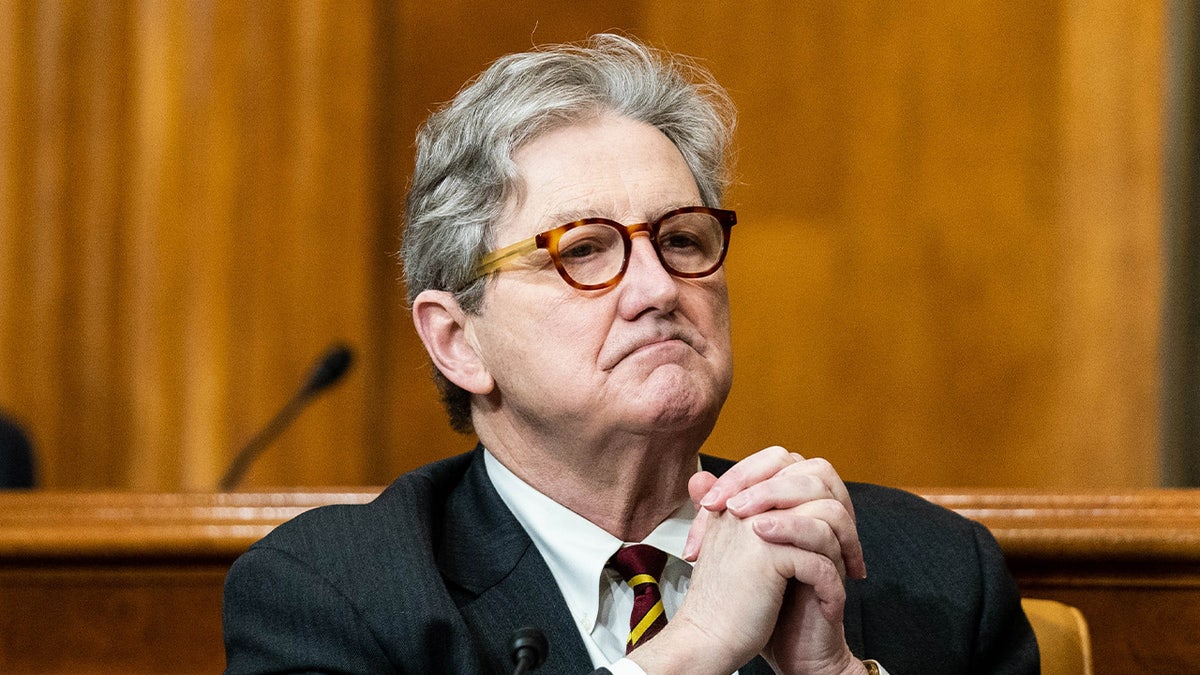
Their differences reflect broader disagreements over immigration, federal spending, government accountability, and the direction of American political institutions during a period of intense national division.
Kennedy, a Republican senator from Louisiana, has developed a recognizable public speaking style built around direct questions, plainspoken expressions, and challenges to political arguments.
Omar, a Democratic representative from Minnesota, has become a prominent voice in progressive politics, advocating policies involving immigration reform, economic inequality, healthcare, and civil rights.
Their contrasting political identities make the prospect of a direct confrontation particularly compelling to audiences who follow congressional debates and political exchanges online.
Yet understanding what either politician actually said requires more than an emotionally charged description of facial expressions, silence, or a supposedly devastating verbal exchange.
The real question is whether a documented disagreement between these two lawmakers supports the dramatic claims now circulating under their names.
And until that evidence emerges, the most revealing story concerns how political confrontations become viral narratives, sometimes without the underlying encounter being established at all.
The United States Congress provides a natural setting for high-profile political disagreements because lawmakers regularly debate policies affecting millions of Americans.
Those disagreements can involve complicated questions about constitutional authority, government spending, national security, immigration enforcement, and the proper relationship between federal and state governments.
Senators and representatives often approach these subjects from different ideological perspectives, producing exchanges that can become heated even when participants remain within procedural rules.
But a dramatic disagreement is not the same thing as a personal confrontation, and an ideological difference does not prove that two lawmakers exchanged hostile remarks.
This distinction is particularly important when the individuals involved serve in different chambers of Congress and participate in different legislative procedures.
Kennedy serves in the Senate, while Omar serves in the House of Representatives, meaning their routine committee assignments and legislative proceedings generally occur separately.
They can certainly disagree publicly, respond to one another’s statements, or participate in joint congressional events, but such encounters require specific documentation.
The circulating story provides none of the essential details that would allow journalists or readers to establish where the alleged confrontation happened.
There is no hearing title, no committee identification, no date, and no complete quotation from either lawmaker that could independently confirm the narrative.
Instead, the account relies on descriptions of a stunned audience and a mysterious sentence whose contents remain undisclosed.
Those elements create suspense, but they do not establish the existence of an actual congressional exchange or its supposed political consequences.
The search for corroboration reveals that similar Kennedy–Omar confrontation stories have circulated in several forms, sometimes involving different quotations, documents, or supposed reactions.

Some versions describe a secret recording. Others claim Kennedy produced translated remarks concerning Somalia or confronted Omar about Minnesota-related controversies.
These variations are significant because the most dramatic claims have not been accompanied by complete, independently authenticated congressional recordings or transcripts.
Factually+2
The underlying political disagreements, however, are real and deserve examination independently of sensational descriptions that cannot be verified.
Kennedy’s political career has included frequent criticism of progressive policies, particularly concerning government spending, immigration, public safety, and federal accountability.
Omar has defended progressive positions on economic justice, immigration, civil liberties, and American foreign policy, often challenging Republican interpretations of those subjects.
These disagreements provide ample opportunities for substantive debate, even without the existence of a dramatic face-to-face confrontation between the two lawmakers.
One area attracting national attention has been Minnesota’s Feeding Our Future fraud scandal, involving the misuse of federal child nutrition funds.
Federal prosecutors alleged that participants exploited pandemic-era food assistance programs, submitting fraudulent claims and diverting money intended to provide meals for children.
The scandal generated widespread questions about government oversight, the administration of emergency assistance programs, and the effectiveness of safeguards against financial misconduct.
Political commentators have sometimes connected those debates to Omar because she represents a Minnesota congressional district and has participated in discussions about the state’s communities.
But geographic representation and political disagreement do not establish personal involvement in criminal wrongdoing, and accusations require evidence specific to the individuals concerned.
The broader debate raises legitimate questions about how government agencies should balance rapid emergency assistance with financial controls and accountability.
Republicans have frequently emphasized stricter oversight and enforcement, while Democrats have also supported investigations and reforms, sometimes differing over their implementation.
Those policy disagreements can be examined through legislation, public statements, official investigations, and congressional proceedings rather than relying on unverified personal confrontations.
Another significant area of disagreement involves immigration policy and the treatment of communities with strong connections to countries outside the United States.
Omar, who was born in Somalia and later became an American citizen, has frequently discussed the experiences of immigrants and refugees in American society.
Her political positions have drawn both support and criticism, particularly concerning immigration enforcement, national identity, and American foreign policy.
Kennedy has expressed different views on immigration enforcement and federal government responsibilities, contributing to broader Republican arguments about border security and public accountability.
These disagreements can become emotionally charged because they involve questions about citizenship, belonging, public resources, and the responsibilities of elected representatives.
Nevertheless, a policy dispute should be evaluated through the arguments and evidence presented rather than assumptions about an individual’s personal loyalty or motives.
That distinction becomes especially important when political content uses emotionally charged descriptions to suggest that one lawmaker has exposed another’s supposed hidden intentions.
The alleged Kennedy–Omar confrontation illustrates how easily a complicated political disagreement can be transformed into a simplified narrative about humiliation and victory.
The story portrays Kennedy as delivering an irresistible argument and Omar as losing the ability to respond, leaving little room for the actual substance of either position.
But effective congressional debate is not measured by whether an audience gasps, whether a politician pauses, or whether a short video attracts attention.
It is measured more meaningfully by the accuracy of the claims presented, the relevance of supporting evidence, and the consequences for public policy.
Kennedy’s documented questioning of judicial nominees demonstrates that his direct speaking style can produce consequential moments during official congressional proceedings.
In December 2017, for example, he questioned federal judicial nominee Matthew Petersen about courtroom experience and legal procedures during a Senate Judiciary Committee hearing.
Petersen struggled to answer several questions concerning litigation practice, and the exchange subsequently received widespread national coverage.
Petersen later withdrew his nomination, making the hearing a documented example of how congressional questioning can influence a major appointment decision.
That incident provides a genuine basis for examining Kennedy’s approach to questioning, but it does not establish that a similar encounter occurred with Omar.
The distinction matters because political reputations can make fictionalized stories seem plausible, especially when they resemble earlier, well-documented events.
Omar has likewise participated in confrontational congressional debates, responding to criticism of her political positions and challenging statements made by political opponents.
Her public record contains speeches, legislative proposals, interviews, and committee appearances that allow readers to evaluate her arguments without relying on imagined exchanges.
The availability of those records makes the absence of evidence for the supposed five-word confrontation particularly important.
If Kennedy delivered a statement that fundamentally changed a congressional proceeding, the specific words and circumstances would be essential to understanding its significance.
A complete account would identify the date, location, participants, original quotation, and the response that allegedly followed.
Without those details, claims that Omar was unable to defend herself remain descriptions within an unsupported narrative rather than established observations.
The same problem applies to assertions that the encounter ended her career or produced irreversible political consequences.
A politician’s career is affected by elections, legislative activity, party relationships, public controversies, and numerous other developments that cannot be reduced to an unidentified sentence.
Even a widely criticized remark does not automatically determine whether an elected official will retain political influence or public support.
The American political system provides voters with opportunities to evaluate representatives through elections, while congressional institutions establish procedures for legislative and disciplinary matters.
Neither process can be replaced by a viral headline declaring that one politician has defeated another in a supposed confrontation.
There is also a broader media question about why these narratives attract attention even when their most important details remain undisclosed.
Stories describing a powerful individual suddenly rendered speechless create immediate suspense because they promise a reversal of expectations and a decisive revelation.
The missing quotation becomes the central attraction, encouraging readers to continue searching for a moment that may never have been documented.

When political figures are involved, audiences may find the story especially compelling if its outcome aligns with their existing opinions.
Supporters of one politician may interpret the account as confirmation of that person’s rhetorical abilities, while opponents may question its accuracy or fairness.
Neither reaction establishes the truth of the alleged encounter, and both demonstrate why independent verification remains important in political reporting.
The search results surrounding Kennedy and Omar illustrate the problem, with multiple sensational accounts describing different versions of an extraordinary confrontation.
Some reports acknowledge the lack of authenticated video or official documentation, while others repeat dramatic descriptions without resolving those evidentiary gaps.
A…+2
That inconsistency makes it difficult to identify a single original event from which the competing narratives supposedly emerged.
It also raises the possibility that unrelated statements, political disagreements, and imagined reactions have been combined into a more dramatic story.
Such possibilities should not be mistaken for definitive explanations, but they underscore the need to distinguish verifiable records from speculative storytelling.
For Americans interested in congressional accountability, the essential question is not whether Kennedy or Omar appeared more confident during an alleged exchange.
The more important question is whether either lawmaker presented evidence capable of clarifying a significant issue affecting constituents or national policy.
That standard applies equally to Republican and Democratic officials, regardless of their public speaking styles or ideological positions.
Congressional oversight is most valuable when it exposes institutional weaknesses, identifies factual inconsistencies, and helps the public understand decisions made by government officials.
It becomes less informative when attention shifts entirely toward personal insults, theatrical reactions, or unsupported claims about an opponent’s supposed humiliation.
The Kennedy–Omar story offers an opportunity to examine those competing approaches to political communication and the expectations Americans place on elected representatives.
Kennedy’s supporters may appreciate his concise questioning and willingness to challenge political opponents, while critics may disagree with his policy positions or rhetoric.
Omar’s supporters may value her advocacy on immigration and economic issues, while critics may challenge her legislative priorities and public statements.
Those differences are legitimate subjects of political discussion, provided the arguments remain connected to identifiable statements, actions, and evidence.
The alleged five-word revelation, however, remains unidentified, and no authenticated record establishes the scene described in the circulating account.
Until such evidence is available, the story cannot support conclusions about Omar’s conduct, Kennedy’s supposed remarks, or the political consequences attributed to them.
What can be established is that both lawmakers participate in significant national debates and represent contrasting perspectives within American politics.
Their actual statements and legislative records offer considerably more reliable information than a narrative built around an unnamed hearing and an undisclosed quotation.
The appeal of a dramatic confrontation is understandable, especially during an era when political exchanges can spread rapidly through short-form video and social media.
But the consequences of accepting unsupported claims extend beyond entertainment, potentially distorting public understanding of congressional proceedings and individual political records.
A genuine political revelation should withstand examination after the excitement fades, when audiences can review the original evidence and evaluate its significance independently.
That is the standard against which the supposed Kennedy–Omar confrontation must ultimately be measured, regardless of how forcefully its headline promises a dramatic outcome.
For now, the most consequential unanswered question is not whether Omar was left speechless, but whether the extraordinary exchange described online ever happened.
And until a verifiable recording or transcript establishes otherwise, the mysterious five-word statement remains a claim without a documented speaker, setting, or political consequence.
