
A dramatic political story circulating online claims Senator John Kennedy confronted Representative Ilhan Omar with financial records allegedly documenting millions of dollars in suspicious foreign transfers.
The account describes a tense congressional hearing in which Omar initially laughed at Kennedy’s questions before the senator produced a folder containing supposedly damaging banking evidence.
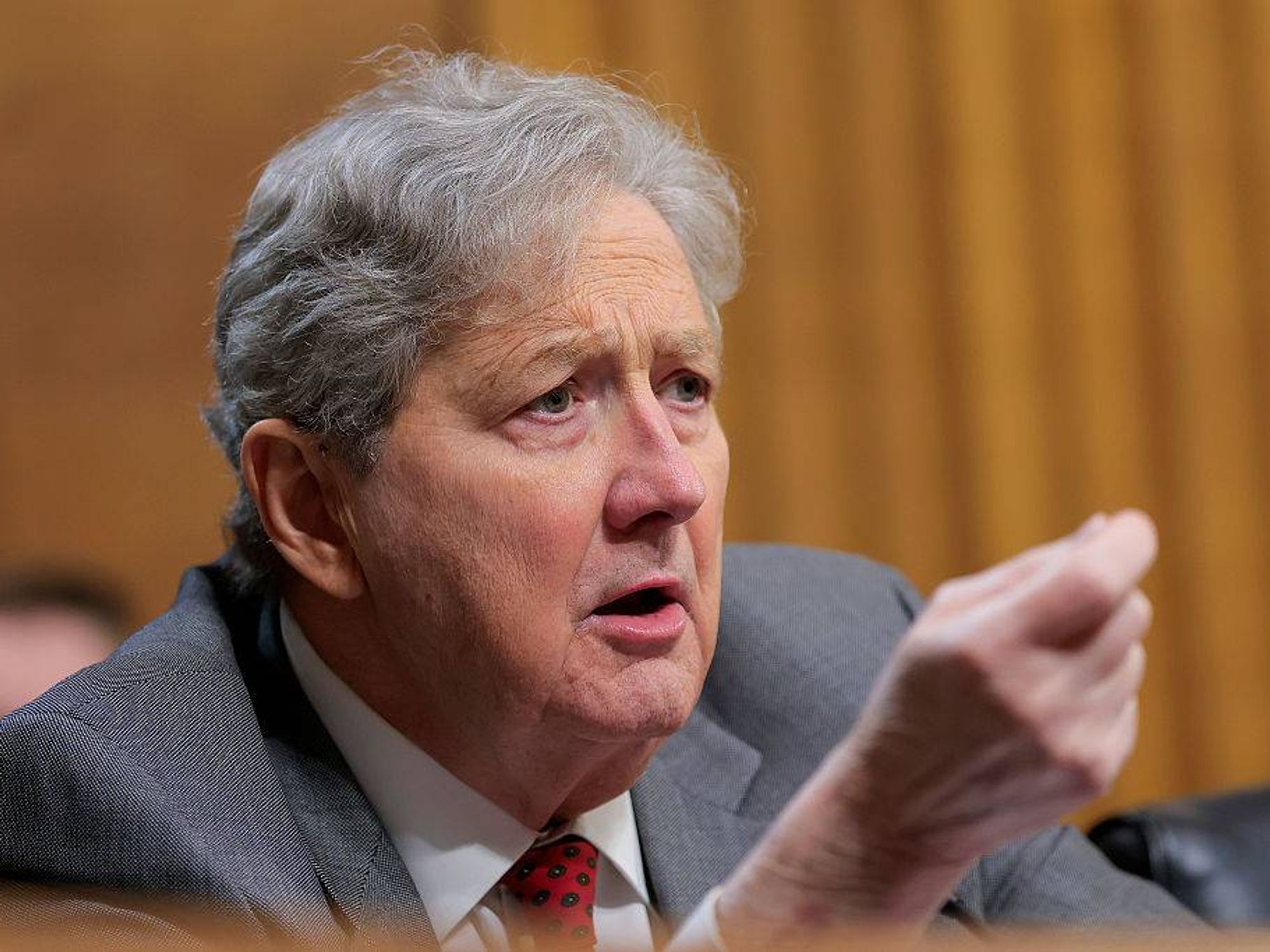
According to the viral narrative, the documents identified 17 wire transfers totaling $4.3 million into accounts associated with a family foundation.
The alleged transactions were described as originating in areas of Somalia controlled by al-Shabaab, a designated terrorist organization.
Additional claims connected the supposed money trail to Qatar, Turkey, and Iran, suggesting that foreign financial interests influenced Omar’s legislative activities.
The story culminates with Kennedy allegedly announcing that the documents would be referred to federal investigators and congressional ethics authorities.
But there is a fundamental problem with this account.
No authenticated FinCEN records, official hearing transcript, or verified congressional referral has been found to substantiate the allegations.
Available reviews of similar Kennedy–Omar confrontation stories have identified a repeated pattern of dramatic claims unsupported by official congressional documentation.
A separate, documented financial-disclosure controversy involving Omar also produced a substantially different outcome than the viral story suggests.
The contrast between the circulating allegations and the available official evidence is central to understanding the controversy.
The Alleged Hearing That No Official Record Confirms
The viral account begins with Omar supposedly laughing through several minutes of questions from Kennedy.
It portrays Kennedy as remaining composed while preparing to introduce financial documents capable of changing the entire hearing.
The senator allegedly opens a folder and begins displaying transaction dates, account information, and signatures.
According to the story, those records establish financial connections between Omar’s family and overseas organizations.
The narrative then describes a dramatic change in the room as Omar’s supposed amusement disappears.
However, no identified congressional hearing supports this sequence of events.
Kennedy serves in the United States Senate, while Omar represents Minnesota in the House of Representatives.
Members of the two chambers can participate in certain joint proceedings or appear as witnesses before one another’s committees.
But a confrontation of the magnitude described would ordinarily leave an identifiable documentary trail.
A hearing date, committee name, witness list, transcript, or official recording would provide the basic starting point.
The viral account offers none of those essential identifiers.
It also provides no verifiable evidence that Omar laughed at Kennedy for five minutes or was questioned about the alleged transfers.
That absence matters because the story’s emotional impact depends on treating the encounter as an authentic congressional event.
Without independently verifiable documentation, the scene cannot responsibly be presented as a factual hearing.
Similar online stories have described Kennedy confronting Omar with secret folders, translated statements, and supposedly decisive financial documents.
Those accounts frequently use overlapping dramatic descriptions while providing little primary evidence.
The repetition of a claim across websites does not establish its accuracy.
To verify the encounter, investigators would first need an official record showing when and where it occurred.
Until that exists, the supposed confrontation remains unsupported.
The $4.3 Million Allegation Requires More Than a Number
The most serious allegation concerns the claimed $4.3 million in foreign wire transfers.
The story presents the figure as the total of 17 transactions supposedly identified through FinCEN banking records.
It further alleges that money originated in territories controlled by al-Shabaab and reached accounts linked to a foundation associated with Omar’s family.
Those are allegations of potentially severe financial and national security significance.
They would require evidence establishing the identities of the sender and recipient, the ownership of accounts, and the actual purpose of the transactions.
Investigators would also need to determine whether any transfers violated applicable sanctions, financial reporting requirements, or criminal statutes.
A geographic connection to a conflict-affected region would not alone establish that a transaction involved a terrorist organization.
Similarly, a financial relationship with a foreign entity would not automatically prove improper political influence.
The allegation becomes even more serious when the narrative suggests that legislative decisions were connected to the supposed payments.
Establishing such a connection would require evidence extending beyond the timing of transactions.
Records would need to demonstrate relevant communications, agreements, knowledge, or conduct.

The viral account provides no authenticated transaction identifiers or financial institution records supporting its claims.
It also fails to identify a verifiable foundation receiving the alleged funds.
No official finding presented in the available evidence connects Omar to the described transfers.
The same evidentiary problem applies to the references involving Qatar, Turkey, and Iran.
Naming multiple countries does not establish that foreign governments or organizations financed a member of Congress.
Each alleged financial connection would require separate verification.
Without that evidence, the claim cannot support a conclusion that Omar received illicit foreign money or acted on behalf of an overseas interest.
Why the FinCEN Reference Matters
The use of FinCEN’s name gives the viral allegation an appearance of official financial intelligence.
The Financial Crimes Enforcement Network is a bureau of the United States Treasury Department.
It collects and analyzes financial information to support efforts against money laundering, terrorist financing, and other illicit financial activities.
Financial institutions submit certain reports concerning transactions that may warrant additional examination.
These include suspicious activity reports prepared under the Bank Secrecy Act.
However, the existence of a suspicious activity report does not independently establish that criminal activity occurred.
Financial institutions may report transactions because circumstances warrant scrutiny, even when the underlying activity is ultimately lawful.
Such reports are subject to confidentiality requirements and established rules governing access.
FinCEN guidance also distinguishes suspicious activity reports from the supporting documents maintained by financial institutions.
Those records can assist authorized investigators, but they must still be evaluated alongside other evidence.
A person claiming to possess genuine FinCEN material should therefore be able to establish its authenticity through an appropriate evidentiary process.
A purported screenshot or dramatic description of a banking document would not be sufficient.
Investigators would need to establish its origin, integrity, and relevance.
They would also need to determine whether the information accurately identified the individuals and entities involved.
The viral Kennedy story does not provide that foundation.
Its use of precise figures and references to federal financial intelligence does not compensate for the absence of authenticated records.
This is especially important when the accusation associates an identifiable politician with financing connected to terrorism.
Such a claim cannot be substantiated through rhetorical certainty or unverified descriptions alone.
Omar’s Actual Financial-Disclosure Controversy
There is a separate, documented controversy involving Ilhan Omar’s congressional financial disclosures.
In 2026, questions emerged about the valuation of business interests associated with her husband, Tim Mynett.
Earlier disclosure information appeared to indicate that the couple held business assets worth millions of dollars.
The reported values attracted political scrutiny and prompted questions about the accuracy of the filings.
Omar subsequently amended the information, substantially reducing the stated asset values after accounting errors were identified.
Republican critics argued that the original figures warranted investigation.
Omar’s representatives maintained that the discrepancy resulted from reporting mistakes rather than intentional misconduct.
The matter was reviewed by the Office of Congressional Conduct.
On September 9, 2026, reporting on the review indicated that the watchdog’s board voted 5-1 to recommend dismissal of the allegations.
The review found insufficient reason to believe that Omar had knowingly submitted false or incomplete financial information in violation of the relevant requirements.
That outcome did not mean questions about financial disclosures were inappropriate.
It meant the particular allegations examined had not met the evidentiary standard necessary to support further action recommended by the watchdog.
The distinction is important because this verified controversy concerned asset valuations and financial reporting.
It was not an investigation establishing foreign terrorist financing.
Nor did the documented review identify the alleged 17 wire transfers described in the viral story.
The two narratives should not be combined.
Doing so would transform an actual disclosure dispute into an unsupported allegation involving terrorism and foreign influence.
The public record supports scrutiny of the filings and the review that followed.
It does not support treating the viral banking allegations as findings of that investigation.
The Alleged Criminal Referrals Remain Unverified
The closing scene of the viral narrative claims Kennedy announced formal referrals to three federal or congressional institutions.
The organizations named are the Justice Department, the House Ethics Committee, and the Treasury Department.
Such referrals could potentially result in further examination, depending on the evidence and jurisdiction involved.
However, the story does not provide an official referral letter.
It identifies no confirmed receiving official, submission date, or case reference.
There is also no authenticated public documentation establishing that Kennedy transmitted the described financial package.
These omissions matter because congressional referrals are concrete institutional actions.
A statement that evidence was referred to investigators should be distinguishable from an unsupported allegation that such a referral occurred.
The House Ethics Committee possesses authority to examine potential violations involving House members.
The Justice Department investigates possible federal criminal offenses through legally established procedures.
The Treasury Department and its financial intelligence functions have separate responsibilities concerning financial information and enforcement.
Their involvement cannot be presumed merely because a social media story names them.
Even a verified referral would not automatically establish the truth of the allegations.
Authorities would still need to evaluate the underlying evidence and determine whether further action was warranted.
A referral is not equivalent to an indictment.
An indictment is not equivalent to a conviction.
And an unverified announcement about a supposed referral does not establish that any government investigation exists.
The viral account collapses these distinctions into a single dramatic conclusion.
But the available evidence does not support that conclusion.
The Most Important Question Behind Kennedy’s Alleged Folder
The appeal of the viral story comes from its apparent simplicity.
A politician laughs at an opponent, the opponent reveals secret documents, and the documents supposedly settle the dispute.
The narrative offers precise numbers, recognizable institutions, and an immediate political consequence.
Yet the most consequential detail is what remains missing.
There is no authenticated record establishing that Kennedy presented the alleged FinCEN documents.
There is no verified evidence of the described $4.3 million transfer scheme.
There is no established congressional hearing documenting the confrontation as narrated.
And there is no confirmed referral of that supposed financial package to the agencies named.
Those omissions cannot be resolved through increasingly dramatic descriptions of the same allegations.
They require primary evidence.
The actual financial-disclosure review involving Omar provides an instructive contrast.
That matter involved identifiable reporting, specific financial forms, a recognized oversight process, and a documented recommendation.
The evidence could be examined independently of the political arguments surrounding it.
By contrast, the viral banking narrative relies on claims about documents whose authenticity has not been demonstrated.
That distinction determines how the story should be understood.
The financial activities of elected officials are legitimate subjects of public accountability.
So are concerns about foreign influence, improper payments, and possible conflicts of interest.
But serious accusations must be evaluated under evidentiary standards appropriate to their consequences.
The public should be able to distinguish confirmed findings from allegations and allegations from unsupported internet narratives.
Kennedy and Omar have substantial political disagreements, and both can be examined through their documented public records.
Those disagreements do not establish that the particular exchange occurred.
Nor do they demonstrate that the alleged transfers were real.
As of November 14, 2026, the available evidence does not substantiate the viral account’s central accusations.
The documented September financial-disclosure review instead recommended dismissing a separate set of allegations involving Omar’s reported assets.
That is the consequential finding supported by identifiable reporting.
The alleged hearing, banking records, and referrals remain unverified.
