
“HE’S A LITTLE… YOU KNOW!” — Marco Rubio’s Remark About Kim Jong Un Draws Laughter, Then His Warning About Iran Takes a Much Darker Turn…
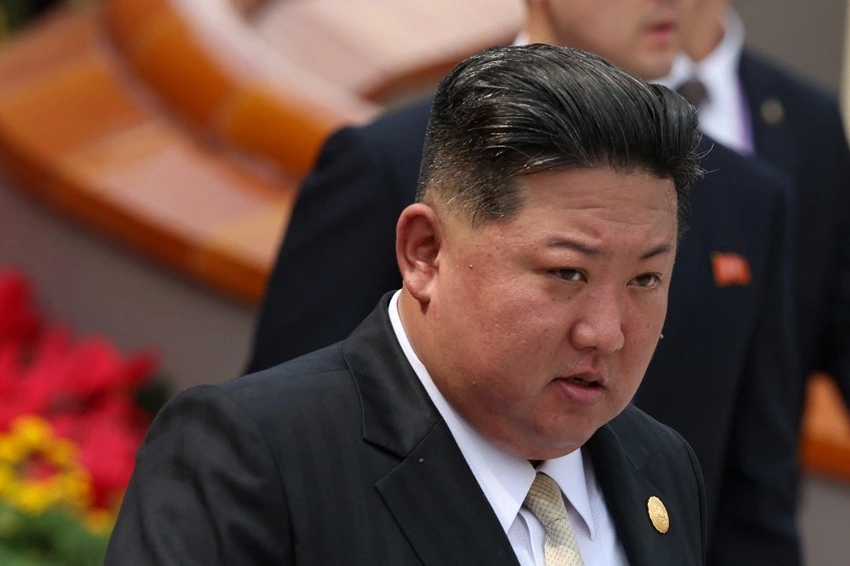
Secretary of State Marco Rubio was discussing the dangers of nuclear proliferation when an unexpected remark about North Korean leader Kim Jong Un drew laughter from his audience.
The comment came during Rubio’s November 13, 2026, address to the Federalist Society’s National Lawyers Convention.
But the moment was more than an offhand insult.
Rubio was explaining why he viewed the Iranian government as a different kind of nuclear threat from North Korea.
His argument centered on a distinction between two strategic objectives: protecting an existing regime and expanding influence beyond national borders.
North Korea, Rubio argued, primarily seeks to preserve its ruling system.
Iran’s leadership, he maintained, has broader regional ambitions that could become more dangerous if backed by nuclear weapons.
Then Rubio described what he believed could happen if Tehran possessed both a nuclear deterrent and an extensive network of missiles, drones, and armed partners.
He warned that the result could fundamentally restrict America’s ability to respond to future threats.
The contrast was stark.
A passing joke about Kim Jong Un had introduced a serious argument about nuclear deterrence, regional conflict, and the possibility of a much larger confrontation.
And the most consequential part of Rubio’s remarks was not the joke.
It was his warning about how a nuclear-armed Iran might change the balance of power across the Middle East.

The Unexpected Remark That Changed the Speech’s Tone
Rubio’s remarks came as he defended the Trump administration’s approach to international law, national sovereignty, and American military power.
The audience was gathered for a conservative legal conference, not a conventional diplomatic briefing.
Much of his address concerned the limits he believed international institutions should place on American decision-making.
He also discussed the administration’s military and economic confrontation with Iran.
The comparison with North Korea emerged as Rubio explained his understanding of Tehran’s strategic intentions.
He began describing Kim Jong Un, then paused during an unfinished personal characterization.
The audience laughed.
Rubio continued by explaining that he did not view North Korea as seeking to conquer Japan or China.
Instead, he characterized Kim’s principal objective as preserving his regime.
He also emphasized that this description was not intended to excuse North Korea’s human-rights abuses.
The distinction was important to his argument.
Rubio was not claiming that North Korea’s nuclear arsenal was harmless.
He was distinguishing his assessment of Pyongyang’s strategic ambitions from his assessment of Tehran’s.
North Korea already possesses nuclear weapons and missile capabilities that present serious security challenges.
Its arsenal complicates diplomacy, military planning, and efforts to maintain stability in Northeast Asia.
But Rubio argued that Iran’s leadership had a different vision of regional power.
He described its rulers as revolutionaries seeking to extend their influence through armed organizations and military pressure.
That assessment formed the foundation of the warning that followed.
Why Rubio Believes Iran Presents a Different Nuclear Danger
Rubio’s comparison rested on the distinction between nuclear weapons as instruments of regime survival and nuclear weapons as potential protection for regional power projection.
A government primarily concerned with survival might use its nuclear arsenal to discourage foreign intervention.
A government pursuing wider regional influence might also use nuclear deterrence to raise the costs of opposing its conventional military activities.
Rubio argued that Iran’s leadership fell into the second category.
He pointed to Tehran’s longstanding relationships with armed organizations throughout the Middle East.
Those organizations have operated in countries including Lebanon, Iraq, Syria, and Yemen.
Iran has supported various groups through combinations of financing, training, weapons, and political relationships.
The extent and character of those relationships differ across organizations and historical periods.
Rubio nevertheless argued that they form part of a broader regional strategy.
He identified Hezbollah, Iraqi militias, the Houthis, and armed elements that supported Bashar al-Assad’s former government.
He described Iran’s clerical leadership as the common factor connecting many regional security problems.
That was his assessment, not a conclusion that Iran alone caused every conflict involving those organizations.
Regional conflicts also involve local political struggles, historical grievances, rival governments, and competing outside powers.
Nevertheless, Rubio maintained that Iran’s network of relationships could become substantially harder to confront if Tehran possessed nuclear weapons.
The central concern involved escalation.
If an Iranian-supported organization attacked American personnel or a regional ally, Washington might consider military retaliation.
But an Iranian nuclear arsenal could increase the perceived risks of broader confrontation.
That could influence decisions even when the original incident involved conventional weapons.
Rubio’s warning was therefore not limited to the possible use of a nuclear bomb.
It concerned the political and military freedom that nuclear deterrence might provide.
He believed that distinction separated the potential Iranian threat from his characterization of North Korea’s objectives.
The argument also raised questions about whether Tehran’s intentions were being interpreted accurately.
Analysts disagree about how Iran balances ideological ambitions, regional influence, and regime security.
Those uncertainties matter because nuclear strategy depends heavily on judgments about intentions as well as capabilities.
The Missile Shield Rubio Says Could Change Everything
Rubio then moved from political intentions to military capabilities.
He argued that Iran had invested heavily in missiles, drones, and other conventional systems.
These weapons could threaten military installations, ships, and infrastructure across the region.
His concern was that Tehran might eventually use those capabilities to discourage outside intervention against its nuclear program.
Rubio described this as a conventional shield.
The concept involved making military action against Iran so costly that foreign governments would hesitate to undertake it.
An extensive missile arsenal could threaten bases and population centers.
Drones could complicate defensive operations.
Attacks on maritime infrastructure could disrupt international trade and energy supplies.
Together, these capabilities could increase the consequences of any major confrontation.
Rubio argued that such a shield might allow Iran to preserve or expand nuclear activities despite outside objections.
The argument resembled warnings he had made years earlier as a senator.
In 2015, Rubio publicly compared Iran’s nuclear ambitions with North Korea’s established arsenal.
He advocated maintaining economic pressure while preserving the possibility of military action.
His current remarks continued that broader strategic concern.
But the circumstances had changed considerably.
As secretary of state, Rubio was now defending policies implemented by the administration he served.
The United States and Israel had already conducted military operations against Iran.
Rubio argued that those actions helped prevent Tehran from developing a conventional deterrent powerful enough to protect a future nuclear breakthrough.
That claim remains a strategic assessment requiring evaluation against available intelligence and military evidence.
It does not establish that every element of the predicted danger would otherwise have occurred.
The distinction is especially important when discussing future nuclear capabilities.
The ability to enrich uranium, produce weapons-grade material, assemble a nuclear device, and deploy a usable weapon involves different technical stages.
Progress in one area does not automatically establish completion of the others.
Rubio’s warning concerned what he believed could happen if those capabilities eventually came together.
And the consequences he described extended far beyond Iran’s borders.
The Strait of Hormuz Becomes the Center of His Worst-Case Scenario
Rubio focused particular attention on the Strait of Hormuz.
The narrow waterway connects the Persian Gulf to international shipping routes.
It plays a central role in global energy transportation.
Disruption in the strait can affect oil markets, shipping costs, insurance arrangements, and economies far beyond the Middle East.
Rubio argued that Iran could use the threat of maritime attacks to influence foreign governments.
Missiles, drones, naval vessels, and other capabilities could complicate commercial navigation.
He then asked his audience to consider how such pressure might change if Iran possessed nuclear weapons.
His warning was that Tehran could attempt to make foreign intervention prohibitively dangerous.
That could allow it to exert greater pressure over shipping and neighboring governments.
Rubio suggested that a nuclear-armed Iran might hold the region hostage through the threat of escalation.
The statement was a prediction about potential behavior rather than proof of an existing nuclear-backed strategy.
Still, the scenario identified a genuine problem in international security.
A military confrontation near a major shipping route can create economic consequences for countries that are not direct participants.
Energy prices may change rapidly.
Commercial vessels may face higher insurance costs.
Governments may need to protect shipping while avoiding additional escalation.
Adding nuclear weapons to such a confrontation could increase uncertainty about the consequences of military action.
That possibility formed one of the central elements of Rubio’s argument.
Yet it also introduced a difficult policy question.
If preventing nuclear proliferation requires military pressure, how can governments avoid increasing the risk of the broader conflict they seek to prevent?
Rubio acknowledged that armed conflict was unpopular and economically disruptive.
He argued that substantial economic pressure on Iran could make additional military action unnecessary under current conditions.
That distinction mattered.
His immediate position emphasized continued pressure rather than presenting another military operation as inevitable.
However, his speech also defended the broader confrontation as necessary to prevent a more dangerous future.
The unresolved issue was whether those policies could achieve the desired nuclear restrictions without producing further regional instability.

The Nuclear Nightmare Behind the Casual Joke
The most significant shift in Rubio’s speech occurred when he connected nuclear deterrence with Iran’s regional activities.
His initial remark about Kim Jong Un had drawn laughter.
But his subsequent argument concerned the possibility that a nuclear arsenal could shield a government’s conventional actions from effective outside opposition.
Rubio described Iranian leaders as seeking regional dominance.
He argued that nuclear weapons could strengthen their ability to support armed partners while discouraging retaliation.
The concern was not simply that Iran might launch a nuclear attack.
It was also that possession of nuclear weapons could change the choices available to its adversaries.
American officials might become more cautious about responding to attacks.
Regional governments could face greater pressure.
Military operations could involve new escalation risks.
Even limited confrontations might acquire consequences that were difficult to predict.
Rubio had made a similar argument during congressional testimony earlier in 2026.
He suggested that Iran could view nuclear weapons as a means of achieving regional dominance, beyond the security benefits he associated with North Korea’s arsenal.
Rev
But this comparison has limitations.
North Korea’s nuclear weapons program remains a substantial threat to regional and international security.
Its weapons affect the calculations of South Korea, Japan, the United States, and China.
Describing Kim’s leadership as primarily focused on survival does not eliminate the possibility of dangerous escalation.
Likewise, assessing Iran’s regional ambitions does not establish precisely how its leaders would behave if they acquired nuclear weapons.
A country’s strategic intentions can change with circumstances.
Deterrence can also produce unexpected outcomes.
An arsenal intended to discourage foreign intervention may simultaneously increase the risk of miscalculation.
Rubio’s comparison therefore presented a particular interpretation of two governments’ motivations.
It should not be mistaken for a definitive explanation of their future behavior.
The deeper issue concerned the relationship between nuclear capabilities and political influence.
A government with nuclear weapons may believe it has additional protection against military intervention.
Other governments may respond by strengthening military alliances, expanding defensive systems, or increasing pressure.
Those reactions can create further instability.
This is why the implications of Rubio’s argument extend beyond one country.
The same strategic problem can arise whenever nuclear capabilities become intertwined with conventional conflict.
The Final Warning Reveals What Rubio Wants Washington to Prevent
Rubio ended the relevant portion of his address by broadening the issue.
He argued that regional threats could eventually create direct consequences for American security.
Geographic distance, he suggested, offered less protection in a world connected through international shipping, military technology, energy markets, and long-range weapons.
His immediate objective was clear.
He wanted to prevent Iran from obtaining nuclear weapons.
He argued that this goal justified sustained economic and military pressure.
But his remarks also demonstrated the difficult choices involved in pursuing that objective.
Sanctions can restrict financial resources while affecting ordinary civilians.
Military operations can degrade capabilities while generating risks of retaliation.
Diplomacy can establish limits and monitoring arrangements while leaving disputes about regional activities unresolved.
No single instrument automatically addresses every dimension of the problem.
Rubio’s speech emphasized the danger of allowing Iran to acquire a powerful deterrent.
It devoted less attention to the possibility that sustained confrontation could also encourage governments to seek stronger deterrence.
That tension remains central to nuclear nonproliferation policy.
Pressure may discourage certain activities.
But policymakers must also consider how targeted governments interpret threats to their survival.
The effectiveness of any strategy depends partly on intelligence, diplomatic communication, verification, and the incentives facing the parties involved.
The final distinction in Rubio’s remarks concerned North Korea.
He characterized Kim Jong Un’s nuclear strategy primarily as an effort to preserve an existing regime.
He portrayed Iran’s leadership as seeking greater regional influence.
From that contrast, Rubio argued that an Iranian nuclear arsenal would create particularly dangerous consequences.
The evidence supports reporting that he made this comparison.
It does not establish that North Korea is harmless or that Iran would necessarily follow every course of action he predicted.
Nor does it prove that one particular military or diplomatic approach must succeed.
The significance of the remarks lies in the strategic problem Rubio identified.
Nuclear weapons can influence international decisions even when they are never used.
Their existence can affect military planning, diplomatic negotiations, and perceptions of vulnerability.
That was the central point behind his warning about Iran.
The speech began its most widely discussed passage with an unfinished description of Kim Jong Un.
The audience laughed.
But the larger argument concerned what could happen when conventional military pressure and nuclear deterrence reinforce one another.
Rubio wanted the audience to imagine a Middle East in which Tehran could threaten regional interests while making retaliation increasingly dangerous.
That was the future he argued Washington needed to prevent.
His warning was not evidence that such a future had already arrived.
It was a statement of the administration’s strategic rationale during an ongoing confrontation.
And the unresolved question is what combination of pressure, verification, diplomacy, and security arrangements can prevent that danger without creating another one.
The brief joke about Kim Jong Un drew attention.
The nuclear warning explained why Rubio believed the stakes were much greater.
Because the consequences he described would not be confined to one government, one military confrontation, or one region.
They could affect international security far beyond the Middle East.
That was the lasting message behind his remarks.
The danger Rubio identified was not merely a nuclear weapon itself, but the possibility that possessing one could fundamentally change what other countries were willing to do.
