
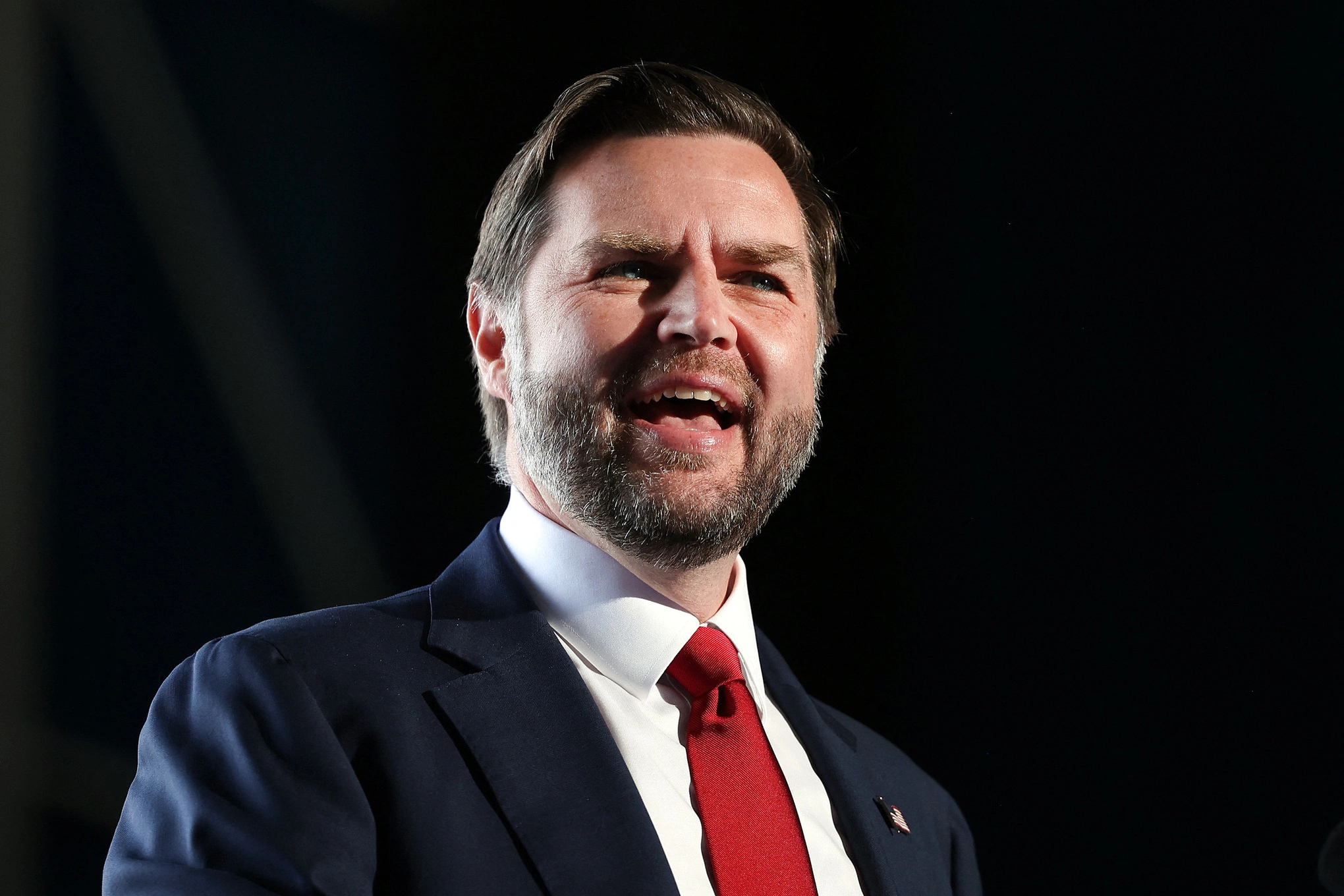
Vice President JD V.a.n.c.e was sitting beneath the television studio lights when the host placed a document labeled “H.e.g.s.e.t.h Impeachment Inquiry” on the desk.
The discussion concerned allegations involving Iran, Pentagon leadership, and the conduct of Defense Secretary Pete H.e.g.s.e.t.h.
Critics argued that decisions involving sensitive military matters deserved independent scrutiny.
Supporters questioned whether the proposed impeachment effort reflected legitimate oversight or political opposition to H.e.g.s.e.t.h’s leadership agenda.
V.a.n.c.e examined the document.
He did not interrupt the host.
He did not raise his voice.
Instead, he turned to the final page and asked a question.
“Can somebody show me the actual allegation we’re supposed to be discussing?”
The host pointed toward a summary of concerns involving military operations and government accountability.
V.a.n.c.e looked down at the paper.
“That’s a list of political disagreements.”
He paused.
“Where is the evidence establishing an impeachable offense?”
The studio became quiet.
Across the table, a constitutional-law analyst challenged him.
“Vice President, impeachment doesn’t require a criminal conviction.”
V.a.n.c.e nodded.
“That’s correct.”
Then he opened a second folder.
“But if Congress is going to take a step this serious, the American people deserve to understand what conduct is being alleged.”
The folder contained a timeline of Pentagon management disputes, proposed institutional reforms, and questions about decisions involving Iran.
But one document stood apart from the others.
It described opposition to a proposed Pentagon reorganization.
And the timing of that opposition would become the most disputed detail of the broadcast.
The controversy had begun with disagreements over H.e.g.s.e.t.h’s leadership of the Defense Department.
His supporters emphasized efforts to change military administration, review spending priorities, and reshape decision-making procedures.
Critics raised concerns about management practices, oversight, and the handling of sensitive national security responsibilities.
Those disagreements were politically significant.
But they were not identical to a formal impeachment finding.
The host asked V.a.n.c.e whether he believed Congress had authority to investigate a defense secretary.
V.a.n.c.e answered that it did.
The Constitution provides Congress with substantial oversight responsibilities.
The House also possesses the authority to initiate impeachment proceedings against civil officers.
The Senate has the constitutional responsibility to conduct impeachment trials.
But V.a.n.c.e argued that constitutional authority should be exercised with clear allegations and reliable evidence.
The analyst responded that investigations sometimes began before all relevant facts were established.
An inquiry could be intended to determine whether additional proceedings were justified.
V.a.n.c.e acknowledged that distinction.
Then he asked whether political opposition to a cabinet secretary was enough by itself.
The analyst answered that disagreement over policy did not automatically establish impeachable misconduct.
However, the analyst also cautioned that an official’s policy agenda did not shield unrelated conduct from investigation.
The distinction was central.
A defense secretary could pursue controversial reforms without necessarily committing an impeachable offense.
But a reform agenda could not automatically invalidate credible allegations involving other responsibilities.
V.a.n.c.e turned toward the first document.
It contained a fictional summary of complaints concerning decisions connected to Iran.
Some questioned the administration’s communication with Congress.
Others concerned the review of military options and the handling of sensitive information.
The summary did not establish that H.e.g.s.e.t.h had committed a specific offense.
It identified subjects requiring further examination.
V.a.n.c.e pointed toward the page.
“These are serious subjects.”
He paused.
“But serious subjects aren’t the same thing as established wrongdoing.”
The analyst agreed that conclusions required evidence.
The host asked whether V.a.n.c.e would support a legitimate examination of documented misconduct.
V.a.n.c.e replied that oversight should be based on facts rather than a predetermined political outcome.
Then he redirected the conversation.
He wanted to discuss another dispute developing inside the Pentagon.
The second folder concerned proposed changes to defense administration.
In the reconstructed scenario, H.e.g.s.e.t.h’s team had prepared a plan to review contracting procedures, management layers, and reporting requirements.
The proposal challenged several long-standing administrative practices.
Supporters argued that the changes could improve efficiency and accountability.
Critics warned that rapid restructuring might disrupt military operations and weaken established safeguards.
V.a.n.c.e believed the timing deserved examination.
He pointed toward the reform calendar.
The first draft of the plan had circulated weeks before the latest political controversy.
The timeline showed internal objections emerging soon afterward.
Some officials questioned whether the proposed changes had received sufficient review.
Others raised concerns about how the reforms would affect procurement and oversight.
V.a.n.c.e looked toward the host.
“Now here’s what I find interesting.”
He tapped the document.
“We’re being told this entire controversy is about Iran.”
Then he turned another page.
“But some of these political arguments began before the latest Iran-related allegations.”
The host challenged the implication.
“Are you saying everyone who opposes the reforms is secretly coordinating an impeachment effort?”
V.a.n.c.e answered that the documents did not establish such coordination.
But he believed the overlapping disputes made it necessary to examine what critics were actually arguing.
The analyst agreed that chronology could identify questions.
However, timing alone could not establish someone’s motives.
A person could oppose Pentagon reforms and independently support an investigation into unrelated conduct.
The existence of two disagreements did not prove that one was merely a disguise for the other.
V.a.n.c.e acknowledged the limitation.
Then he introduced a fictional internal memorandum concerning administrative reform.
The document described proposals to consolidate certain management functions and review contracting processes.
It also identified potential benefits and operational risks.
One section warned that implementing major changes without adequate transition planning could create difficulties.
V.a.n.c.e argued that opponents were using those concerns to resist necessary reform.
The host asked whether the concerns might be legitimate.
V.a.n.c.e replied that proposed changes should be evaluated according to their effects.
The analyst noted that management reforms could improve performance when carefully designed.
They could also create problems if their implementation disrupted essential functions.
The evidence would depend on the specific proposal.
V.a.n.c.e turned toward the screen.
A chart showed the fictional Pentagon restructuring plan.
Several offices appeared in overlapping administrative roles.
Another section identified procurement processes requiring multiple stages of review.
V.a.n.c.e argued that excessive bureaucracy could slow decisions and increase costs.
The host asked whether removing those stages would preserve necessary safeguards.
V.a.n.c.e acknowledged that essential oversight had to remain.
Then he asked whether every existing administrative layer was indispensable.
The analyst answered that the question required operational evidence.
Some procedures might be redundant.
Others could protect against waste, fraud, or dangerous mistakes.
The issue could not be resolved by assuming that all bureaucracy was either beneficial or harmful.
V.a.n.c.e agreed that the details mattered.
But he maintained that the department should be willing to examine long-standing practices.
The host returned to the impeachment controversy.
“Even if H.e.g.s.e.t.h’s reforms are worthwhile, how does that answer questions about Iran?”
V.a.n.c.e paused.
It was the strongest challenge of the evening.
He examined the two folders.
Then he made an important distinction.
“The reforms don’t answer those questions.”
He continued.
“The point is that we shouldn’t confuse opposition to someone’s policy agenda with proof that the person committed impeachable misconduct.”
The analyst acknowledged that distinction.
But the host pressed further.
“Couldn’t both things be true?”
V.a.n.c.e looked toward him.
The host continued.
“Couldn’t officials have legitimate concerns about the reforms while Congress separately examines national security decisions?”
V.a.n.c.e answered that both possibilities needed to be considered.
The exchange changed the direction of the discussion.
The documents could not establish that the impeachment allegations were merely a political disguise.
But they also did not establish wrongdoing by H.e.g.s.e.t.h.
The controversy required evaluating each set of questions independently.
Then V.a.n.c.e introduced the final document.
It was a fictional comparison of the arguments advanced by different critics.
One column contained concerns about Iran-related decisions.
The second addressed Pentagon restructuring.
The third listed broader political objections to H.e.g.s.e.t.h’s leadership.
V.a.n.c.e argued that public commentary sometimes combined those separate disputes into one sweeping accusation.
The analyst examined the table.
Several entries concerned policy disagreements.
Others described potential oversight questions.
A smaller category referred to conduct that, if substantiated, might require legal or constitutional analysis.
The distinction was important.
Not every controversial policy decision constituted misconduct.
Not every management disagreement established abuse of power.
And not every allegation concerning national security was automatically invalid because the accused official supported reforms.
V.a.n.c.e leaned toward the microphone.
“Then why aren’t we separating these issues before demanding the most serious remedy Congress possesses?”
The host asked the analyst to explain the impeachment process.
The analyst noted that the House must determine whether allegations justify impeachment under the constitutional standard.
If articles are adopted, the Senate conducts a trial.
Removal requires the constitutionally specified supermajority.
The process is distinct from an ordinary personnel disagreement.
But it is also a constitutional mechanism for addressing serious alleged misconduct by covered officials.
V.a.n.c.e emphasized the gravity of that process.
He argued that lawmakers should identify the conduct at issue rather than rely on general hostility toward an administration.
The analyst agreed that specificity was important.
Then the analyst raised another concern.
Congress did not have to accept a defense secretary’s explanation merely because the executive branch characterized the disputed conduct as necessary for national security.
Oversight could be especially important when sensitive information limited public understanding.
V.a.n.c.e acknowledged that legitimate classified information required appropriate handling.
But he maintained that secrecy should not become a substitute for accountability.
The host asked what evidence would resolve the Iran-related questions.
The analyst identified relevant communications, lawful testimony, decision records, and applicable procedural requirements.
Any assessment would need to consider what H.e.g.s.e.t.h actually did.
It would also need to examine his responsibilities and the governing rules.
V.a.n.c.e looked toward the original allegation summary.
He asked whether the material presented during the broadcast established those elements.
The analyst answered that it did not.
The summary identified concerns.
It was not a complete evidentiary record.
V.a.n.c.e nodded.
“Then people should say that.”
The host challenged him.
“They should also avoid saying the investigation has been disproven when the evidence hasn’t been fully examined.”
V.a.n.c.e accepted that a lack of completed findings did not automatically invalidate an inquiry.
But he argued that public figures should avoid describing disputed allegations as established misconduct.
The confrontation had reached its central question.
Was the controversy primarily about Iran-related conduct or opposition to Pentagon restructuring?
The fictional documents established that both disputes existed within the scenario.
They did not prove that one was secretly manufactured to conceal the other.
V.a.n.c.e then turned toward the third column of the comparison chart.
It contained public criticism of H.e.g.s.e.t.h’s leadership style and proposed administrative changes.
He argued that such criticism could be legitimate political debate.
But it should not be substituted for evidence supporting impeachment.
The analyst agreed.
The host asked whether V.a.n.c.e would likewise accept that a genuine allegation involving national security could not be dismissed simply by describing critics as bureaucratic opponents.
V.a.n.c.e answered that credible allegations required examination.
That response narrowed the disagreement.
Both sides acknowledged that political motives could be debated.
But conclusions about misconduct required evidence.
The host asked whether the Pentagon restructuring plan should receive independent scrutiny.
V.a.n.c.e agreed that proposals should be evaluated.
He emphasized that evaluations should consider costs, operational readiness, and administrative performance.
The analyst added that oversight protections should also be examined.
A reform could reduce unnecessary procedures.
It could also unintentionally weaken accountability.
The appropriate conclusion would depend on the plan’s details.
V.a.n.c.e returned to the fictional memorandum.
Its final page contained a recommendation that had not appeared in the opening political arguments.
The proposal called for an independent assessment of the reforms before implementation.
The recommendation included a review of financial implications, command responsibilities, and operational risks.
V.a.n.c.e examined the passage.
The document undermined the suggestion that every concern about the reforms represented resistance to change.
Some objections concerned how the changes would be implemented.
The host asked whether those objections should be considered legitimate.
V.a.n.c.e acknowledged that operational concerns deserved attention.
But he maintained that objections should be supported by specific analysis.
The analyst agreed.
The same standard applied to the impeachment allegations.
Critics needed evidence.
Supporters needed evidence.
And neither side could establish its position simply by questioning the motives of the other.
Then the host returned to the statement that had opened the broadcast.
“Vice President, can you prove this impeachment controversy has absolutely nothing to do with Iran?”
V.a.n.c.e looked toward the three-column chart.
For several seconds, he did not answer.
Then he spoke.
“The documents we’ve examined don’t prove that.”
The studio became quiet.
He continued.
“But they do show why people need to distinguish actual allegations from unrelated political arguments.”
The analyst agreed that the distinction was important.
The host asked whether the opposite conclusion could be established.
Did the available material prove that H.e.g.s.e.t.h had engaged in impeachable misconduct concerning Iran?
The analyst answered no.
The case file did not provide sufficient evidence for such a finding.
Nor did it establish a hidden campaign by Pentagon officials to manufacture allegations because of proposed reforms.
Both claims required evidence beyond the material presented.
The exchange had produced a narrower result than either dramatic political narrative promised.
But it also identified the questions that mattered.
What specific actions were being investigated?
What legal or constitutional responsibilities applied?
What evidence supported the allegations?
And which objections concerned policy disagreements rather than alleged misconduct?
V.a.n.c.e closed the first folder.
Then he placed the Pentagon restructuring proposal beside it.
He looked toward the host.
“Here’s the mistake Washington keeps making.”
He paused.
“We take three different arguments, throw them into one headline, and expect the public to choose a side before anyone sorts out the facts.”
The analyst acknowledged that separating issues could improve public understanding.
The host asked V.a.n.c.e whether he believed H.e.g.s.e.t.h should be subject to independent oversight.
V.a.n.c.e answered that lawful oversight remained part of the constitutional system.
He emphasized that investigations should be conducted fairly.
The analyst added that fairness included examining credible evidence even when the allegations involved senior executive officials.
V.a.n.c.e agreed that political position alone did not determine whether an allegation deserved scrutiny.
The host prepared to conclude the broadcast.
But V.a.n.c.e requested one final statement.
He pointed toward the two folders.
One contained the Iran-related allegations.
The other described Pentagon administrative reforms.
Then he asked the question that brought the discussion into focus.
“If the evidence is supposed to determine the outcome, why are we arguing about motives before examining the actual conduct?”
The studio became quiet.
The analyst responded that motivations could be relevant in some circumstances.
But speculation about political motives could not substitute for evaluating the evidence underlying a constitutional allegation.
V.a.n.c.e accepted that principle.
The host asked for a final summary.
The fictional case materials illustrated legitimate differences between policy opposition, administrative disputes, and allegations of misconduct.
They did not establish that an impeachment proceeding had been secretly orchestrated by corrupt Pentagon officials.
They also did not establish that H.e.g.s.e.t.h had committed an impeachable offense.
The Pentagon reform proposal required its own examination.
Any Iran-related allegations required separate evaluation under applicable law and constitutional procedures.
The host closed the discussion.
No dramatic confession had emerged.
No secret order directing a political campaign against H.e.g.s.e.t.h had been authenticated.
And no document had demonstrated that all criticism of the defense secretary originated from officials resisting administrative reform.
But the discussion identified why the distinction mattered.
A political controversy could contain several overlapping disputes.
Some concerned policy.
Others concerned management.
Still others involved allegations of conduct requiring independent investigation.
Treating them as identical could distort the public’s understanding.
V.a.n.c.e gathered his papers.
The analyst closed the constitutional briefing.
The two folders remained on the desk.
Their contents did not provide an automatic verdict.
Instead, they established the questions that any responsible inquiry would have to answer.
If officials opposed Pentagon reforms, their objections could be examined according to operational evidence.
If lawmakers alleged misconduct involving Iran, those allegations could be evaluated through relevant records and testimony.
Neither process required pretending the other did not exist.
And neither justified declaring guilt or innocence before examining the complete facts.
The confrontation had begun with an accusation that a hidden establishment campaign was using Iran as a political weapon.
It ended with a more precise distinction between suspicion, political opposition, and evidence.
The unanswered question was not whether Washington’s competing factions disliked Pete H.e.g.s.e.t.h. It was whether the specific allegations against him could be established through reliable evidence.
