
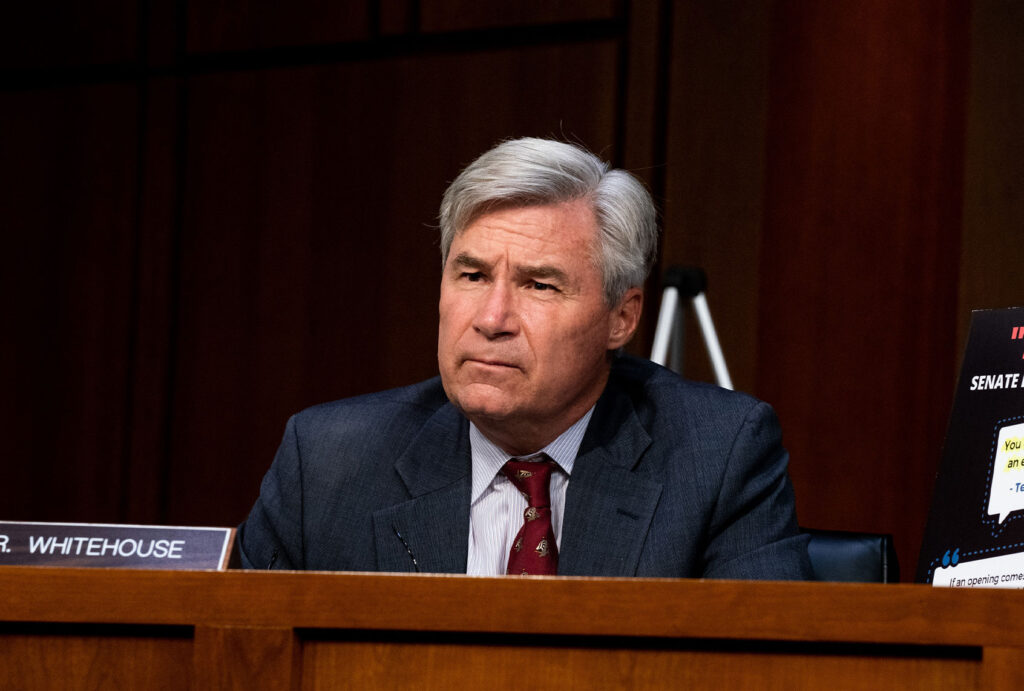
The television studio fell silent when Senator She.l.d.o.n Whit.e.h.o.u.s.e placed a pocket Constitution beside a printed copy of a proposed constitutional amendment.
Across the desk sat Representative Nan.c.y Ma.c.e.
The debate concerned a proposal that could fundamentally change who was eligible to serve in some of the highest offices of the United States government.
Mace had introduced legislation seeking to extend the natural-born citizenship requirement to members of Congress, federal judges, and several categories of appointed federal officials.
Whitehouse had one question about the proposal.
And he wanted it answered before the discussion went any further.
“Congresswoman, are you saying that an American who becomes a citizen through naturalization should never be allowed to serve in Congress?”
Mace leaned toward her microphone.
In this imagined exchange, she defended the proposal as an attempt to establish stronger citizenship qualifications for sensitive federal positions.
Whitehouse listened.
Then he removed his glasses.
“That’s a policy argument.”
He opened the Constitution.
“Now let’s examine what the Constitution actually says.”
The moderator asked the production team to display Article I.
Whitehouse pointed toward the eligibility requirements for the House of Representatives.
Then he turned toward Mace.
“Congresswoman, there’s a reason I brought this document.”
He paused.
“And there’s a difference between defending the Constitution as it exists and proposing to change it.”
The cameras moved closer.
On the screen appeared the language of the real constitutional amendment Mace had introduced.
The wording was direct.
It would prohibit people who were not natural-born citizens from serving in specified federal positions.
But a second page contained an important detail concerning when those restrictions would take effect.
And that detail would shape the rest of the fictional confrontation.
On May 20, 2026, Mace introduced H.J.Res. 188, a proposed amendment to the United States Constitution.
The resolution sought to require natural-born citizenship for members of the House and Senate, federal judges, and certain officials whose appointments require Senate confirmation.
Its provisions would extend a qualification already familiar from presidential eligibility to additional positions in federal government.
The proposal was not itself a constitutional amendment already in force.
Introducing a resolution did not change the Constitution.
An amendment proposed through Congress must receive the constitutionally required supermajorities and then be ratified by three-fourths of the states.
That process matters because constitutional eligibility rules cannot be rewritten through an ordinary political declaration.
In the fictional broadcast, Whitehouse began by separating the existing rules from the proposed changes.
The current Constitution establishes that members of the House must have been United States citizens for at least seven years.
Senators must have been citizens for at least nine years.
Those requirements do not categorically exclude naturalized citizens.
The presidency has a different constitutional qualification involving natural-born citizenship.
Whitehouse pointed toward those distinctions.
“Congresswoman, the framers didn’t write the same citizenship requirement for every federal office.”
Mace responded that the Constitution could be amended.
Whitehouse agreed.
“Of course it can.”
He leaned toward his microphone.
“But if you’re proposing to change the rules, shouldn’t voters understand exactly whose eligibility would change?”
The moderator turned toward the constitutional-law analyst.
The analyst explained that naturalized citizens are American citizens.
They can vote in federal elections when otherwise eligible.
They can participate in political organizations.
And they can seek congressional office when they satisfy the Constitution’s qualifications.
Mace’s amendment would change that framework for the positions it covered.
The host asked whether the proposal amounted to revoking anyone’s American citizenship.
The analyst answered no.
It would not, by itself, revoke citizenship.
But it would impose a new eligibility restriction on certain federal offices.
That distinction became central.
A naturalized person could remain an American citizen while losing eligibility for a position covered by the proposed amendment.
Whitehouse turned toward Mace.
“Then we’re talking about Americans who would continue to possess citizenship but would face a new barrier to public service.”
Mace defended the distinction between possessing citizenship and qualifying for particular federal offices.
The analyst agreed that the Constitution already imposes different eligibility requirements on different offices.
The unresolved question was whether extending the natural-born qualification would be appropriate.
Whitehouse returned to the document.
He wanted the audience to understand that the proposal affected more than congressional elections.
The amendment also covered the federal judiciary.
That included positions whose qualifications and appointment processes differed from those governing elected lawmakers.
The analyst explained that the proposal would establish a natural-born citizenship restriction for federal judges notwithstanding Article III.
Whitehouse looked toward the screen.
“So we’re not discussing only the House of Representatives.”
He paused.
“We’re discussing the federal courts too.”
Mace maintained that sensitive federal positions warranted particular qualifications.
Whitehouse responded by asking what evidence supported treating naturalized citizenship itself as a disqualification.
The moderator requested a precise distinction.
The proposal concerned the circumstances of a person’s citizenship, not a finding that a particular individual had engaged in unlawful conduct.
The analyst confirmed that naturalization alone did not establish divided loyalty or misconduct.
Whitehouse nodded.
“Then the justification needs to explain why the method of becoming an American should determine eligibility for these offices.”
The host asked Mace to explain her rationale.
Within the fictional exchange, she argued that leadership positions involving national authority should be subject to strict constitutional qualifications.
She noted that the presidency already carried a natural-born citizenship requirement.
Whitehouse acknowledged the existing presidential rule.
But he challenged whether that established the case for extending it to every office in her proposal.
“An existing rule for one office doesn’t automatically answer whether it should apply to ten others.”
The analyst agreed that the offices had different constitutional structures and responsibilities.
The host asked whether the Constitution’s existing congressional citizenship requirements reflected deliberate distinctions.
The analyst explained that the text itself plainly distinguished the offices.
Interpreting the historical reasons for those differences required examining the constitutional debates and subsequent scholarship.
But the legal distinction was clear.
Congressional eligibility did not currently require natural-born citizenship.
Whitehouse turned toward the printed resolution.
“Then what you’ve introduced isn’t a clarification of existing congressional qualifications.”
He paused.
“It’s a proposal to replace them with a more restrictive standard.”
Mace acknowledged that the resolution sought a constitutional change.
That acknowledgment altered the fictional exchange.
The question was no longer whether the Constitution already prohibited naturalized citizens from serving in Congress.
It did not.
The question was whether the Constitution should be amended to impose that prohibition.
Whitehouse then reached for the second page.
It contained the amendment’s proposed effective dates.
For the House, the change would take effect on January 3 of the first odd-numbered calendar year following ratification.
The Senate provision contained additional language addressing the conclusion of senators’ existing terms.
The judiciary and covered appointed offices had a different implementation period.
Whitehouse pointed toward the dates.
“Congresswoman, these aren’t minor administrative details.”
The moderator asked why.
The analyst explained that the effective dates determined when the new restrictions would begin applying to people seeking or holding the specified offices.
The language could have significant consequences for eligibility and transitions.
Whitehouse asked whether a naturalized American who had already served in Congress might face a changed eligibility standard.
The analyst explained that the proposal’s precise effects would depend on the relevant office, timing, and final interpretation if ratified.
But the proposed amendment clearly sought to replace existing eligibility standards for future service in covered positions.
Mace defended the inclusion of transition provisions.
Whitehouse acknowledged that transition rules were necessary when qualifications changed.
But he wanted to return to the larger question.
“Why should someone who has been a United States citizen for decades be excluded from serving in Congress solely because that citizenship was acquired through naturalization?”
The moderator allowed Mace to respond.
In the fictional discussion, she argued that eligibility rules could reflect judgments about the responsibilities attached to public office.
Whitehouse challenged whether the proposed distinction demonstrated anything about an individual’s actual allegiance or ability to fulfill constitutional duties.
The analyst explained that naturalized citizens undertake legal obligations as Americans.
Citizenship obtained through naturalization is not merely temporary political permission.
Mace responded that the proposal did not seek to revoke citizenship or ordinary civic rights.
Whitehouse acknowledged that point.
“But it does propose to exclude those citizens from particular positions.”
The moderator confirmed that this was the effect the amendment sought to establish.
The debate became more focused.
Supporters of the proposal could argue for extending existing natural-born qualifications to additional offices.
Opponents could question whether doing so unnecessarily restricted political representation and public service.
Both arguments concerned a proposed constitutional change.
Neither could be resolved by pretending that the existing Constitution already contained the proposed restriction.
Then Whitehouse introduced a hypothetical example.
Imagine an American who immigrated legally, became naturalized, lived in the country for thirty years, and fulfilled every existing constitutional qualification for the House.
Under current rules, such a person could seek election if otherwise eligible.
Under Mace’s proposed amendment, natural-born status would become an additional requirement.
The host asked whether the person’s long history of citizenship would eliminate that new restriction.
The analyst answered that it would not, under the proposed categorical rule.
Whitehouse looked toward Mace.
“Then the proposal wouldn’t ask how long this person had served the country.”
He paused.
“It would ask how that person became a citizen.”
Mace maintained that constitutional qualifications necessarily drew lines between eligible and ineligible candidates.
Whitehouse agreed that eligibility requirements did exactly that.
But he argued that lawmakers proposing new restrictions should explain the basis for drawing those lines.
The analyst emphasized that this was a policy and constitutional-design disagreement, not evidence of criminal conduct by either participant.
Whitehouse turned toward the moderator.
“That’s the question Americans should be discussing.”


The host then raised the amendment process.
Even if Congress approved the resolution, the proposed change would still require ratification by three-fourths of the states.
Whitehouse pointed toward the first page.
“That means the decision doesn’t belong to one representative, one senator, or one television panel.”
The analyst agreed.
The Constitution establishes a demanding process for formal amendment.
Mace acknowledged that her proposal would have to proceed through that process.
The moderator asked whether introducing H.J.Res. 188 meant naturalized citizens had already lost eligibility for the covered offices.
The analyst answered no.
The introduced resolution was a proposal, not an enacted constitutional amendment.
Whitehouse emphasized that distinction.
Then he turned toward the camera.
“Whatever people think about the idea, let’s at least be accurate about what has happened.”
He paused.
“A proposal has been introduced.”
He looked toward the resolution.
“The Constitution has not been changed merely because somebody filed it.”
The fictional debate had reached its central issue.
Mace sought to establish a new natural-born citizenship standard for specified federal offices.
Whitehouse questioned the justification for excluding naturalized citizens who otherwise satisfied existing qualifications.
The host asked whether other constitutional principles were relevant.
The analyst explained that citizenship, political representation, and eligibility for public office involved different constitutional provisions.
An amendment adopted through Article V would itself alter the constitutional framework.
That made the proposed change consequential.
It also meant critics needed to address the amendment’s actual text rather than characterize it as an executive order or immediate ban.
Whitehouse nodded.
“Then here’s what we should put in front of voters.”
He raised the document.
“The current rule.”
He pointed toward the first page.
“The proposed rule.”
Then he looked toward the moderator.
“And the justification for changing it.”
The host asked whether the proposal established that naturalized citizens were less loyal to the United States.
The analyst answered that the resolution did not constitute evidence about the loyalty of individual naturalized Americans.
A citizenship classification was not a finding of misconduct.
Whitehouse asked whether naturalized citizens could fulfill the constitutional duties of members of Congress under current law.
The analyst answered yes, provided they met the applicable qualifications.
Mace maintained that the amendment concerned what the qualifications should become.
That distinction remained central.
Then the moderator posed another hypothetical.
Suppose a naturalized citizen served honorably in government for decades.
Would the proposed qualification allow that person’s experience to override the natural-born requirement?
The analyst explained that the proposed categorical language did not establish an exception based on years of service.
Whitehouse examined the wording.
He asked why experience, public trust, and prior service should not matter to eligibility.
Mace responded that constitutional qualifications sometimes operated independently of those characteristics.
The analyst agreed that many existing eligibility standards were categorical.
But determining whether a new categorical restriction was desirable remained a matter for constitutional debate.
The moderator asked both participants to address the same question.
What public interest justified the proposed change?
Mace emphasized the responsibilities associated with sensitive federal positions.
Whitehouse questioned whether birthplace-related citizenship status was a reliable substitute for evaluating those responsibilities.
The analyst explained that the proposal did not establish a method for assessing individual loyalty.
It would impose a status-based qualification.
The distinction was significant.
An individual examination of conduct could produce different conclusions for different people.
A categorical citizenship requirement would apply according to the defined constitutional status.
Whitehouse turned toward the resolution.
“Then we’re talking about a rule that would apply even without any allegation that a particular citizen had done something wrong.”
The analyst confirmed that the proposed restriction did not require a finding of wrongdoing.
Mace defended the principle of establishing office qualifications independently of criminal conduct.
Whitehouse acknowledged that constitutional qualifications were not punishments for crimes.
But he argued that new exclusions deserved careful justification because they affected the electorate’s available choices.
The host raised a final question about democracy.
If voters wanted to elect a naturalized American to the House, what would happen under the proposed rule?
The analyst explained that a ratified amendment would make candidates who lacked the new qualification ineligible, regardless of voter preference.
Whitehouse looked toward the screen.
“Then this proposal affects more than the people who might run for office.”
He paused.
“It affects the choices voters are allowed to make.”
The moderator asked Mace whether that concern was inherent in any constitutional eligibility requirement.
She replied that all qualifications restricted the range of eligible candidates.
Whitehouse agreed.
But he argued that the existence of some restrictions did not settle whether additional restrictions were warranted.
The discussion had become less about political insults and more about constitutional design.
Then Whitehouse placed the pocket Constitution directly beside H.J.Res. 188.
Two documents now lay in front of the cameras.
One showed the country’s existing framework.
The other proposed changing it.
Whitehouse looked toward Mace.
“Congresswoman, I want to make sure we’re discussing the same thing.”
He paused.
“You’re not claiming that the Constitution already prohibits naturalized Americans from serving in Congress.”
Within the fictional exchange, Mace acknowledged that her proposal sought to change the existing qualifications.
Whitehouse nodded.
“And you’re not claiming that introducing this resolution immediately changes those qualifications.”
The moderator confirmed the amendment process.
Whitehouse continued.
“Then here’s the question that matters.”
The studio grew quiet.
The host allowed him to finish.
Whitehouse turned toward the camera.
“If naturalized Americans are citizens trusted to vote, serve, and participate in our democracy, what justifies denying them eligibility for these offices solely because of how they became Americans?”
The fictional exchange paused on that question.
Mace defended her proposed standard as a constitutional policy choice concerning federal leadership.
Whitehouse maintained that the exclusion required a persuasive public justification.
The moderator observed that neither position could be established merely through rhetorical accusations.
The text of the proposal was clear enough to frame the disagreement.
Its consequences were substantial enough to deserve serious public examination.
And its implementation would require the demanding constitutional amendment process.
The host thanked both participants.
The fictional confrontation ended without an invented confession or claim of personal misconduct.
No actual televised exchange between Whitehouse and Mace had been established.
No verified evidence showed that Mace had been forced into silence by Whitehouse.
But the underlying constitutional question was real.
Mace’s May 2026 resolution proposed natural-born citizenship requirements for offices that currently operate under different eligibility standards.
Supporters could argue that such positions warranted the additional qualification.
Opponents could argue that the proposal would unnecessarily exclude naturalized Americans from important forms of public service.
The constitutional text distinguished those positions.
And the amendment process provided the mechanism through which any proposed change would have to be considered.
Whitehouse closed his pocket Constitution.
Mace gathered the resolution.
The moderator returned to the document displayed on the screen.
Its most important feature was not an insult or a dramatic confrontation.
It was the proposed replacement of existing citizenship qualifications.
The difference between being a citizen for seven or nine years and being required to be natural-born was not a technical detail.
It would determine whether certain Americans could ever seek the covered offices.
And it would affect the range of candidates available to voters.
The final question therefore reached beyond the fictional studio.
Should the Constitution extend the presidential natural-born requirement to members of Congress, federal judges, and other specified federal officers?
Or should the existing distinctions remain?
That was the actual constitutional debate raised by the proposal.
The decisive issue was never who delivered the sharpest television insult. It was whether America should change its Constitution to make naturalized citizenship a permanent barrier to holding additional federal offices.
