
“CALL IT A WITCH HUNT? THEN SHOW THE RECEIPTS!” Lauren Boebe.r.t Challenges Sheldon Whitehou.s.e in Explosive Dark-Money Showdown
Washington thrives on political confrontation. A sharp accusation, a heated exchange, or a carefully chosen insult can transform an ordinary congressional discussion into a national controversy.
But beneath the familiar theater of American politics lies a much more complicated battle: who finances political organizations, who benefits from their activities, and how much information the American public is entitled to know.
That battle has repeatedly brought Senator Sheldon Whitehou.s.e into conflict with Republican lawmakers.
And in this fictionalized confrontation, Representative Lauren Boebe.r.t becomes his most vocal challenger, questioning his motives, attacking his political approach, and demanding answers about the investigations he has championed.
The subject is dark money.
The accusation is political hypocrisy.
And the central question is whether Washington’s political establishment is willing to apply the same transparency standards to everyone.
BOEBERT OPENS FIRE: “THIS IS A POLITICAL WITCH HUNT!”
The atmosphere becomes tense as Boebe.r.t challenges Whitehou.s.e’s approach to campaign finance investigations.
She argues that his repeated criticism of conservative organizations risks turning legitimate political advocacy into a target of partisan investigations.
For Boebe.r.t, the issue is not whether financial transparency matters.
It is whether politicians are using transparency as a weapon against organizations whose political positions they dislike.
BOEBERT: “Senator Whitehou.s.e, you keep talking about dark money as though every conservative organization is automatically suspicious. Is this really about transparency, or is it about attacking people who disagree with you?”
Whitehou.s.e listens before responding.
He does not accept the characterization.
WHITEHOUSE: “Congresswoman, political organizations have every right to advocate for their positions. But the American people also have a right to understand who is financing significant political spending.”
Boebe.r.t interrupts.
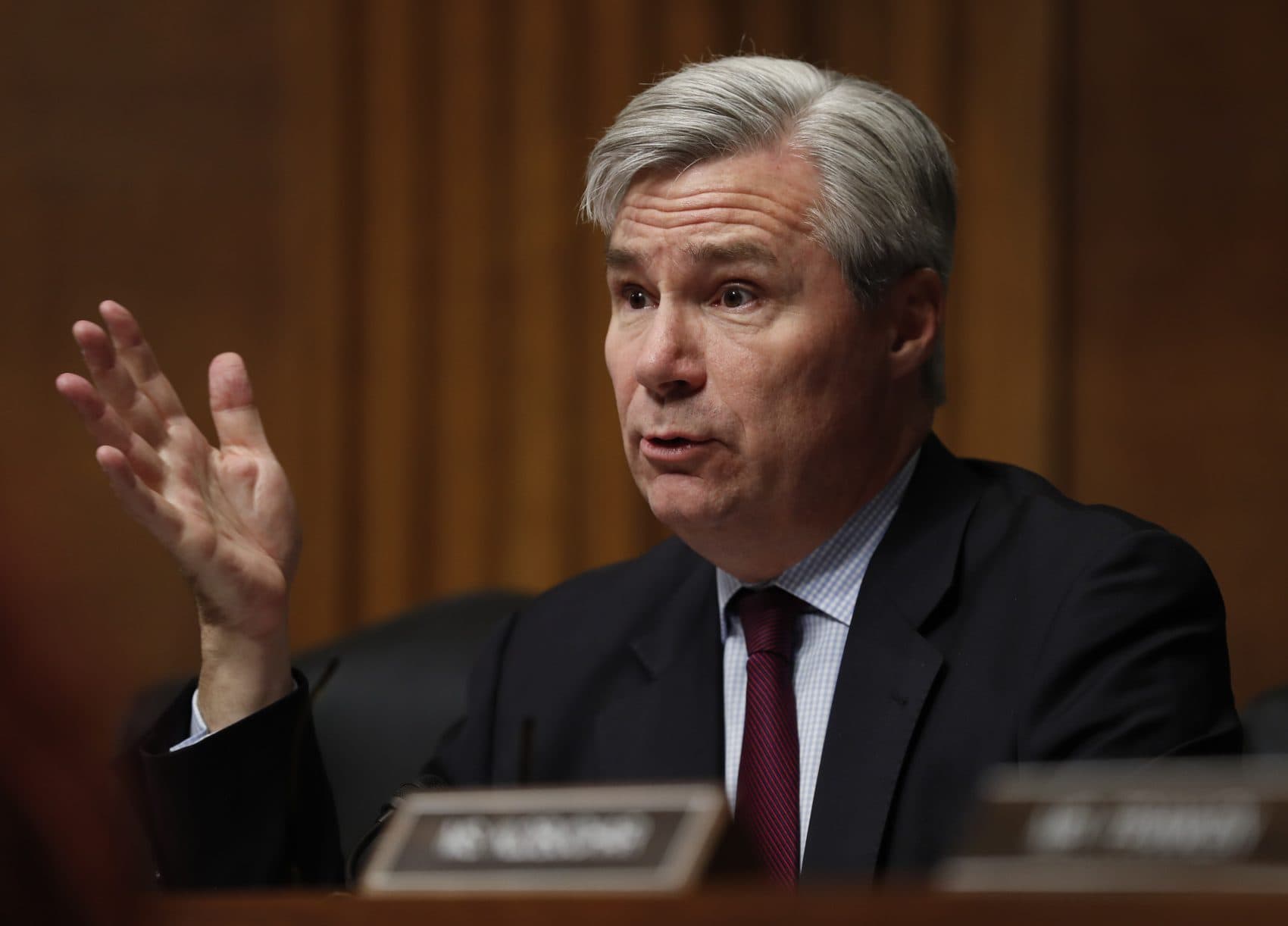
BOEBERT: “Then why should anyone believe that your investigations are anything other than another partisan exercise?”
The question strikes at the heart of the disagreement.
Whitehou.s.e has repeatedly argued that anonymous political spending creates opportunities for wealthy interests to influence public policy without adequate disclosure.
Republicans have countered that donor privacy is constitutionally protected and that disclosure requirements must not become tools for political intimidation.
Neither concern can simply be dismissed.
But Whitehou.s.e is determined to make one point clear.
The debate should concern financial records, not political labels.
WHITEHOUSE: “LET’S FOLLOW THE MONEY, NOT THE SLOGANS.”
For years, Whitehou.s.e has focused on the financial structures surrounding politically active nonprofit organizations.
His investigations have examined Section 501(c)(4) organizations, super PACs, donor-advised funds, and other arrangements that can make identifying the original source of political contributions difficult.
In a May 4, 2022, Senate hearing, he explained how political spending through certain nonprofit organizations had expanded following the Supreme Court’s 2010 Citizens United decision.
He cited figures showing that spending by 501(c)(4) organizations on political expenditures increased from approximately $103 million during the decade before the ruling to more than $1 billion during the following decade.
Those figures formed part of his argument for stronger disclosure requirements.
Whitehou.s.e believed the public was being left out of an increasingly important financial conversation.
And he wanted Congress to do something about it.
BOEBERT: “YOU’RE IGNORING THE CONSTITUTION!”
Boebe.r.t’s counterargument focuses on the First Amendment.
Political organizations are entitled to express their opinions, support causes, and associate with people who share their beliefs.
Donors may also have legitimate reasons to protect their identities, particularly when supporting controversial political positions.
The Supreme Court addressed this constitutional concern in its 2021 decision in Americans for Prosperity Foundation v. Bonta.
The Court ruled against California’s blanket collection of charitable donor information, emphasizing that government disclosure requirements must respect freedom of association.
Boebe.r.t’s imagined response draws on that constitutional principle.
BOEBERT: “You cannot demand that every American reveal their political contributions just because Washington wants another investigation. People have constitutional rights.”
Whitehou.s.e responds by distinguishing between ordinary private contributions and substantial political expenditures.
WHITEHOUSE: “Nobody is suggesting that every small donor should be exposed. The question is whether Americans deserve to know who is financing major political campaigns and organizations.”
His position reflects the purpose of the DISCLOSE Act, legislation he has repeatedly championed.
The proposal seeks to increase transparency surrounding significant political spending.
But the constitutional debate remains difficult.
How much disclosure is enough?
When does transparency become an unreasonable invasion of privacy?
And how can Congress prevent financial influence from operating in secrecy without discouraging legitimate political participation?
Those questions cannot be answered through insults.
They require evidence and carefully designed laws.

THE FINANCIAL RECORDS THAT CHANGED THE DIRECTION OF THE DEBATE
In the imagined exchange, Whitehou.s.e places a collection of documents on the table.
The folder is not presented as a confidential 2018 investigation or a newly discovered scandal.
Instead, it represents the public financial records, congressional correspondence, and legislative materials that have shaped his longstanding campaign for disclosure.
He points to his March 2021 correspondence with several conservative organizations.
Following a Senate Judiciary hearing, Whitehou.s.e requested that the Federalist Society, Judicial Crisis Network, and Capital Research Center identify their five largest contributors.
The request followed an exchange in which a progressive organization had agreed to disclose its own major donors.
Whitehou.s.e argued that equivalent transparency should apply to organizations on both sides of the political divide.
The correspondence also revealed an interesting political complication.
During the hearing, Republican Senator Ted Cruz had pressed a witness to disclose the organization’s largest contributors.
Whitehou.s.e subsequently used that same argument to request disclosure from conservative organizations.
His reasoning was straightforward: if transparency was appropriate for one political organization, why should another receive a different standard?
That question continues to define the broader debate.
WHITEHOUSE: “IF YOU WANT TRANSPARENCY, YOU CANNOT MAKE EXCEPTIONS FOR YOUR FRIENDS.”
In this fictionalized exchange, the senator directs his attention back toward Boebe.r.t.
WHITEHOUSE: “You want to investigate financial influence? Fine. But the rules must apply to everyone. Democratic organizations, Republican organizations, conservative donors, progressive donors. Nobody should receive special treatment.”
Boebe.r.t responds that equal treatment also requires protecting constitutional freedoms.
BOEBERT: “And nobody should have their rights taken away because a politician doesn’t like their political views.”
Whitehou.s.e does not dispute the importance of those rights.
Instead, he argues that the debate should focus on the distinction between protecting political association and concealing significant financial activity.
It is an important distinction.
An organization receiving a contribution is not automatically committing wrongdoing.
A donor supporting a political cause does not automatically control the organization.
And a complicated financial relationship is not proof of corruption.
But those relationships can still justify legitimate questions about disclosure, accountability, and the influence of money in public life.
THE ELEVEN-WORD CLOSING CHALLENGE
The viral headline promises an eleven-word sentence that supposedly left the room in stunned silence.
No authenticated recording or congressional transcript establishes that such a statement was delivered during an actual confrontation between Boebe.r.t and Whitehou.s.e.
For this dramatic reconstruction, however, the closing challenge is:
“Bring me the records and let the facts speak for themselves.”
The sentence contains exactly eleven words.
It captures the central principle of Whitehou.s.e’s argument without pretending to be a historical quotation.
The challenge is directed at the entire political establishment.
If lawmakers believe that dark money is distorting American democracy, they should produce verifiable evidence.
If they accuse organizations of concealing financial relationships, they should identify the relevant records.
And if they demand transparency from political opponents, they should accept comparable scrutiny themselves.
Boebe.r.t’s constitutional objections would remain part of the discussion.
But the financial questions would not disappear simply because the two lawmakers disagreed about the appropriate legal response.
WHY THIS FIGHT MATTERS BEYOND BOEBERT AND WHITEHOUSE
The confrontation reflects a much larger disagreement over the relationship between money and American democracy.
Since Citizens United, political spending and donor disclosure have remained central issues in congressional debates.
Whitehou.s.e has repeatedly argued that wealthy donors can use nonprofit organizations and other financial arrangements to support political activities without revealing their identities.
He has also raised concerns about organizations participating in campaigns surrounding federal judicial appointments.
His 2022 testimony described what he characterized as a $580 million network of secretive spending connected to judicial advocacy.
That figure was presented as part of his argument and should not be interpreted as a judicial finding of illegal conduct.
Conservative advocates have offered a different interpretation.
They argue that organizations supporting judicial nominees are exercising legitimate constitutional freedoms.
They also warn that broad disclosure requirements can discourage participation and expose private citizens to harassment.
The disagreement is particularly significant because the federal judiciary exercises enormous influence over American law.
Judicial decisions affect elections, business regulations, environmental protections, civil liberties, and the relationship between federal and state governments.
Consequently, financial support for organizations involved in judicial politics attracts substantial public attention.
But financial influence and judicial corruption are not interchangeable concepts.
Evidence of a donation does not establish that a judge has been improperly influenced.
Evidence of political advocacy does not automatically establish unlawful coordination.
A responsible investigation must establish those distinctions rather than assume the conclusion.
BOEBERT’S CHALLENGE AND WHITEHOUSE’S RESPONSE
The most revealing aspect of this fictionalized confrontation is not the supposed folder or the dramatic eleven-word sentence.
It is the fundamental disagreement between two approaches to political accountability.
Boebe.r.t’s argument emphasizes constitutional protections, donor privacy, and the danger of selective investigations.
Whitehou.s.e’s argument emphasizes disclosure, public accountability, and the importance of identifying major financial interests behind political spending.
Both perspectives raise questions that lawmakers must confront.
Should major political contributors be publicly identified?
Should nonprofit organizations participating in political campaigns face stronger reporting requirements?
How can disclosure laws protect legitimate association?
And should the same rules apply to organizations regardless of their political ideology?
The answers will shape the future of campaign finance debates in Washington.
THE QUESTION THAT REMAINS AFTER THE CAMERAS STOP ROLLING
The imagined confrontation ends without a verified apology, an authenticated confidential folder, or an actual eleven-word ultimatum.
But the larger political dispute remains very real.
Whitehou.s.e continues to advocate stronger financial disclosure.
Republican lawmakers and conservative organizations continue to raise constitutional concerns.
And Americans remain divided over how much information should be publicly available about the financial forces supporting political activity.
The ultimate challenge is not simply exposing the political opponents of one party.
It is establishing a consistent system that allows the public to understand significant financial influence without undermining constitutional freedoms.
Because democracy depends not only on the right to speak, but also on the ability of citizens to evaluate the interests and arguments presented to them.
And as Washington prepares for its next political confrontation, one question deserves to remain at the center of the debate:
If every political organization claims to support transparency, why is establishing one consistent standard for everyone still so difficult?
