
Alexandria Ocasio-Cortez had spent several minutes defending her economic agenda when Senator John Neely Kennedy placed a thick folder on the hearing table.
The argument had already become contentious.
Ocasio-Cortez accused conservative critics of exaggerating the costs of progressive policies while ignoring the economic pressures facing ordinary American families.
Kennedy rejected that characterization.
But instead of responding with another sarcastic remark, he opened a document marked Federal Spending and Accountability.
Across the table sat Pete Hegseth, a military veteran whose presence introduced another dimension to the discussion about government spending.
Kennedy had brought a series of financial summaries, congressional budget records, and policy comparisons.
Some were based on publicly available information.
Others were illustrative calculations designed to test the participants’ claims.
None established that Ocasio-Cortez had committed financial misconduct or personally concealed government documents.
But Kennedy believed they exposed a weakness in the way ambitious policy proposals were sometimes presented to voters.
He looked toward the congresswoman.
“Before Washington promises another trillion dollars, shouldn’t taxpayers know exactly what they are being asked to finance?”
Ocasio-Cortez leaned forward.
“Then let’s discuss the actual costs, Senator, instead of pretending every proposal is already a government expenditure.”
Kennedy turned to the first page.
The confrontation had reached its central question.
Could either side demonstrate the true fiscal consequences of the policies it defended without confusing political proposals with enacted spending?
Five Minutes of Argument Lead to One Financial Question
The disagreement began with Ocasio-Cortez defending policies intended to expand affordable housing, improve health care access, and accelerate investments in clean energy.
She argued that Americans were already paying enormous costs through medical bills, housing shortages, and economic insecurity.
Kennedy questioned whether the federal government could finance additional commitments without increasing taxes, borrowing, or long-term fiscal pressures.
The congresswoman challenged his assumptions.
She argued that evaluating a policy required examining its benefits alongside its direct financial costs.
An investment could require substantial spending while also reducing expenses or creating economic activity over time.
Kennedy acknowledged that possibility.
But he maintained that projected benefits should not be treated as guaranteed savings.
He pointed toward the first financial summary.
The document separated federal appropriations, proposed legislation, projected expenditures, and estimates produced by outside analysts.
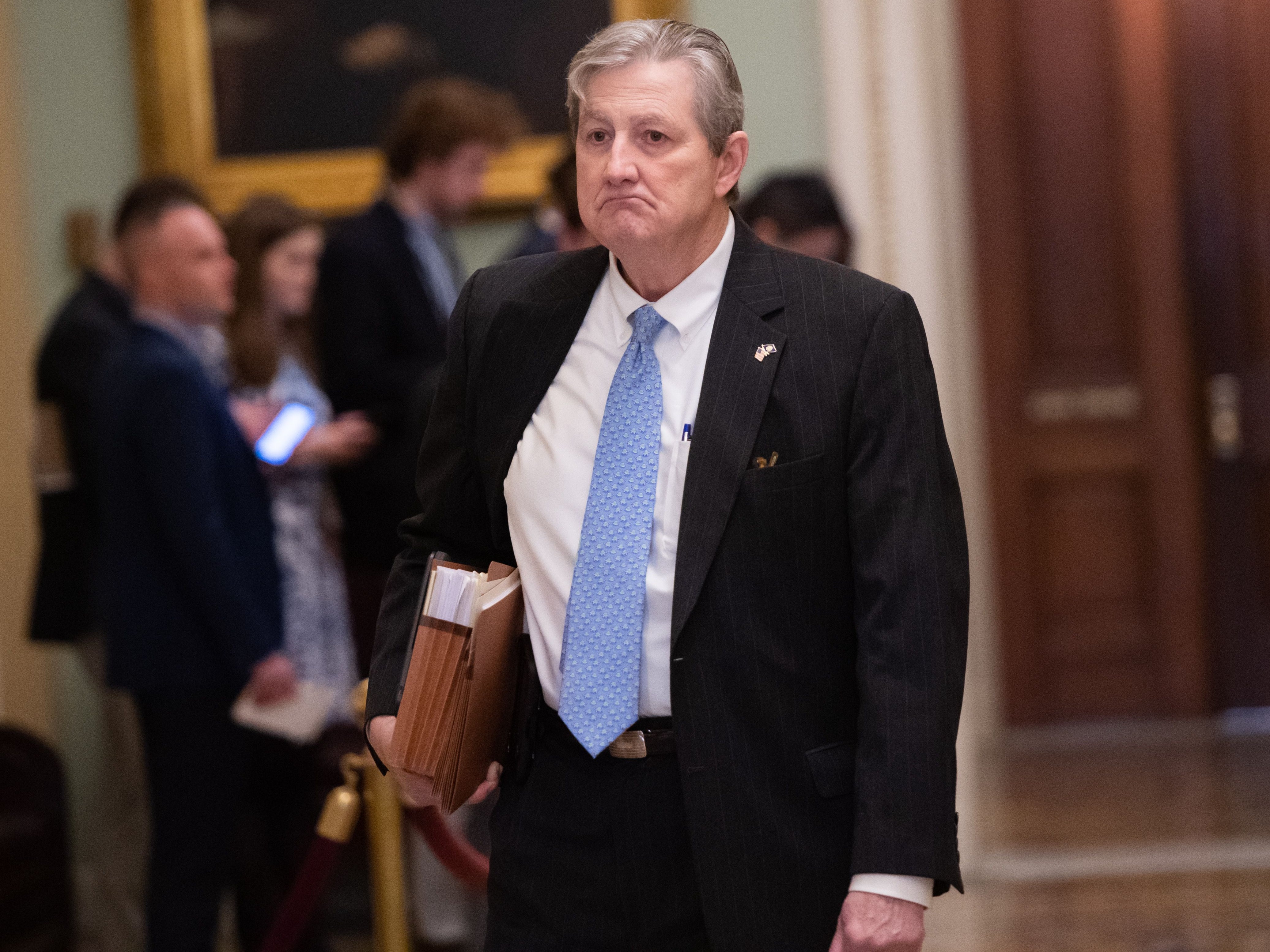
Kennedy asked Ocasio-Cortez to identify which numbers represented money Congress had actually authorized.
She examined the display.
“These categories cannot be treated as interchangeable,” she answered.
Kennedy agreed.
Then he highlighted a widely circulated estimate associated with sweeping climate and economic proposals.
He asked whether the figure represented official federal spending or an outside projection based on assumptions.
Ocasio-Cortez challenged the estimate’s methodology.
She argued that some calculations combined unrelated programs and failed to account for economic benefits.
Kennedy responded that the same scrutiny should apply to savings projections promoted by supporters.
The disagreement became more precise.
Neither participant could simply identify an enormous dollar figure and claim it proved a policy’s success or failure.
The underlying assumptions mattered.
And the next document demonstrated why.
Kennedy Opens the Green New Deal File
Kennedy turned to a folder labeled Green New Deal.
The Green New Deal was introduced in Congress in 2019 as a resolution outlining broad environmental and economic objectives.
Ocasio-Cortez was among its principal congressional sponsors.
The proposal called for ambitious efforts to address climate change while promoting employment, infrastructure investment, and economic security.
But the resolution was not itself a detailed federal spending law.
It did not authorize every program associated with its broader policy vision.
That distinction became the first significant revelation.
Kennedy displayed several cost estimates that had circulated in political debate.
The estimates differed substantially because analysts used different assumptions about government participation, technology costs, and program design.
Ocasio-Cortez immediately challenged their comparability.
“You cannot price an entire economic transformation without defining the legislation you are actually evaluating,” she argued.
Kennedy replied that voters still deserved realistic estimates before supporting major commitments.
He introduced three questions.
Which programs would the government finance?
What taxes or borrowing would support those programs?
And which projected benefits could be measured reliably?
Ocasio-Cortez argued that climate policy also involved costs associated with inaction.
Extreme weather, infrastructure damage, public health effects, and economic disruption could impose substantial burdens.
Kennedy acknowledged that those costs belonged in a comprehensive analysis.
But he challenged whether projected benefits justified every proposed spending mechanism.
The argument had moved beyond partisan slogans.
The financial document exposed a problem common to major policy debates.
A resolution expressing broad goals cannot be evaluated as though every possible implementation has already become law.
And a policy’s projected benefits cannot be assumed without examining the evidence supporting them.
Kennedy closed the Green New Deal folder.
Then he opened another document with a more immediate financial question.
The Spending Records Reveal an Important Distinction
The second folder contained a comparison of appropriated funds, obligated funds, and money actually spent.
Kennedy argued that public discussion frequently confused these categories.
Congress might authorize a program without immediately spending every dollar associated with it.
Federal agencies could subsequently obligate funds through grants, contracts, or other commitments.
Actual expenditures could occur over a longer period.
Those distinctions were central to evaluating federal programs.
Kennedy highlighted an illustrative clean-energy investment program.
The example involved $20 billion in authorized funding, with only part of that amount obligated or spent during the initial reporting period.
He asked Ocasio-Cortez whether a delayed expenditure necessarily demonstrated program failure.
She answered that implementation schedules could depend on construction timelines, application reviews, and contractual requirements.
Kennedy agreed that timing alone did not establish failure.
Then he introduced a performance question.
What measurable outcomes should taxpayers expect before additional funding became available?
Ocasio-Cortez suggested employment, energy production, emissions reductions, and infrastructure completion as possible measures.
Kennedy added independent auditing and public reporting.
Their positions briefly converged on the importance of measurable results.
But the disagreement returned when Kennedy asked what consequences should follow if a program repeatedly missed its targets.
Ocasio-Cortez argued that problems could justify changes in administration, implementation, or funding.
Kennedy pressed further.
“Would you support reducing funding if independent evidence showed the program consistently failed?”
She responded that decisions should consider whether failures reflected flawed design or obstacles that could be corrected.
Kennedy challenged whether political support sometimes made lawmakers reluctant to acknowledge unsuccessful programs.
The question created a meaningful obstacle for the congresswoman.
She could defend ambitious government investment while still accepting that individual programs required scrutiny.
But she also insisted that failure in one initiative did not invalidate every policy pursuing similar goals.
The distinction was important.
Government accountability requires evaluating specific programs rather than assuming that all spending within a political category produces identical outcomes.
The next document brought Hegseth into the discussion.
Hegseth Introduces the Defense Spending Comparison
Pete Hegseth, an Army National Guard veteran, reviewed a separate financial summary concerning military procurement and federal contracting.
Kennedy, whose background is in law and public finance rather than military service, directed the next question toward him.
The document compared several types of government contracts.
Some involved fixed prices.
Others included provisions allowing costs to change under specified circumstances.
The example illustrated how large federal programs could experience delays, increased expenses, and disputes over performance.
Hegseth argued that military procurement offered lessons about the importance of clearly defined requirements and oversight.
He emphasized that ineffective spending could reduce operational readiness without necessarily improving outcomes.
Ocasio-Cortez challenged him to apply the same standards to defense spending that conservatives demanded from social and environmental programs.
Hegseth agreed that military contracts should receive serious financial scrutiny.
But he questioned whether all government programs could be evaluated using identical performance measures.
Kennedy returned to the comparison.
He argued that independent audits should examine the results of major federal expenditures regardless of which political coalition supported them.
Ocasio-Cortez pushed the argument further.
“Then accountability cannot become a weapon used only against programs your party opposes,” she said.
Kennedy replied that poor performance should face examination regardless of political sponsorship.
Hegseth identified a separate concern.
Some projects could meet administrative requirements while failing to achieve their intended practical objectives.
A contract might be legally compliant and still deliver disappointing results.
That observation changed the scope of the debate.
The issue was not simply whether public money had been spent according to the rules.
It was whether the spending produced the outcomes promised.
Kennedy placed the defense comparison beside the clean-energy example.
Both required accurate accounting.
Both required performance measures.
And both could create financial risks when oversight failed.
The room’s central disagreement now concerned how lawmakers should respond when ambitious commitments encountered disappointing results.
The Final Page Changes the Financial Argument
Kennedy returned to his original folder and removed the last document.
It contained a framework distinguishing verified expenditures from disputed forecasts and unsupported allegations.
The first category included spending established through official federal records.
The second contained projections based on economic assumptions.
The third identified questions requiring additional investigation.
Ocasio-Cortez examined the framework.
She pointed out that the available material did not establish that her own proposals had caused the specific losses implied by the original accusation.
Kennedy acknowledged that distinction.
A policy proposal could not create actual federal expenditures until the necessary legal and administrative actions occurred.
Similarly, a broad estimate of potential future costs did not demonstrate that an equivalent amount of public money had already disappeared.
The realization changed the confrontation.
The documents did not establish a hidden financial scandal involving the congresswoman.
They did, however, reveal how easily political arguments could combine hypothetical costs, real expenditures, and future projections into one alarming figure.
Kennedy asked whether Ocasio-Cortez would support requiring standardized financial explanations for major legislative proposals.
She replied that transparent estimates could improve public debate if their assumptions and limitations were disclosed.
Hegseth suggested that the same approach should apply to major procurement programs and federal contracts.
Kennedy then identified the final question.
What should happen when political advertisements present speculative forecasts as confirmed financial losses?
Ocasio-Cortez argued that lawmakers and commentators should distinguish policy estimates from documented spending.
Kennedy maintained that elected officials also had a responsibility to explain the fiscal consequences of their proposals.
The framework required both.
A credible financial claim needed an identifiable source, a transparent method, and an accurate description of what the number represented.
Without those elements, even a dramatic figure could mislead voters.
The final page therefore produced a different result from the accusation that began the confrontation.
It established a standard for evaluating political claims rather than proving that one participant had concealed financial misconduct.
Kennedy’s Demand for an Investigation
Kennedy concluded by proposing a review of how major federal programs reported spending and performance.
His proposal focused on documentation rather than allegations about a particular political opponent.
The review would compare authorized funding, actual expenditures, implementation schedules, and independently measured outcomes.
It would also examine whether public communications accurately distinguished forecasts from completed spending.
Ocasio-Cortez challenged the proposal to apply equally across federal agencies.
She argued that the investigation should not exclude military contracts, tax expenditures, or programs supported by Republican lawmakers.
Hegseth maintained that defense spending should face rigorous oversight while acknowledging the distinct requirements associated with national security.
Kennedy agreed that the review’s credibility would depend on consistent standards.
But he also warned that collecting additional documents would accomplish little without identifying specific failures and recommending corrective action.
Ocasio-Cortez replied that accountability should include evaluating whether programs delivered meaningful benefits to the people they were intended to serve.
The disagreement did not disappear.
Kennedy remained concerned about fiscal discipline and government spending.
Ocasio-Cortez continued defending public investment as a response to major economic and environmental challenges.
Hegseth emphasized financial controls and practical performance.
But the final document had changed what each participant could reasonably claim.
A cost projection was not proof of actual government loss.
An authorized budget was not identical to money already spent.
And a disappointing result did not automatically establish corruption.
Those distinctions limited the accusations that could be supported by the records.
They also identified where further investigation might produce useful answers.
The Consequence Behind the Financial Records
The confrontation ended with Kennedy returning to the question that had opened the debate.
How should Americans determine whether ambitious government programs are worth their cost?
He argued that public officials must explain what taxpayers are financing and what results they expect.
Ocasio-Cortez maintained that the analysis must also consider the economic and social costs of leaving existing problems unresolved.
Hegseth emphasized that financial oversight should connect appropriations to measurable performance.
The positions remained different.
But the documents had established boundaries that political rhetoric could not erase.
There was no verified evidence in the presentation that Ocasio-Cortez had personally hidden financial records.
The illustrative spending comparisons did not demonstrate that she had caused catastrophic federal losses.
Nor did they establish grounds for a criminal investigation against her.
What they revealed was a broader accountability problem.
Major policy debates often depend on estimates that voters cannot easily compare.
Some figures represent proposed spending.
Others represent legal appropriations, projected economic effects, or actual expenditures.
When those categories are confused, even an accurate number can create a misleading impression.
Kennedy’s proposed review offered one possible response.
It would require lawmakers to explain funding sources, implementation timelines, and performance measures.
Ocasio-Cortez’s challenge added another requirement.
Those standards should apply consistently rather than being used selectively against political opponents.
Hegseth’s contribution reinforced the importance of examining results across different government functions.
The final consequence was therefore a dispute over enforceable financial transparency, not a personal humiliation.
Kennedy had demanded clearer accounting.
Ocasio-Cortez had challenged the assumptions behind the cost estimates.
And Hegseth had raised additional questions about government contracting and performance.
The financial records had not produced a confession or established a concealed scandal.
They had forced the participants to distinguish documented facts from projections and political interpretation.
That distinction mattered far beyond one confrontation.
Americans regularly encounter enormous dollar figures attached to health care, energy, defense, infrastructure, and taxation.
Those figures influence political judgments even when their underlying assumptions remain unclear.
The central question is whether voters receive enough information to evaluate them accurately.
A credible financial debate requires more than a large number displayed on a television screen.
It requires evidence showing where the number came from, what it measures, and which conclusions it can legitimately support.
The ultimate test is not whether a politician can produce the largest financial figure, but whether the evidence proves what that politician claims.
And that standard applies to every party, every major spending proposal, and every official entrusted with public money.
