
“NATIONAL SECURITY IS NOT YOUR GET-OUT-OF-JAIL CARD!” Sheldon Whitehou.s.e Corners Kash Pat.e.l in Explosive Senate Showdown Over FBI Political Allegations
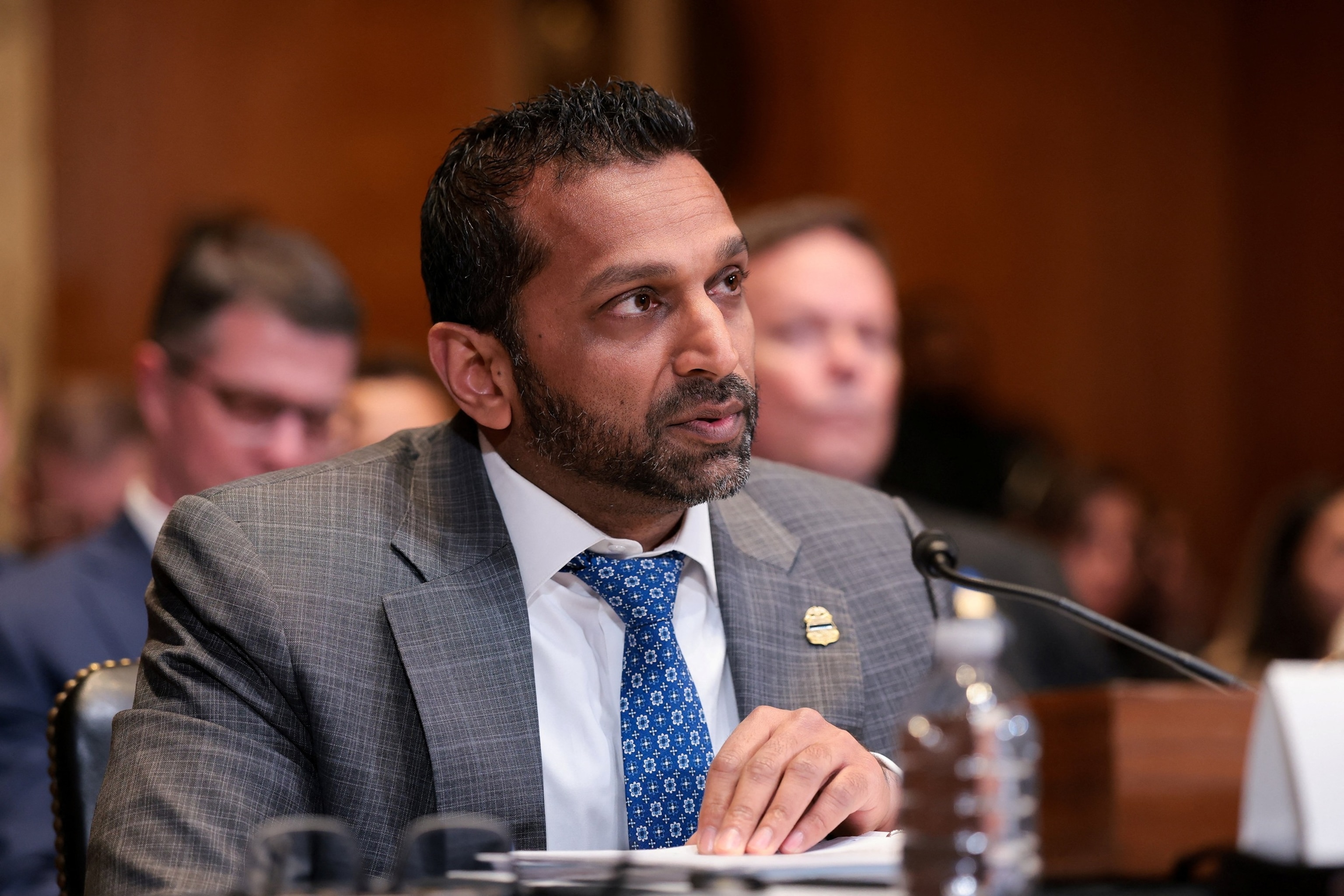
The Senate hearing room was already tense when Senator Sheldon Whitehou.s.e turned toward FBI Director Kash Pat.e.l, preparing to challenge him over allegations of political influence, questionable personnel decisions, and the growing controversy surrounding the bureau’s independence.
Pat.e.l sat confidently before the committee, surrounded by documents and prepared remarks, while senators waited for answers about the direction of America’s most powerful federal law enforcement agency.
Whitehou.s.e, however, appeared uninterested in another presentation about arrests, terrorism prevention, or the administration’s promises to restore public confidence.
He wanted something much more specific.
He wanted explanations.
“Director Pat.e.l, I want to discuss something that seems to disappear every time you talk about national security,” Whitehou.s.e began, looking directly at the FBI director.
Pat.e.l adjusted his microphone.
“Senator, if you’re referring to the FBI’s operations, I can assure you that protecting the American people remains our highest priority.”
Whitehou.s.e immediately interrupted.
“That’s a wonderful sentence, Director. But it doesn’t answer my question.”
A few senators turned toward the exchange.
Whitehou.s.e continued, carefully emphasizing every word.
“National security is not a magic phrase that allows you to avoid accountability. You don’t get to invoke terrorism every time Congress asks how your agency is operating.”
Pat.e.l responded firmly.
“Senator, the FBI deals with threats that most Americans never see. We have responsibilities that cannot always be discussed publicly.”
Whitehou.s.e leaned forward.
“And nobody is asking you to disclose classified intelligence. We’re asking whether you’re following the law.”
The confrontation had reached its central question.
Could Pat.e.l demonstrate that the FBI remained independent while operating under an administration whose political priorities had become a major source of controversy?
Whitehou.s.e intended to make that question impossible to ignore.
THE FIRST CLASH: WHITEHOUSE REFUSES TO ACCEPT GENERAL ANSWERS
“Director Pat.e.l, let’s start with your responsibilities,” Whitehou.s.e continued. “You lead an agency with extraordinary investigative powers. Those powers come with extraordinary obligations.”
Pat.e.l nodded.
“I agree, Senator.”
“Then let’s talk about the people who work inside that agency,” Whitehou.s.e replied.
The senator raised concerns about personnel decisions and the treatment of FBI employees whose names had appeared in political controversies.
He returned to Pat.e.l’s previous book, Government Gangsters, which had included a glossary identifying individuals Pat.e.l criticized as part of what he described as a corrupt government establishment.
Whitehou.s.e wanted to examine whether people associated with that list had subsequently experienced adverse employment decisions.
“Director, you published a list of individuals you considered part of a corrupt government system. Now you’re responsible for the FBI. How should Americans know that those personal political judgments aren’t influencing your decisions?”
Pat.e.l rejected the suggestion.
“Senator, I do not operate an enemies list. The FBI makes decisions based on performance, qualifications, and the requirements of the institution.”
Whitehou.s.e immediately pressed him.
“Then explain the decisions. Don’t just tell us that everything is professional.”
Pat.e.l responded that personnel matters had to be evaluated individually and within the appropriate legal framework.
Whitehou.s.e was not satisfied.
“That’s exactly what I keep hearing. Every answer is another explanation about why we cannot get a straightforward explanation.”
Pat.e.l leaned toward his microphone.
“Senator, I reject the premise that the FBI is targeting people for political reasons.”
Whitehou.s.e answered:
“Rejecting an allegation is not the same thing as answering the evidence.”
The exchange illustrated the growing disagreement between the two men.
Pat.e.l maintained that his decisions were based on professional standards.
Whitehou.s.e wanted evidence demonstrating that political considerations played no role.
Neither was prepared to retreat.
THE SECOND CLASH: PATEL BRINGS OUT THE NATIONAL SECURITY ARGUMENT
Pat.e.l attempted to redirect the conversation toward the FBI’s operational achievements.
He emphasized the bureau’s responsibilities in combating terrorism, violent crime, foreign intelligence operations, cybercrime, and organized criminal networks.
His argument was straightforward.
The FBI was confronting serious threats, and its leadership should be evaluated partly through the results delivered by its investigators.
But Whitehou.s.e wanted to separate operational achievements from questions about political independence.
“Director Pat.e.l, nobody is questioning whether terrorism exists,” the senator replied. “Nobody is questioning whether the FBI should investigate dangerous criminals.”
Pat.e.l responded:
“Then I would hope you recognize the importance of giving our agents the resources and authority they need.”
Whitehou.s.e immediately countered.
“Resources and authority are not the same thing as unlimited political discretion.”
Pat.e.l maintained that the bureau operated under legal restrictions and oversight requirements.
Whitehou.s.e continued.
“Then demonstrate that those restrictions are being respected.”
Pat.e.l replied that the FBI was doing precisely that.
But Whitehou.s.e returned to his original concern.
“Every time we ask about politically sensitive decisions, you return to terrorism statistics. Those statistics may describe enforcement activity, but they don’t answer questions about political interference.”
The distinction was crucial.
An agency could report arrests, disrupted criminal networks, and successful investigations while still facing legitimate questions about management, transparency, and institutional independence.
One issue did not automatically resolve the other.
Pat.e.l’s supporters could reasonably point to law enforcement results as evidence of the bureau’s operational activity.
But Whitehou.s.e was demanding something different: proof that the FBI’s investigative powers were not being influenced by partisan considerations.
THE THIRD CLASH: WHO IS CONTROLLING THE FBI’S PUBLIC MESSAGE?
Whitehou.s.e then turned toward another sensitive subject: the relationship between government communications and political messaging.
He had long criticized what he described as the influence of wealthy donors, political networks, and outside organizations over federal policy.
Now he wanted to examine whether the FBI’s public image was being shaped by partisan considerations.
“Director Pat.e.l, the FBI is supposed to be an independent law enforcement institution. It is not a political campaign operation.”
Pat.e.l responded:
“The FBI has a responsibility to communicate with the American people about its work. Transparency is important.”
Whitehou.s.e immediately challenged him.
“Transparency? Then why should Americans have to question whether official communications are designed to inform them or advance a political narrative?”
Pat.e.l rejected the implication.
“Our communications are intended to explain the bureau’s work and protect public safety.”
Whitehou.s.e continued.
“Then explain the role of outside public-relations interests in this environment. Who is shaping the message, and who is ultimately accountable?”
Pat.e.l insisted that the FBI’s communications responsibilities were legitimate government functions.
But Whitehou.s.e’s broader argument concerned the boundary between public information and political promotion.
A federal agency cannot simply rely on its own publicity to establish public confidence.
Its credibility depends on independent oversight, accurate reporting, and the ability to answer uncomfortable questions.
The senator’s challenge was that the FBI should not become another institution where political messaging replaces transparency.
The controversy became even more complicated because the specific allegation about a partisan PR firm had not been established through a verified hearing transcript.
Nevertheless, the underlying issue remained significant.
Who controls the public narrative surrounding federal law enforcement?
And what safeguards prevent official government communications from becoming political propaganda?
THE FOURTH CLASH: WHITEHOUSE BRINGS THE QUESTIONS BACK TO PATEL
The senator then returned to the issue he appeared most determined to pursue.
Congressional oversight.
Whitehou.s.e had previously criticized the Justice Department and FBI leadership over unanswered questions involving sensitive investigations and the handling of information requested by lawmakers.
He wanted to know why congressional inquiries could remain unresolved despite repeated requests.
“Director Pat.e.l, when Congress asks legitimate questions about the FBI, who decides whether those questions deserve answers?”
Pat.e.l responded:
“The FBI must evaluate every request according to the law, investigative requirements, and national security obligations.”
Whitehou.s.e shook his head.
“That’s not an answer to what I asked.”
Pat.e.l continued.
“Senator, there are circumstances where information cannot be disclosed without compromising ongoing investigations.”
Whitehou.s.e immediately replied.
“And there are circumstances where refusing to answer legitimate questions damages public confidence.”
Pat.e.l maintained that the bureau had to balance transparency with its operational responsibilities.
Whitehou.s.e leaned forward.
“Then explain where that balance is being applied. Show us the documentation.”
Pat.e.l responded that the agency would follow the appropriate procedures.
Whitehou.s.e was not finished.
“Americans cannot evaluate an institution if the institution refuses to explain its decisions.”
The senator’s argument was becoming increasingly clear.
He was not demanding that the FBI publish confidential intelligence files or expose undercover operations.
He was demanding accountability for decisions that could be examined without compromising legitimate investigations.
That distinction became the foundation of the confrontation.
THE FINAL QUESTION: CAN PATEL SAY NO TO POLITICAL PRESSURE?
As the questioning approached its conclusion, Whitehou.s.e returned to the fundamental issue behind every previous exchange.
The FBI director’s independence.
The senator looked directly at Pat.e.l.
“Director, I want to ask you something that should have a very simple answer.”
Pat.e.l waited.
“If a powerful political figure demands that the FBI investigate an opponent without legitimate legal justification, what happens?”
Pat.e.l responded that the FBI investigates matters according to the law and the available evidence.
Whitehou.s.e continued.
“And if that demand comes from someone inside the administration?”
Pat.e.l maintained that the bureau’s investigative responsibilities did not change according to political pressure.
Whitehou.s.e pressed further.
“And if refusing that demand creates a political problem for you personally?”
Pat.e.l reiterated his commitment to carrying out the FBI’s responsibilities.
Whitehou.s.e paused before delivering the central challenge.
“Then your independence will be measured by what you do when saying no becomes uncomfortable.”
The exchange captured the deeper conflict surrounding Pat.e.l’s leadership.
A promise of independence is easy to make in a Senate hearing.
Demonstrating that independence when powerful political interests are involved is considerably harder.
Pat.e.l had defended his record and the FBI’s operational priorities.
Whitehou.s.e had demanded evidence that the bureau’s extraordinary powers were being exercised without partisan interference.
The two positions remained fundamentally opposed.
WASHINGTON’S UNFINISHED CONFRONTATION
The disagreement between Whitehou.s.e and Pat.e.l was never simply about statistics or political speeches.
It was about the future credibility of federal law enforcement.
Pat.e.l’s defenders argue that the FBI needs strong leadership, operational flexibility, and the ability to confront threats without political interference from Congress.
His critics argue that those same extraordinary powers require stronger safeguards, transparent personnel decisions, and meaningful congressional oversight.
Both sides invoke the importance of protecting the American people.
But they disagree over what institutional independence should look like in practice.
Whitehou.s.e wants documentation.
Pat.e.l wants his leadership evaluated within the realities of running a national law enforcement agency.
And the public is left with questions that cannot be answered by either political speeches or impressive statistics alone.
How are controversial personnel decisions being made?
How does the bureau protect itself against political interference?
What information can Congress legitimately demand?
And who ensures that national security is never used to avoid accountability?
Those questions will continue following Pat.e.l long after the cameras leave the hearing room.
Because the next controversial investigation could place the FBI director in precisely the situation Whitehou.s.e described.
A politically powerful figure could demand action.
Congress could demand explanations.
And Pat.e.l could once again face the difficult choice between defending the administration’s position and demonstrating the bureau’s independence.
That is the confrontation Washington has not yet finished having.
And the next time Sheldon Whitehou.s.e sits across from Kash Pat.e.l, the most uncomfortable question may not concern what the FBI has already done.
It may concern what the director is prepared to do when the next political demand arrives.
