
Nancy Mace and the $240 Billion Fraud Claim: The Senate Proposal Behind a Viral Political Story
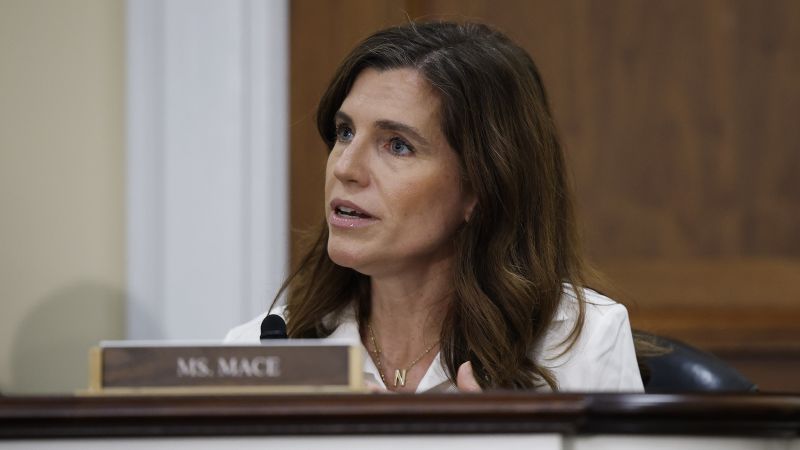
A dramatic political story is circulating online, claiming that Representative Nancy Mace confronted House leaders, demanded an immediate vote to eliminate $240 billion in government fraud, and exposed powerful figures during a tense confrontation just before lawmakers left for the holidays. The account promises an extraordinary scene inside Congress. But the public record points to a different story — one involving a Senate anti-fraud proposal, a separate House investigation, and a dollar figure that has been attached to the wrong lawmaker.
The $240 billion figure is real, but it is not tied to an emergency vote demanded by Mace. It comes from the Protecting American Taxpayers Act, a legislative package led by Republican Senator Joni Ernst of Iowa. Ernst introduced the proposal in April 2026, describing it as a comprehensive effort to prevent fraud in federal programs, recover stolen funds, and strengthen oversight of taxpayer money. The legislation was projected to save approximately $240 billion if enacted. That figure represents an estimate of potential savings, not money already recovered or an immediate reduction in government spending.

Senator Roger Marshall of Kansas also publicly promoted the proposal, delivering a Senate floor speech on July 23 in support of the legislation. Marshall repeated the projected $240 billion savings estimate and outlined provisions intended to prevent fraudulent payments, recover public funds, and give authorities additional tools to pursue suspected offenders. His remarks provide another clear connection between the figure and the Senate campaign — but not to a confrontation led by Nancy Mace in the House.
The proposal subsequently faced a political obstacle of its own. On September 30, Ernst announced that Senate Democrats had blocked an effort to advance the anti-fraud package. She argued that Congress should act before lawmakers left Washington, emphasizing the potential savings and the scale of alleged losses to federal programs. The dispute was real, and it involved a high-profile legislative effort. However, the documented confrontation took place in the Senate and centered on Ernst’s proposal, not an unscripted House vote initiated by Mace.
Nancy Mace has, separately, been involved in congressional scrutiny of alleged government fraud. As a member of the House Oversight Committee, she has publicly pressed questions surrounding fraud investigations in Minnesota and criticized Democratic lawmakers during committee proceedings. In remarks published by her congressional office, Mace argued that the scale of alleged fraud deserved greater scrutiny and called for accountability. Those comments help explain why her name may appear in stories about government fraud, but they do not establish that she introduced or demanded a vote on the Senate’s $240 billion package.
The distinction matters because the two developments belong to different legislative processes. Mace’s work took place in the House, where committee members can question witnesses, seek records, and pursue investigations. Ernst’s Protecting American Taxpayers Act was a Senate initiative, developed with Republican colleagues and designed to change how federal agencies prevent, detect, and respond to fraud. The two efforts address overlapping concerns, but they are not the same event.
The Senate proposal itself contains several policy ideas. According to its sponsors, the package would limit certain payments made before services are delivered, trigger investigations when suspicious payment patterns emerge, restrict convicted fraudsters from receiving federal funds, and improve the government’s ability to recover money lost through fraudulent schemes. It also includes measures addressing pandemic-era funds, veterans’ scams, and emerging forms of technology-enabled fraud. These are legislative proposals, not proof that every suspected loss has been established or that the projected savings will necessarily materialize.
That qualification is particularly important when discussing large government-fraud estimates. A September 27 report by Linda Qiu of The New York Times, republished by The Philadelphia Inquirer, examined the Trump administration’s claims about identifying hundreds of billions of dollars in fraud. The analysis found that some figures lacked sufficient public documentation, while others included funding temporarily withheld, older investigations, or cases whose outcomes had not yet produced recovered money. The report also noted that the Government Accountability Office has estimated annual federal fraud losses in a broad range of $233 billion to $521 billion. That estimate describes a potential nationwide scale of losses; it should not be confused with a verified amount recovered by a particular politician or legislative package.
The House has also taken up fraud-related measures independently. On June 11, 2026, members approved House Resolution 1335, a measure condemning actors seeking to defraud the federal government and expressing support for stronger prevention of fraud and improper payments. The measure passed 235–177. The official roll-call record lists Mace among those who did not vote. This was a recorded House vote on a resolution, not the dramatic last-minute vote described in the viral caption.
Taken together, the records show that government fraud has become a significant subject of congressional debate, with lawmakers pursuing different approaches in both chambers. Mace has participated in House oversight activity. Ernst has led a Senate legislative campaign built around a projected $240 billion in savings. Marshall has publicly defended that proposal, and Senate Democrats blocked an effort to advance it in September.

What the available evidence does not show is the central scene promised by the viral post: Mace slamming a folder onto a House desk, demanding an immediate vote to cut $240 billion, reading out a list of powerful names, or leaving party leaders visibly panicked. No authenticated footage or official record identified in the available sources establishes that sequence of events.
The underlying policy debate is substantial enough without adding an unsupported confrontation. The central questions remain whether federal agencies can detect suspicious payments earlier, how much money can realistically be recovered, what safeguards should protect legitimate beneficiaries, and how Congress can measure results transparently. Those questions deserve scrutiny from both parties — and answers grounded in legislation, documented investigations, and verifiable financial figures rather than a dramatic scene that the public record does not substantiate.
