
Kamala Harris and John Kennedy: The Viral “Sit Down, Boy” Confrontation That Has No Verified Evidence
A dramatic political confrontation involving former Vice President Kamala Harris and Republican Senator John Kennedy has been circulating online, with claims of an explosive exchange at a bipartisan leadership forum in Phoenix. The story describes a heated insult, an extended silence and an unexpected gesture involving a pocket Constitution. But despite its cinematic details, the alleged confrontation has not been substantiated by credible reporting.
According to the viral account, Harris interrupted Kennedy during a discussion about leadership and national unity, telling him to sit down and referring to him as “boy.” The senator supposedly responded without raising his voice, allowing several seconds of silence before delivering a carefully worded statement about respect, public service and political disagreement.
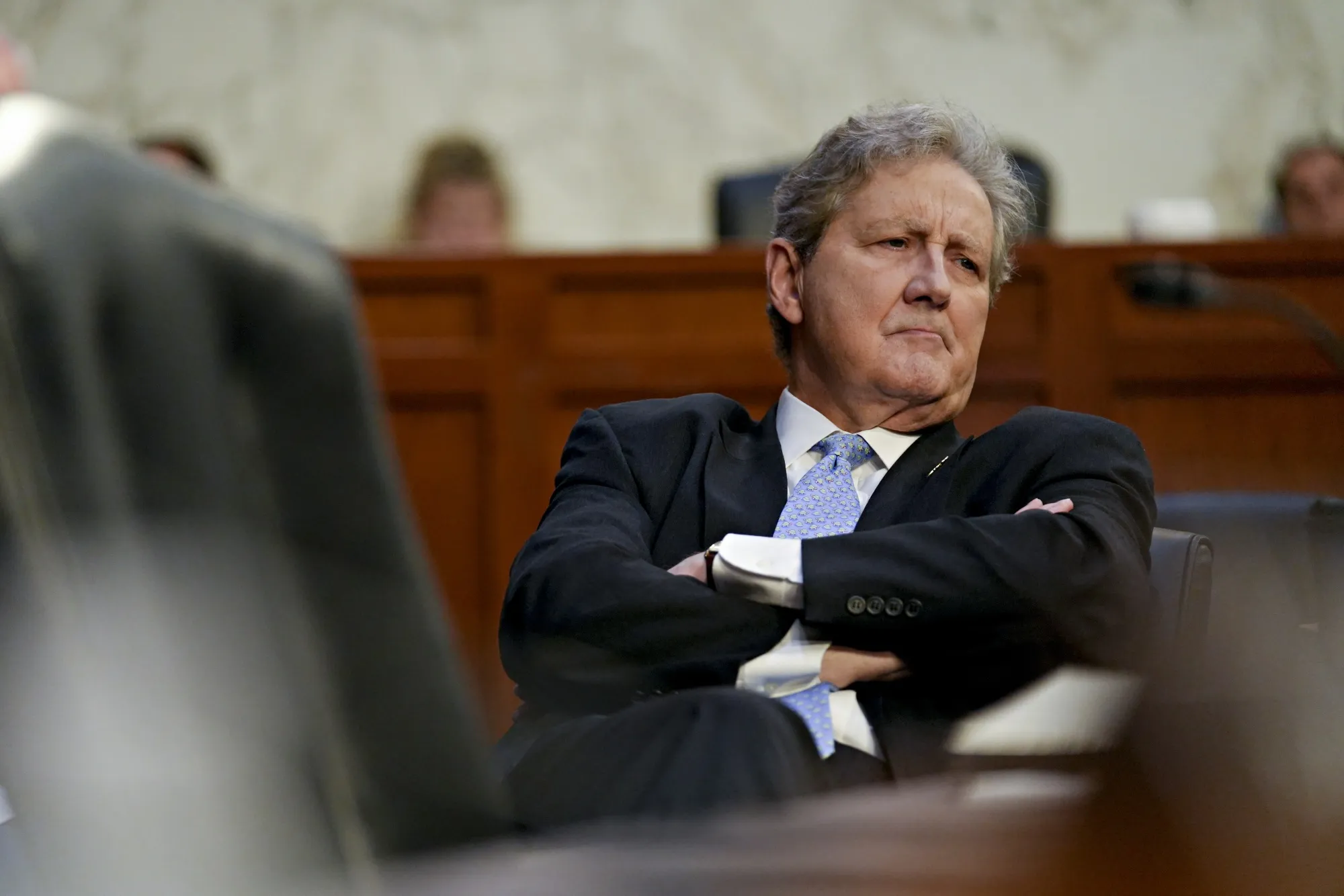
The narrative then introduces an even more theatrical moment. Kennedy allegedly leaves his chair, approaches Harris’s podium and places a worn copy of the United States Constitution beside her microphone. He is said to whisper five words before walking away as the audience rises in applause.
It is an effective story structure: a public insult, a composed response, a symbolic gesture and a dramatic ending. Yet the essential elements remain unverified. No reliable event record, authenticated video, transcript or independent news report has established that the Phoenix forum took place as described or that either politician participated in such an exchange.
That absence is particularly significant because both figures have extensive public profiles. Kamala Harris served as vice president from 2021 to 2025 and remains an influential figure in Democratic politics. John Kennedy, a Republican senator from Louisiana, is known for his distinctive speaking style and frequent participation in high-profile congressional debates. A confrontation of the scale described in the viral post would ordinarily generate a substantial documentary trail.
Harris has continued to appear at political events following the 2024 presidential election. During the 2026 midterm campaign, she traveled to support Democratic candidates in several states and participated in events focused on issues including affordability, reproductive rights and voter participation. Her public schedule and campaign appearances have attracted national coverage, particularly as speculation about her political future continues.
Kennedy has likewise remained active in the Senate, where he regularly questions government officials and comments on legislation, spending and national policy. His sharp delivery has made him a familiar figure in political clips shared across social media.
Those recognizable public personas help explain why the fictional confrontation may attract attention. The story assigns each politician a role that audiences can immediately understand: Harris as the person delivering the initial challenge and Kennedy as the senator who responds through silence and a symbolic appeal to the Constitution.
The pocket Constitution is especially important to the narrative. In American political culture, the document represents the country’s founding principles, constitutional limits and the relationship between government authority and individual rights. Placing it on a podium during a heated disagreement would carry a powerful symbolic meaning.
But symbolism cannot establish that an event occurred. Without authenticated footage or a credible account from people who attended the supposed forum, the gesture and the alleged whispered remark should not be treated as historical facts.
The same caution applies to the quotation attributed to Harris. Political figures are frequently assigned provocative statements in fabricated videos and recycled social media posts. A quotation becomes more convincing when it is attached to a recognizable name and placed inside a detailed scene, but specificity is not the same as verification.
There is a broader reason these stories spread. Short political narratives are designed to deliver an emotional payoff quickly. They often present a confrontation as though it were a defining moment in a larger struggle over national identity, respect or constitutional values. Viewers are encouraged to react before checking whether the event can be independently confirmed.

The structure also creates a false sense of immediacy. References to cameras, stunned audiences, hot microphones and supposedly hidden final words suggest that an authentic recording exists somewhere. A promise that footage is about to disappear can create additional pressure to share the post before examining its source.
For readers, the most useful questions are straightforward. Where and when did the event occur? Which organization hosted the forum? Are there independent recordings from the venue? Did established news organizations report the exchange? Can the full remarks be compared with an official transcript?
Those questions are not obstacles to political discussion. They are basic standards that allow public debate to remain grounded in evidence.
The United States has a long tradition of intense political disagreement, and exchanges between lawmakers and former national leaders can become significant moments in public life. Harris and Kennedy represent different political perspectives and have distinct approaches to communicating with voters. Their documented statements and policy positions provide more than enough material for serious discussion without inventing a confrontation.

For now, the alleged “Sit Down, Boy” exchange, the pocket Constitution gesture and the five whispered words remain unsupported by verifiable evidence. The story may be presented as an unforgettable political showdown, but its dramatic conclusion should not be confused with a documented event.
In an era when political clips can spread across millions of screens within hours, the distinction between a real confrontation and an invented one is essential. The most important question is not what Kennedy supposedly whispered to Harris, but why an unverified story can look so convincing when it is presented with the language and imagery of breaking news.
