
Senators John Kennedy and Sheldon Whitehouse have become familiar voices in some of Washington’s most contentious debates, often approaching questions of judicial accountability, campaign finance, and constitutional authority from sharply different political perspectives.
The Louisiana Republican is known for direct questioning and memorable courtroom-style exchanges, while the Rhode Island Democrat frequently builds detailed arguments about undisclosed political spending and the influence of wealthy interests.
Their contrasting approaches have inspired a dramatic online narrative claiming Whitehouse delivered a devastating five-word rebuke that left Kennedy speechless during a televised Senate confrontation.
The story describes an abrupt broadcast interruption, a stunned committee room, and supposedly leaked footage revealing a political exchange too explosive for ordinary television coverage.
But no authenticated Senate transcript or reliable recording establishes that the alleged confrontation occurred, that Kennedy was unable to respond, or that a broadcast was deliberately interrupted.
The actual relationship between the two senators is more complicated, revealing moments of disagreement, occasional cooperation, and even a remarkable incident in which Whitehouse helped publicize Kennedy’s questioning.
Their documented record offers a revealing examination of how senators from opposing parties can differ over judicial policy while sometimes supporting the same principles of government accountability.
One of their most significant connections occurred in December 2017, when Kennedy challenged a judicial nominee selected by President Donald Trump during a Senate Judiciary Committee hearing.
The nominee, Matthew Spencer Petersen, was being considered for a federal district court position despite having limited experience in courtroom litigation.
Kennedy questioned Petersen about his professional background before asking several questions concerning legal procedures routinely encountered in federal trials.
Petersen acknowledged that he had never tried a case to verdict and struggled to explain legal concepts related to courtroom evidence and procedural motions.
The exchange quickly attracted attention because Kennedy was a Republican questioning the qualifications of a nominee selected by a president from his own party.
Rather than defending the administration’s choice, Kennedy focused on whether Petersen possessed the practical knowledge necessary to serve as a federal judge.
Whitehouse then helped bring the questioning to a national audience by sharing video of the hearing through his social media account.
His post highlighted Kennedy’s questions and Petersen’s difficulty answering them, drawing attention to concerns about the nominee’s preparation for judicial service.
The footage spread widely, attracting millions of views and generating substantial national reporting about the administration’s process for selecting federal judges.
Within days, Petersen withdrew his nomination, ending an appointment that had become controversial because of the televised questioning.
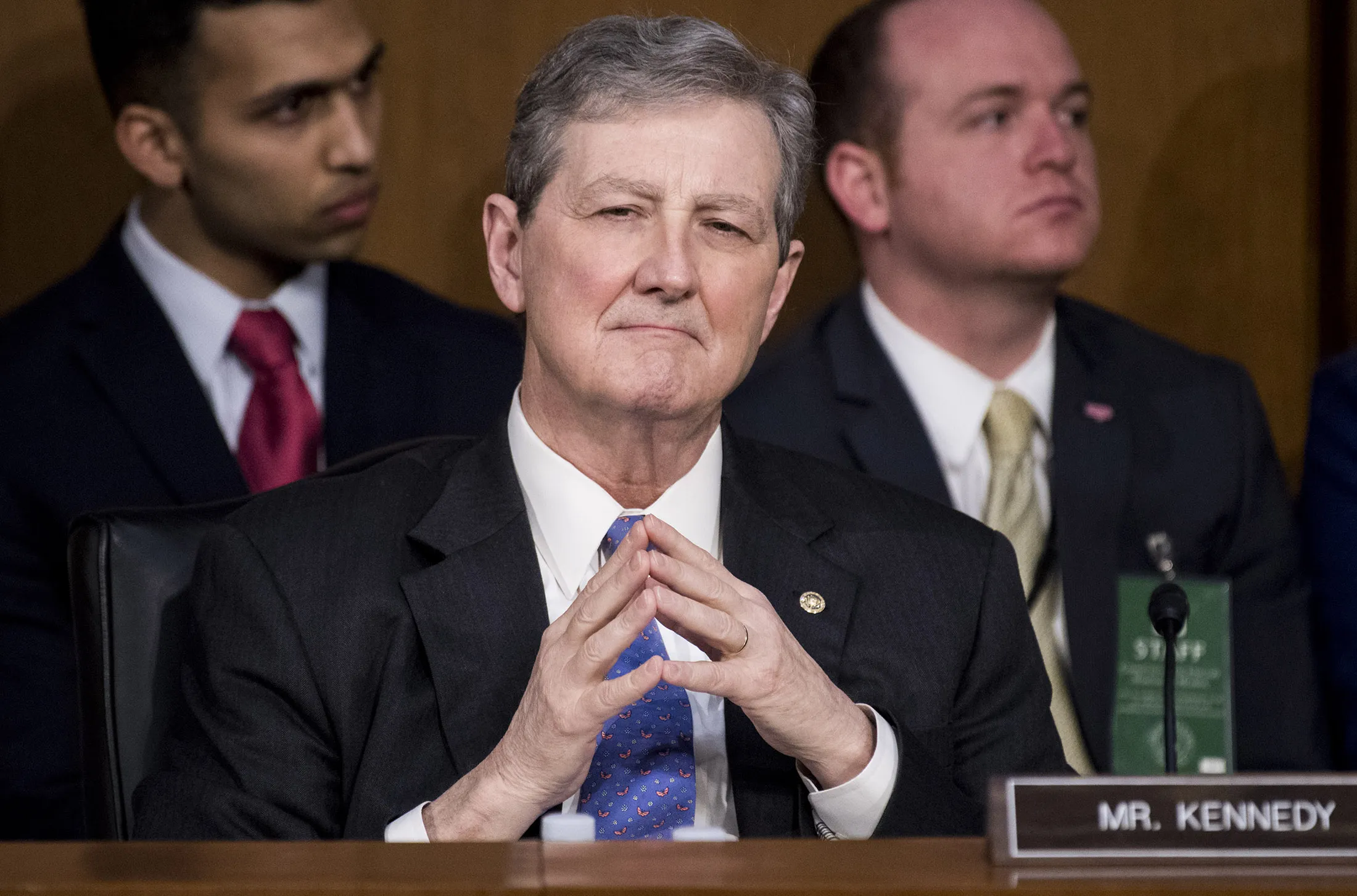
The incident demonstrated that Kennedy and Whitehouse were not always political adversaries, even when their respective parties disagreed over judicial appointments.
Kennedy later explained that he regarded evaluating nominees as a responsibility extending beyond ordinary partisan loyalty, emphasizing the importance of appropriate professional qualifications.
Whitehouse’s decision to share the video reflected a different political interest, but both senators directed attention toward the quality of federal judicial appointments.
That episode offers a striking contrast with claims that Whitehouse’s principal objective was to embarrass Kennedy during a mysterious confrontation.
The actual viral video showed Whitehouse amplifying Kennedy’s scrutiny of a Trump nominee, not attempting to silence the Louisiana senator.
The Washington Post+1
Their documented interactions also include direct conversations during Supreme Court confirmation proceedings, particularly the contentious 2020 nomination of Amy Coney Barrett.
Republicans moved quickly to confirm Barrett after Justice Ruth Bader Ginsburg’s death, while Democrats challenged the timing and accused the majority of applying inconsistent standards.
Whitehouse argued that rushing the confirmation shortly before a presidential election undermined Senate traditions and intensified public concerns about judicial independence.
During an October 22 Judiciary Committee meeting, he briefly acknowledged Kennedy with a humorous observation about the personalities of people from Louisiana.
The comment was part of a broader argument about the Senate’s institutional responsibilities, not an insult intended to publicly humiliate his Republican colleague.
Whitehouse warned that exercising procedural power simply because the majority possessed enough votes could damage traditions that protect both parties over time.
His argument focused on the consequences of establishing precedents that lawmakers might later regret when political control changed.
Republicans defended their authority to proceed with the nomination, maintaining that the Constitution permitted the president and Senate to fill an existing Supreme Court vacancy.
The disagreement revealed competing interpretations of Senate practice, institutional consistency, and the political legitimacy of judicial confirmations near national elections.
It also foreshadowed Whitehouse’s continuing criticism of the relationship between wealthy political donors and organizations involved in federal judicial nominations.
Those concerns have become a defining feature of his work on the Judiciary Committee, particularly through his continuing series of speeches examining judicial influence networks.
Whitehouse argues that major donors can exercise substantial influence through nonprofit organizations, political advertisements, legal advocacy, and judicial confirmation campaigns.
He has criticized arrangements in which the original sources of political funding remain undisclosed, making it difficult to determine whose financial interests may be involved.
Kennedy has approached judicial policy from a different perspective, often emphasizing qualifications, constitutional interpretation, judicial restraint, and the Senate’s duty to examine nominees.
Those differences can produce contentious debates, but they do not establish that either senator participated in the extraordinary confrontation described by the viral narrative.
The contrast is particularly important because the two lawmakers have previously cooperated on legislation addressing financial transparency within the federal judiciary.
In October 2021, Kennedy and Whitehouse joined a bipartisan group introducing the Courthouse Ethics and Transparency Act.
The proposal sought to make judicial financial disclosure reports more accessible and require certain federal judges to report securities transactions within specified periods.
Kennedy argued that judges should face meaningful financial transparency requirements comparable to those imposed on other federal officials.
Whitehouse supported the measure as part of his broader effort to strengthen accountability and public confidence in the judiciary.
Their joint sponsorship demonstrated agreement on a practical reform despite broader disagreements over the Supreme Court and the influence of political organizations.
The legislation addressed concerns that financial holdings or investment transactions could create conflicts when judges hear cases involving businesses or other parties with economic interests.
Those issues affect public trust because judicial independence depends not only on impartial decision-making but also on credible procedures for identifying potential conflicts.
The initiative showed that political disagreement does not necessarily prevent cooperation when lawmakers identify a specific institutional problem requiring legislative action.
Senator Sheldon Whitehouse+1
The debate has since expanded beyond judicial investment disclosures into the larger question of how political spending shapes the American legal system.
Whitehouse has repeatedly argued that organizations supporting judicial nominations and filing briefs in major cases should disclose more information about their financial backers.
His criticism focuses on the possibility that wealthy donors can influence legal outcomes indirectly through organizations whose funding arrangements remain difficult for the public to examine.
Supporters of existing arrangements counter that independent political advocacy enjoys constitutional protection and that disclosure requirements can expose donors to retaliation or harassment.
The disagreement therefore involves competing concerns about transparency, political participation, personal privacy, and the independence of federal courts.
Whitehouse has attempted to demonstrate the scale of the issue through financial records, nonprofit disclosures, and diagrams mapping relationships among advocacy organizations.
Those presentations have become recognizable features of his Senate speeches, particularly those examining the Federalist Society and groups involved in conservative judicial campaigns.
But a chart identifying financial relationships is not automatically evidence that judges accepted improper payments or that particular decisions were purchased.
Establishing unlawful conduct requires examining actual transactions, applicable statutes, and evidence demonstrating that specific legal obligations were violated.
Whitehouse’s broader argument is that Americans should have enough information to evaluate potential conflicts before those questions reach the level of criminal investigation.
Kennedy’s legislative support for judicial financial disclosures demonstrates agreement with at least part of that transparency objective, even though their broader approaches differ.
Their positions illustrate why judicial ethics cannot always be understood through a simple division between politicians who favor disclosure and those who reject accountability.
In January 2026, Whitehouse renewed his criticism of anonymous political spending during a Senate discussion marking the anniversary of the Supreme Court’s Citizens United decision.
He argued that the ruling had allowed wealthy interests to exercise substantially greater influence over American elections through independent expenditures and other political financing mechanisms.
Whitehouse cited research indicating that spending by billionaire donors had increased dramatically since the decision, raising questions about political influence and access.
His remarks also emphasized the enormous financial resources deployed during the 2024 presidential election cycle by a relatively small number of wealthy families.
Those figures formed part of his argument that the political system should provide greater transparency about the sources of money influencing elections.
However, substantial political spending does not automatically demonstrate illegal coordination, bribery, or improper conduct by the officials who benefit from that spending.
The relevant legal distinctions involve whether money was contributed directly to campaigns, spent independently, transferred through organizations, or used in ways prohibited by federal law.
Whitehouse has argued that existing disclosure requirements leave voters unable to trace some of those financial arrangements to their original sources.
Others defend political anonymity as an important protection for individuals and associations supporting unpopular or controversial causes.
The debate remains significant because identifying financial relationships is different from proving misconduct, yet secrecy can complicate efforts to investigate potential conflicts.
That tension has shaped Whitehouse’s continuing campaign for stronger disclosure rules and his criticism of judicial decisions affecting election finance.
On June 30, 2026, he condemned a Supreme Court ruling in NRSC v. FEC concerning restrictions on political party expenditures coordinated with candidates.
Whitehouse argued that the decision weakened an existing protection against the influence of large political contributions and expanded opportunities for wealthy donors.
The Court’s reasoning concerned constitutional protections for political expression and the legal limits imposed on coordinated party spending.
The competing interpretations reflected a longstanding disagreement about how the First Amendment should apply to campaign finance restrictions.
Whitehouse considered the decision another example of the judiciary weakening safeguards against political corruption, while supporters of fewer restrictions emphasized protected political participation.
His statement was a documented criticism of the Court’s approach, not evidence of a newly recorded confrontation with Kennedy.
SENATE January 14,+1
The distinction matters because online political storytelling can combine authentic positions, recognizable personalities, and invented dialogue into an account that appears credible.
Kennedy and Whitehouse genuinely disagree about significant legal questions, but that disagreement does not establish the existence of a specific televised exchange.
A verifiable Senate confrontation would ordinarily be identifiable through a hearing date, committee records, an official transcript, or an authenticated broadcast.
The circulating account does not identify the subject of the supposed hearing, the date of the exchange, or the substance of Whitehouse’s alleged five-word statement.
It also provides no independently authenticated recording establishing that a television broadcast suddenly ended or that previously hidden footage became available.
Without those details, claims about Kennedy becoming motionless, Whitehouse delivering a decisive rebuke, or lawmakers reacting in collective shock remain unverified.
The phrase describing a leaked recording carries particular significance because an authentic video could establish exactly what the senators said and how the exchange unfolded.
But the existence of a dramatic description is not itself evidence that such a recording exists or that the account accurately represents congressional proceedings.
The documented record offers a substantially different picture of two senators whose disagreements coexist with occasional mutual respect and cooperation.
Kennedy has demonstrated a willingness to challenge nominees selected by Republican presidents when he believes their qualifications warrant greater examination.
Whitehouse has demonstrated a willingness to highlight those challenges when they support his arguments about judicial accountability and confirmation standards.
Their 2017 connection illustrates how a Republican senator’s questioning and a Democratic senator’s public response can reinforce scrutiny of the same nominee.
Their 2021 cooperation illustrates how politicians who disagree about judicial philosophy can support legislation requiring greater transparency in financial reporting.
Those examples do not eliminate their disagreements, particularly concerning the Supreme Court’s composition, campaign finance law, and politically influential advocacy organizations.
Instead, they demonstrate why describing their relationship exclusively through personal rivalry would overlook documented examples of overlapping institutional interests.
The approaching change in congressional control also gives these disagreements renewed importance, particularly as lawmakers prepare for more extensive scrutiny of federal institutions.
After the November 2026 midterm elections, Democrats are preparing to assume majorities in both chambers of Congress when the new session begins in January.
That transition could affect committee leadership, the pace of judicial nominations, and the ability of lawmakers to conduct investigations involving the executive branch.
Whitehouse may gain opportunities to pursue judicial ethics proposals through committee procedures that were more difficult to advance under Republican leadership.
Kennedy will retain his responsibilities as a Republican senator, including questioning nominees, examining legislation, and participating in debates over constitutional authority.
The two lawmakers could therefore find themselves on opposing sides of major procedural disputes involving the judiciary and federal oversight.
They could also encounter areas where bipartisan cooperation remains possible, particularly when legislation concerns financial transparency and clearly defined ethical obligations.
The most important question is whether future proposals can address potential conflicts without unnecessarily restricting constitutionally protected political activity.
For advocates of stronger disclosure, the priority is identifying the sources of financial influence and giving voters reliable information about potential conflicts.
For supporters of existing protections, the concern is preventing excessive regulation of independent political advocacy and preserving the right to participate without unnecessary exposure.
Those disagreements are significant, but they require examination of actual legislation and judicial decisions rather than dramatic claims about personal humiliation.
The discussion also raises questions about how senators use televised committee hearings to hold government officials, nominees, and witnesses accountable.
Kennedy’s questioning style often depends on concise inquiries that require witnesses to explain complicated legal concepts in understandable terms.
Whitehouse frequently approaches similar subjects through extended examinations of institutional relationships, statutory language, and the financial structures surrounding government decision-making.
Neither approach guarantees that every argument will be correct, and the effectiveness of either depends on the evidence supporting the claims being made.
A forceful question may expose a weakness in testimony, while a detailed explanation may identify considerations that a brief exchange cannot adequately resolve.
The democratic value of congressional oversight comes from making those arguments available for public examination rather than deciding beforehand which participant should prevail.
That principle is particularly relevant to controversies involving judicial independence, where political criticism must be distinguished from evidence of actual ethical violations.
Judges are expected to decide cases according to the law, but public confidence also depends on transparent procedures for identifying financial interests and potential conflicts.
Political organizations are entitled to advocate positions before courts within applicable rules, but lawmakers may legitimately examine whether existing disclosure requirements are sufficient.
The intersection of those principles explains why Whitehouse’s financial transparency campaign continues attracting attention and disagreement.
It also explains why Kennedy’s support for certain disclosure reforms should be considered alongside his more conservative positions on judicial philosophy and appointments.
As of November 15, 2026, the verified record does not establish the alleged five-word rebuke, the interrupted broadcast, or the supposedly leaked confrontation.
It establishes that Whitehouse has publicly challenged aspects of Republican judicial policy while Kennedy has scrutinized nominees and supported selected judicial transparency legislation.
The 2017 Petersen hearing remains an especially revealing example because the Democratic senator promoted the Republican senator’s questioning rather than attempting to defeat him.
That cooperation did not end their ideological disagreements, but it demonstrated that congressional scrutiny can sometimes cross party boundaries when lawmakers identify shared concerns.
Their subsequent legislative work reinforced the same principle, even as disputes about political donations and judicial appointments continued.
For Americans following debates over the federal judiciary, those documented actions offer more useful information than unverified descriptions of a senator becoming speechless.
The most consequential question is not whether Whitehouse delivered a mysterious sentence that embarrassed Kennedy before television cameras.
It is whether lawmakers can establish transparent, consistent standards that strengthen public confidence in judicial independence while respecting constitutional protections.
Both senators have participated in that debate through different arguments and, at times, shared legislative efforts.
Their actual record reveals something more complex than a televised political takedown: an ongoing disagreement about power, accountability, and the responsibilities of the United States Senate.
