
“GOD DOESN’T LOVE YOU!” AOC and Nancy M.a.c.e Face Explosive Capitol Hill Showdown as an Eleven-Word Comeback Changes Everything
Washington has witnessed countless political confrontations, but few subjects can ignite a congressional argument quite like religion, personal beliefs, and the question of whether elected officials respect the people they represent.
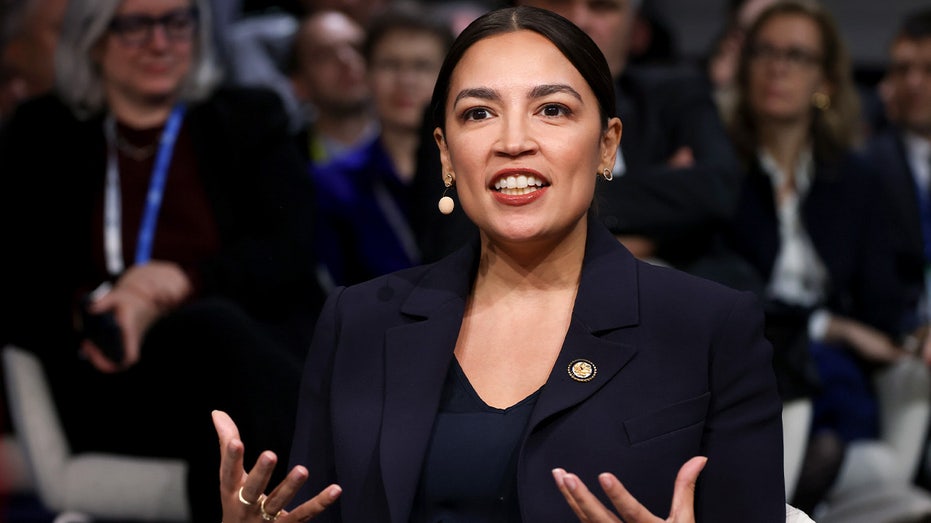
In this fictionalized Capitol Hill confrontation, Democratic Representative Alexandria Ocasio-Cortez and Republican Representative Nancy M.a.c.e find themselves at the center of an increasingly heated exchange.
What begins as a disagreement over political principles quickly becomes a deeply personal argument about faith, respect, and the boundaries of political criticism.
AOC is known for her outspoken political style and willingness to challenge Republican lawmakers.
M.a.c.e has developed her own reputation as a combative political figure, frequently confronting Democrats over cultural issues, government policy, and congressional accountability.
But this imagined confrontation takes a different direction.
The central question is no longer simply about legislation.
It is about whether personal beliefs should ever become weapons in political arguments.
THE REMARK THAT CHANGES THE ATMOSPHERE
The fictional exchange begins when M.a.c.e challenges what she describes as the growing hostility toward religious conservatives in American politics.
She argues that politicians should be able to express their religious beliefs without being ridiculed or treated as politically unacceptable.
AOC pushes back.
She argues that religious freedom also means protecting Americans who do not share the same beliefs and ensuring that government decisions are not dictated by any single religious interpretation.
MACE: “You cannot demand tolerance for your political positions while dismissing the religious convictions of millions of Americans.”
AOC: “And nobody should be allowed to use religion as an excuse to impose their personal beliefs on everyone else.”
The disagreement becomes increasingly tense.
M.a.c.e accuses Democrats of applying different standards when discussing religious conservatives.
AOC responds that protecting religious freedom requires protecting everyone equally.
Then comes the alleged remark in the viral headline.
“God doesn’t love you.”
There is no verified evidence that AOC actually directed those words at M.a.c.e.
In this fictional reconstruction, however, the remark becomes the turning point that pushes the argument into deeply personal territory.
MACE REFUSES TO LET THE ARGUMENT END THERE
M.a.c.e pauses before responding.
Rather than turning the exchange into another argument about political parties, she redirects the discussion toward personal respect.
MACE: “You don’t have to share my faith. You don’t have to agree with my politics. But you don’t get to decide whether I deserve dignity.”
AOC responds that religious language should never be used to silence legitimate criticism.
AOC: “Respecting your beliefs does not mean I have to accept every argument made in their name.”
The distinction is important.
One representative is emphasizing protection from religious hostility.
The other is emphasizing freedom to criticize the political use of religious arguments.
Both positions touch on constitutional principles that extend far beyond the personalities involved.
THE ELEVEN-WORD COMEBACK
The viral headline promises an eleven-word response that supposedly leaves the room silent.
No authenticated recording or congressional transcript establishes that such an exchange occurred.
For this fictionalized version, M.a.c.e delivers the following response:
“You can question my politics, but never dictate my faith.”
The sentence contains exactly eleven words.
It becomes the emotional centerpiece of the imagined confrontation because it separates political disagreement from personal religious conviction.
M.a.c.e’s fictional response is not an argument that religious beliefs should be immune from criticism.
Instead, it expresses the idea that political disagreement should not require personal humiliation.
AOC answers with an equally important principle.
AOC: “And your faith should never become a reason to deny someone else’s freedom.”
The exchange exposes the fundamental disagreement.
Where does religious expression end and political coercion begin?
How can elected officials defend their own beliefs while respecting the rights of people who believe differently?
And should religious arguments have any special authority in debates over public policy?
These questions cannot be resolved through a dramatic comeback.
They require serious discussion.
THE POLITICAL DIVIDE BECOMES A CONSTITUTIONAL QUESTION
The First Amendment protects both religious exercise and freedom from government establishment of religion.
Those principles are related, but they are not identical.
The Establishment Clause restricts government from establishing an official religion or improperly favoring religious beliefs.
The Free Exercise Clause protects the ability of individuals to practice their religion.
Together, these protections create a constitutional framework for a country containing people with dramatically different religious and philosophical convictions.
For M.a.c.e, defending religious expression is an important part of protecting individual liberty.
For AOC, ensuring that religious beliefs do not become instruments of government coercion is equally important.
Their fictional confrontation therefore reflects a broader debate about how religious freedom should operate in a diverse democracy.
Neither representative needs to abandon her convictions to acknowledge the constitutional rights of others.
THE QUESTION THAT REMAINS
The imagined exchange ends without an authenticated apology, a confirmed insult, or evidence that either representative left the chamber in tears.
But the underlying disagreement remains relevant.
Can politicians defend religious freedom without dismissing people who hold different beliefs?
Can elected officials criticize religiously motivated political arguments without attacking the personal dignity of believers?
And can Washington move beyond personal insults long enough to discuss the constitutional principles that affect millions of Americans?
Those questions deserve more attention than an unverified viral headline.
Because political disagreements may disappear from tomorrow’s news cycle, but the consequences of how lawmakers treat freedom of religion and freedom of expression will remain.
And the most important question is still waiting for an answer:
Can two politicians who disagree about faith, politics, and personal convictions still defend the same fundamental right to freedom?
