
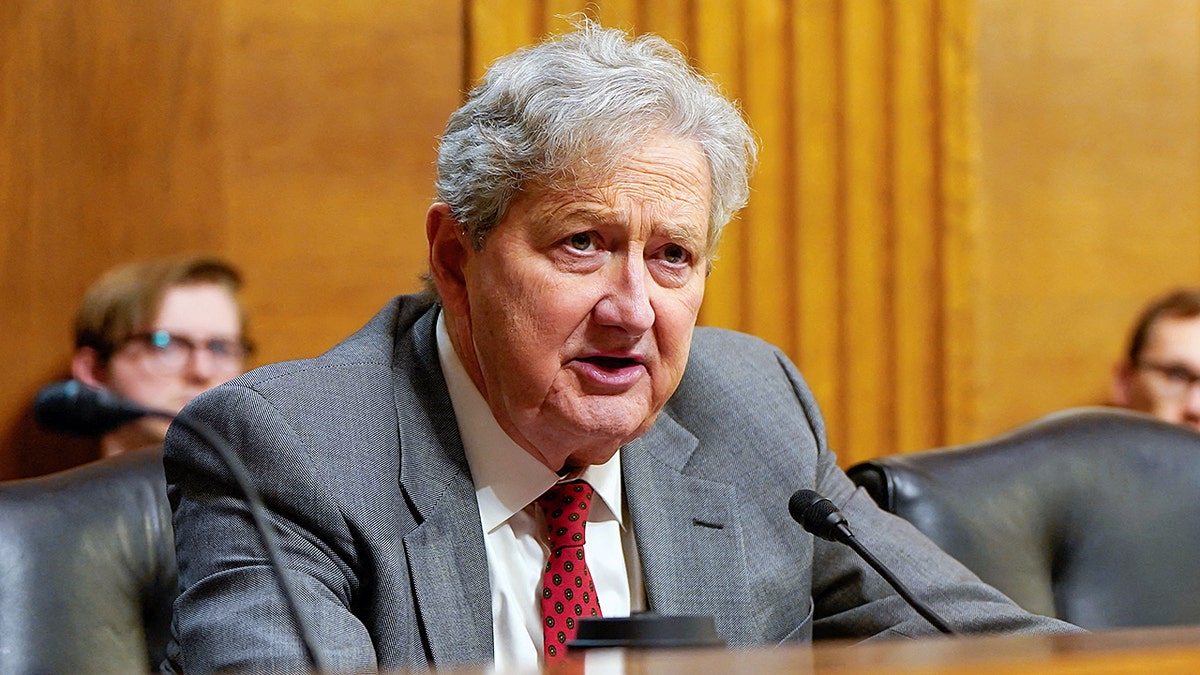
John K.e.r.r.y had spent nearly ten minutes explaining why Americans needed to take climate change seriously when Senator John Ken.n.e.d.y slowly opened a thick black folder.
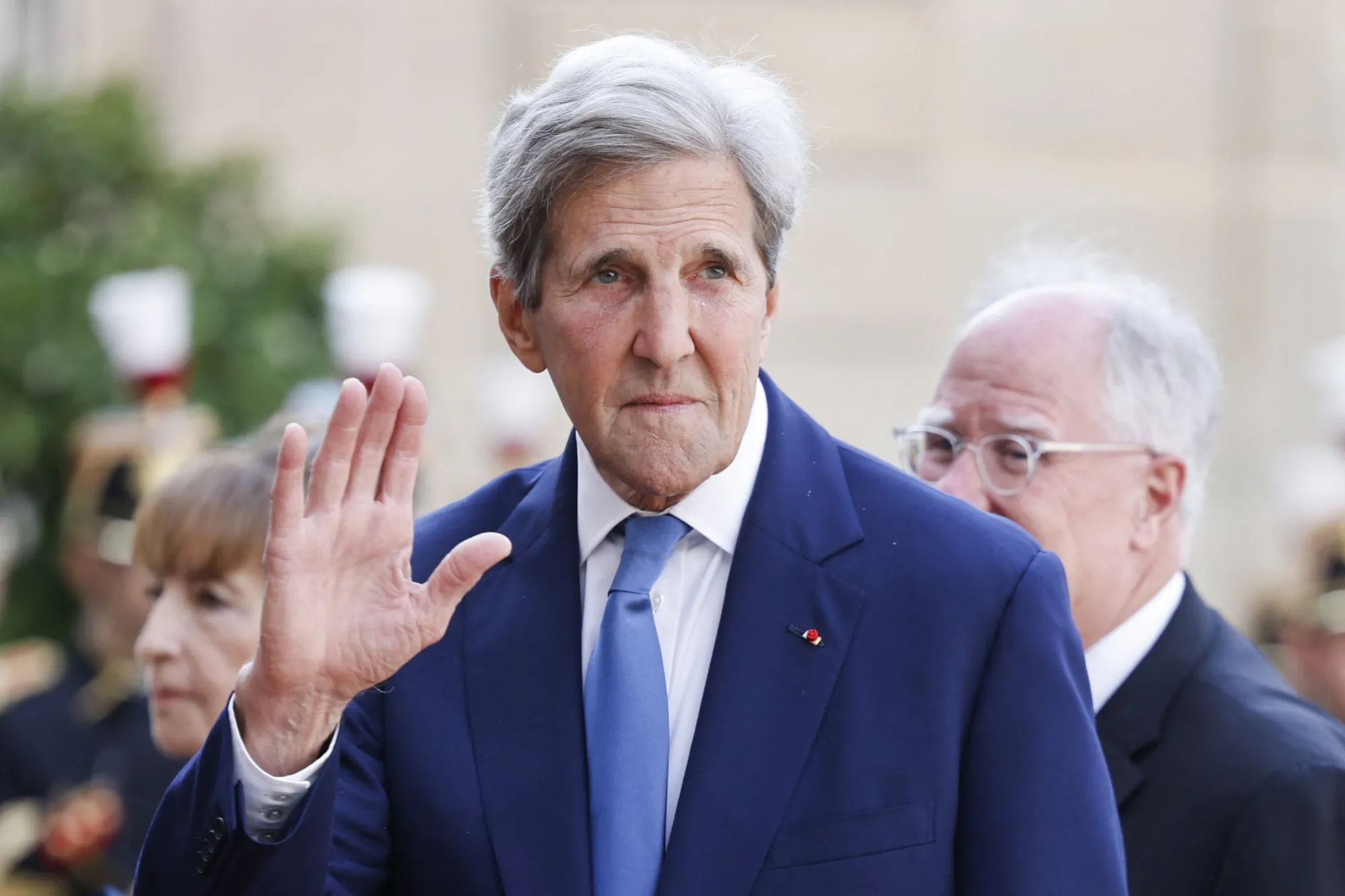
The former U.S. Special Presidential Envoy for Climate had been discussing the transition toward cleaner energy.
He argued that reducing greenhouse gas emissions required difficult decisions from governments, businesses, and consumers.
He emphasized the importance of developing renewable energy technologies.
He also acknowledged that moving away from fossil fuels involved economic challenges.
But Ken.n.e.d.y was focused on a different question.
Who would carry the financial burden of those changes?
The Louisiana senator had listened without interrupting.
He occasionally wrote notes.
Then he glanced toward the folder beside his microphone.
Across its cover appeared four words.
PRIVATE AVIATION — FINANCIAL DISCLOSURES.
Ken.n.e.d.y waited for K.e.r.r.y to finish.
Then he leaned toward his microphone.
“Mr. K.e.r.r.y, I appreciate your concern for the planet.”
He paused.
“But I’ve got a question about the people who have to pay the bills.”
K.e.r.r.y looked toward him.
Ken.n.e.d.y continued.
“You’ve talked about what Americans ought to change.”
He adjusted his glasses.
“I’d like to know how much those changes are going to cost a family that can barely afford groceries.”
The fictional hearing room became quiet.
K.e.r.r.y explained that the transition to cleaner energy involved both upfront investments and potential long-term savings.
He argued that renewable technologies could reduce dependence on volatile fossil fuel markets.
He also emphasized that climate policies needed to support workers and vulnerable communities.
Ken.n.e.d.y nodded.
“That’s a good speech.”
He paused.
“But it doesn’t tell me what happens when a family can’t afford the transition.”
K.e.r.r.y responded that public investment and incentives could help households access more efficient technologies.
He cited the importance of infrastructure development and technological innovation.
Ken.n.e.d.y listened.
Then he opened the folder.
“Well, let’s talk about access.”
The senator removed the first document.
It was a hypothetical aviation activity summary prepared specifically for the fictional hearing.
Several rows listed dates, flight distances, aircraft categories, and estimated operating costs.
A separate column identified journeys involving private aviation arrangements.
Ken.n.e.d.y placed the document beneath the cameras.
“Mr. K.e.r.r.y, I’d like to talk about private jets.”
K.e.r.r.y looked toward the chart.
The senator continued.
“Because it’s a little easier to tell Americans to change their transportation habits when money isn’t a problem.”
K.e.r.r.y responded that official climate diplomacy sometimes required international travel.
He also noted that travel arrangements needed to be examined according to their specific circumstances.
Ken.n.e.d.y acknowledged the distinction.
“That’s fair.”
He paused.
“Then let’s examine the circumstances.”
The senator turned to the second page.
Its heading read AIRCRAFT OPERATIONS AND PASSENGER CAPACITY.
The document compared the emissions associated with different aviation arrangements.
It included private aircraft and commercial passenger flights.
The estimates varied according to aircraft type, distance, fuel consumption, and passenger occupancy.
Ken.n.e.d.y asked the committee’s transportation analyst to explain why private aviation could produce higher emissions per passenger.
The analyst described the basic calculation.
Aircraft burn fuel to complete a journey.
The resulting emissions can be divided among the passengers traveling aboard.
An aircraft carrying relatively few passengers may produce significantly higher emissions per person than a larger commercial flight.
However, precise comparisons require reliable data about the aircraft and its operation.
Ken.n.e.d.y nodded.
“So if somebody takes a private jet with only a few people aboard, the emissions per passenger can be considerably higher.”
The analyst agreed.
K.e.r.r.y emphasized that global climate policy could not be reduced to the travel choices of individual officials.
Ken.n.e.d.y acknowledged that argument.
Then he tapped the folder.
“Maybe not.”
He paused.
“But when the official is telling everybody else to sacrifice, I think the question deserves an answer.”
The room became noticeably quieter.
Ken.n.e.d.y selected another document.
It contained a hypothetical comparison between household energy expenses and private aviation costs.
One side summarized the pressures facing ordinary American households.
Electricity bills.
Home heating expenses.
Gasoline costs.
Vehicle replacement expenses.
And the cost of adopting new energy technologies.
The other side described the expenses associated with operating a private aircraft.
Ken.n.e.d.y placed the two sections next to each other.
“Mr. K.e.r.r.y, a family in Louisiana doesn’t have unlimited transportation options.”
He paused.
“Some people have to drive long distances to work.”
He pointed toward the first column.
“Some live in homes where replacing an old heating system costs thousands of dollars.”
Then he moved toward the aviation summary.
“And some people can afford transportation choices most Americans will never experience.”
K.e.r.r.y acknowledged that household affordability was a significant policy concern.
He argued that cleaner technologies needed to become accessible across income levels.
Ken.n.e.d.y agreed.
But he questioned whether federal officials sufficiently understood the immediate financial pressures facing consumers.
He described a household deciding whether to repair an older vehicle or purchase a newer one.
He mentioned families facing rising electricity expenses.
He also discussed communities where access to public transportation remained limited.
K.e.r.r.y responded that energy policy should recognize those practical constraints.
He maintained that government investment could help reduce the costs of adopting cleaner technologies.
Ken.n.e.d.y nodded.
“Then we ought to be talking about real costs.”
He turned another page.
The document contained several fictional examples of household budgets.
The first represented a family living in a rural community.
Its members depended on personal vehicles.
The second represented an urban household with greater access to public transportation.
The third represented an older couple living on a fixed income.
Ken.n.e.d.y explained that energy policies could affect these households differently.
K.e.r.r.y acknowledged the point.
He emphasized that a successful energy transition required policies tailored to different economic circumstances.
The senator looked toward him.
“Then why do so many Americans feel like they’re being lectured instead of listened to?”
K.e.r.r.y answered that public discussion sometimes oversimplified the objectives of climate policy.
He maintained that the purpose was to expand cleaner energy options rather than punish households.
Ken.n.e.d.y acknowledged that stated objective.
But he questioned whether public communication always reflected the financial constraints facing ordinary people.
The chairman asked the committee’s energy analyst to address the issue.
The analyst explained that energy costs depended on multiple factors.
Fuel prices.
Regional electricity markets.
Infrastructure availability.
Household income.
And the upfront costs of replacing equipment.
A cleaner technology could provide long-term savings in some circumstances.
But the initial investment could remain a serious obstacle.
Ken.n.e.d.y nodded.
“That’s what I’ve been trying to get at.”
Then he returned to the private aviation documents.
The fictional chart contained entries associated with several different travel arrangements.
Some were classified as official journeys.
Others were described as privately arranged travel.
A third category required additional documentation before the funding source could be established.
Ken.n.e.d.y asked whether the documents proved that taxpayer money had been improperly spent.
The committee analyst answered no.
The available summary did not establish unlawful spending.
A complete review would require travel authorizations, payment records, and other supporting materials.
Ken.n.e.d.y acknowledged that limitation.
“Then let’s not pretend these records prove something they don’t.”
He paused.
“But let’s not pretend the questions are unreasonable either.”
K.e.r.r.y agreed that official travel expenditures should comply with applicable rules.
He also maintained that any review should distinguish legitimate government responsibilities from personal travel.
Ken.n.e.d.y nodded.
“That’s exactly the distinction I want.”
The senator opened another folder.
Its cover read PUBLIC MESSAGING AND PERSONAL RESPONSIBILITY.
Inside were fictional excerpts from the climate adviser’s public remarks.
One concerned reducing greenhouse gas emissions.
Another discussed the importance of cleaner transportation.
A third emphasized the responsibilities of governments and businesses.
Ken.n.e.d.y placed the statements beside the aviation summary.
Then he asked whether public officials should make reasonable efforts to follow the principles they advocated.
K.e.r.r.y responded that leadership could involve both personal conduct and institutional policy.
He also argued that individual travel decisions could not replace broader emissions reductions.
Ken.n.e.d.y acknowledged the distinction.
But he questioned whether public confidence depended partly on the examples officials set.
K.e.r.r.y agreed that credibility mattered.
Ken.n.e.d.y leaned forward.
“Then a public official’s travel choices aren’t completely irrelevant, are they?”
K.e.r.r.y answered that relevant facts could be examined.
But he cautioned against drawing conclusions from incomplete information.
Ken.n.e.d.y agreed.
The chairman requested that both participants distinguish documented facts from assumptions.
The senator accepted the instruction.
He emphasized that the fictional flight summary was not a substitute for verified operational records.
He also acknowledged that a private flight could be lawful and, in certain circumstances, operationally justified.
But he maintained that the financial and environmental implications deserved examination.
The hearing moved toward another question.
K.e.r.r.y had served as the first U.S. Special Presidential Envoy for Climate under President Joe Biden.
His diplomatic work involved international negotiations concerning greenhouse gas emissions and climate commitments.
He had participated in discussions involving major economies and international institutions.
Ken.n.e.d.y acknowledged the importance of diplomacy.
But he questioned whether international agreements adequately addressed the economic concerns facing American households.
K.e.r.r.y responded that climate change was a global problem requiring international cooperation.
He explained that emissions reductions in one country could not independently resolve the challenge.
Ken.n.e.d.y agreed that international cooperation mattered.
Then he asked whether American families should be expected to absorb disproportionate costs.
K.e.r.r.y argued that sound policy should balance environmental objectives with economic opportunity.
He emphasized that clean energy development could create jobs and encourage investment.
Ken.n.e.d.y acknowledged those possible benefits.
But he maintained that national policy needed to account for people working in traditional energy industries.
Workers in oil and gas production.
Families dependent on manufacturing.
Communities reliant on existing energy infrastructure.
And households unable to afford expensive upgrades.
K.e.r.r.y responded that transitioning industries required workforce development and economic support.
Ken.n.e.d.y nodded.
“Then we agree that the people paying the price deserve a serious conversation.”
The room became quiet again.
The senator returned to the aviation comparison.
This time he selected a page concerning the relationship between emissions and the number of passengers aboard.
The analyst explained that private aviation emissions varied considerably.
Aircraft size mattered.
Fuel efficiency mattered.
Flight distance mattered.
And passenger occupancy mattered.
A private jet was not automatically responsible for the same emissions on every journey.
Ken.n.e.d.y acknowledged those differences.
But he emphasized that the broader per-passenger comparison remained important.
K.e.r.r.y responded that aviation emissions were one aspect of a much larger energy system.
He also noted that technological innovation could help reduce emissions from transportation.
Ken.n.e.d.y agreed.
But he returned to the question of credibility.
“Mr. K.e.r.r.y, an ordinary person hears that they ought to change the car they drive.”
He paused.
“Then they see wealthy people traveling in ways they could never afford.”
He looked toward the official.
“Do you understand why that might create frustration?”
K.e.r.r.y acknowledged that perceived inconsistencies could undermine public confidence.
He maintained that policymakers needed to communicate more clearly about fairness and affordability.
Ken.n.e.d.y nodded.
“Good.”
He turned another page.
The document concerned government travel transparency.
It identified several possible oversight questions.
Were travel expenses properly authorized?
Were the funding sources accurately disclosed?
Were lower-cost alternatives reasonably available?
And were emissions calculations based on reliable information?
Ken.n.e.d.y asked whether those questions could be examined without accusing someone of criminal wrongdoing.
The ethics adviser answered yes.
An oversight inquiry could evaluate compliance and administrative practices without presuming guilt.
The adviser emphasized that conclusions required supporting evidence.
Ken.n.e.d.y acknowledged the point.
Then he looked toward K.e.r.r.y.
“That’s the kind of accountability I’m talking about.”
K.e.r.r.y responded that he supported appropriate government oversight.
He also emphasized that official travel sometimes involved complex scheduling and security requirements.
Ken.n.e.d.y agreed that those considerations needed to be included.
But he questioned whether every private aviation arrangement would necessarily satisfy those criteria.
K.e.r.r.y answered that each journey needed to be evaluated individually.
Ken.n.e.d.y nodded.
“Then that’s what the committee ought to do.”
The hearing had moved beyond the original hypothetical confrontation.
The senator was questioning the affordability and credibility of climate policies.
K.e.r.r.y was explaining the importance of broad emissions reductions and practical policy design.
Neither issue could be resolved through the aviation chart alone.
But the comparison had raised an important question about public messaging.
Ken.n.e.d.y opened the final section of his folder.
Its title read THE COST OF LEADERSHIP.
The document listed two different measures of public accountability.
The first concerned the effectiveness of policy.
Did proposed climate measures reduce emissions?
Were they economically practical?
And how did they affect households at different income levels?
The second concerned official conduct.
Were travel expenditures properly documented?
Were legal requirements followed?
And were public explanations consistent with the available records?
Ken.n.e.d.y placed the document between himself and K.e.r.r.y.
“Mr. K.e.r.r.y, I’m not asking you to stop advocating for climate policies.”
He paused.
“I’m asking you to recognize that those policies have real consequences for people who don’t have your options.”
K.e.r.r.y acknowledged that public policies needed to account for financial hardship.
He argued that cleaner energy could become more affordable through investment and innovation.
Ken.n.e.d.y agreed that innovation mattered.
But he questioned whether political leaders were sufficiently transparent about the near-term costs of proposed changes.
The energy analyst explained that different technologies could involve different cost profiles.
Some reduced operating expenses but required substantial upfront investment.
Others depended on local infrastructure or financial incentives.
The overall impact varied among households.
Ken.n.e.d.y nodded.
“Then we ought to explain those differences instead of treating everybody’s situation like it’s the same.”
K.e.r.r.y agreed that public communication needed to account for those variations.
The chairman asked for final remarks.
K.e.r.r.y reiterated that climate policy required sustained action across energy, transportation, and industry.
He emphasized that protecting the environment and supporting economic prosperity were not necessarily opposing objectives.
He also acknowledged that affordability and fairness remained important concerns.
Ken.n.e.d.y listened.
Then he slowly closed the folder.
He placed his glasses beside the final page.
“Mr. K.e.r.r.y, I don’t question that climate change deserves serious discussion.”
He paused.
“And I don’t question that Americans should be looking for better energy technologies.”
The room remained quiet.
“But I do question whether Washington always remembers who has to pay for its decisions.”
He pointed toward the household budget summaries.
“That family trying to make a mortgage payment doesn’t have unlimited choices.”
Then he indicated the aviation documents.
“And when public officials travel in ways ordinary people can’t afford, they ought to be prepared to explain those choices.”
K.e.r.r.y responded that public officials should comply with travel requirements and maintain appropriate transparency.
Ken.n.e.d.y acknowledged the answer.
Then he leaned closer to his microphone.

“That’s a good starting point.”
He paused.
“But there’s still one thing I want to know.”
The fictional chamber fell silent.
The senator looked directly toward K.e.r.r.y.
He spoke slowly.
“Mr. K.e.r.r.y, if an American family cannot afford the sacrifices your climate agenda asks of them, why should they trust Washington to understand their burden when the people making the rules have financial choices those families will never have?”
For several seconds, nobody spoke.
K.e.r.r.y responded that effective climate policy needed to make cleaner energy affordable and accessible.
He emphasized that government leaders had a responsibility to address economic concerns rather than dismiss them.
Ken.n.e.d.y acknowledged that response.
But he maintained that public confidence required clear cost estimates and consistent accountability.
The chairman brought the fictional exchange to a close.
No finding of improper spending had been made.
The aviation documents had not established that K.e.r.r.y personally violated travel rules.
Nor did they prove that private flights were financed unlawfully.
The hearing had instead examined two questions.
How should government officials explain the financial consequences of climate policies?
And what standards of transparency should apply to officials advocating changes in public behavior?
Both questions required reliable information.
A person’s use of private aviation did not invalidate the scientific evidence concerning climate change.
But public officials could still face legitimate questions about travel costs, emissions, and consistency in their messaging.
Likewise, a climate policy’s environmental objectives did not automatically establish that it was affordable for every household.
Those impacts needed to be measured carefully.
Ken.n.e.d.y gathered his documents.
K.e.r.r.y collected his prepared remarks.
The chairman dismissed the hearing.
The final aviation summary remained briefly visible beneath the television cameras.
It had not delivered a criminal verdict.
But it had focused attention on the difference between setting public expectations and living with their financial consequences.
For ordinary Americans, energy policy was not simply an argument about emissions targets.
It affected transportation expenses.
Home heating.
Electricity bills.
Jobs.
And the affordability of everyday life.
Those concerns deserved attention alongside the environmental goals policymakers sought to achieve.
The fictional confrontation ended with the central challenge unresolved.
How could Washington pursue long-term climate objectives while ensuring that the costs were understood and distributed fairly?
The answer required more than political speeches or personal accusations.
It required transparent records, realistic economic analysis, and policies that recognized the circumstances of different households.
Because asking Americans to participate in an energy transition is one thing. Demonstrating that the transition is practical, affordable, and fair to the people expected to pay for it is another.
