
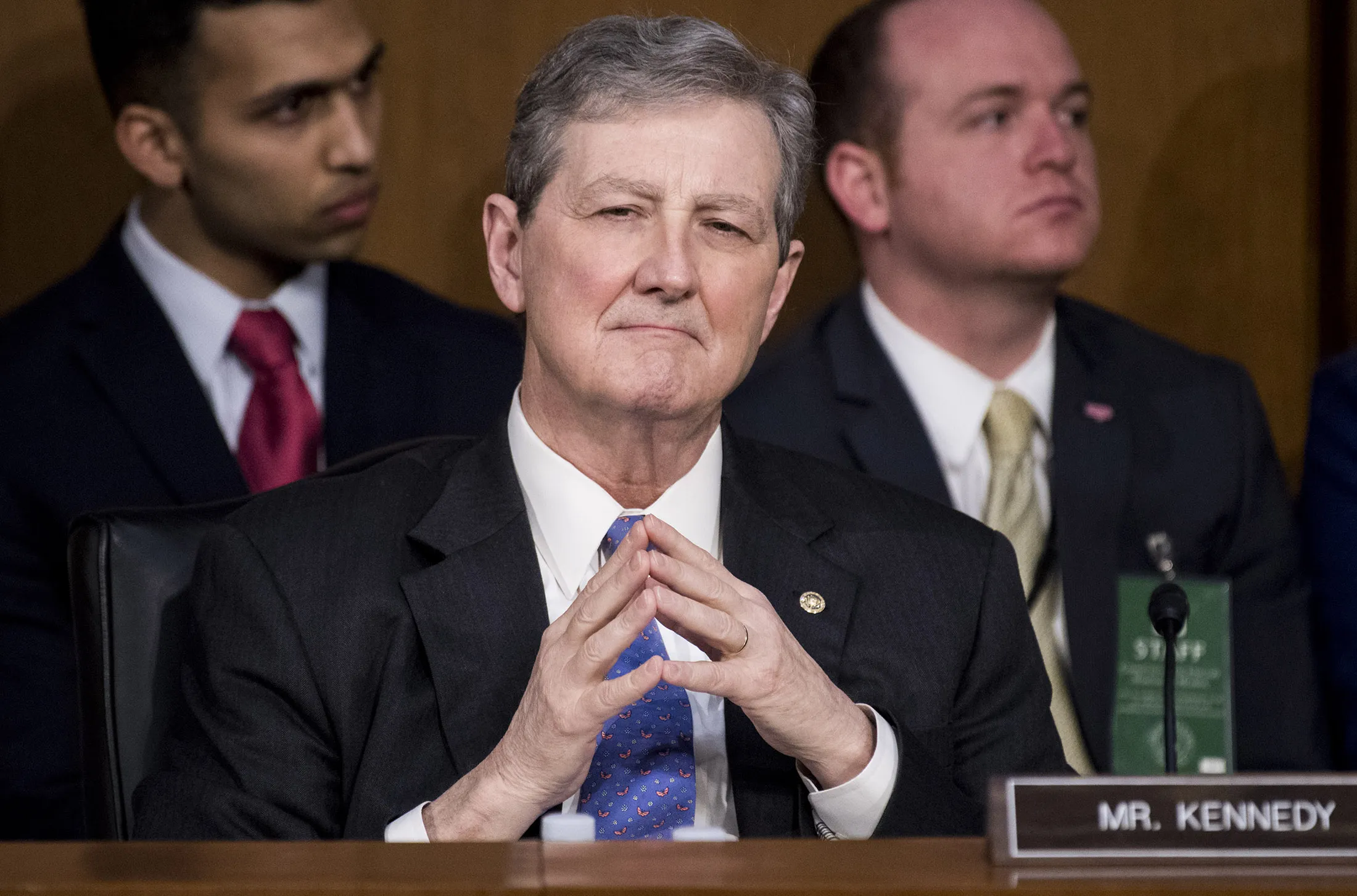
John Kennedy had been questioning the financing of Hamas for several minutes when he abruptly changed direction.
The Louisiana senator stopped asking about Gaza.
He turned toward Danielle Pletka, a senior fellow at the American Enterprise Institute, and shifted the discussion to a bank account hundreds of miles away.
The amount was enormous.
Six billion dollars.
The location was Qatar.
And the money belonged to Iran.
Kennedy wanted to know who could actually control its release.
The hearing room was quiet as he walked through the question.
The United States had helped arrange the transfer of approximately $6 billion in Iranian oil revenues from South Korean banks to restricted accounts in Qatar.
The arrangement formed part of a September 2023 prisoner exchange between Washington and Tehran.
American officials had insisted that the money would be restricted to approved humanitarian transactions.
Iranian officials would not simply receive a suitcase containing $6 billion.
The accounts were subject to monitoring.
And the intended payments were supposed to support purchases such as food and medicine.
But Kennedy was interested in the moment when diplomatic assurances met the operational reality of international banking.
A Qatari financial institution held the assets.
The United States possessed substantial sanctions leverage.
Iran retained a financial interest in the money.
And the question of how those interests would interact had become urgent after Hamas’s October 7 attack on Israel.
Kennedy pressed Pletka on what would happen if Washington and Doha issued conflicting instructions.
She acknowledged the role of the Qatari authorities.
Kennedy followed the answer toward a larger conclusion.
The senator believed American officials were treating complex sanctions arrangements as though written restrictions alone could eliminate every strategic risk.
And he was determined to challenge that assumption.
He turned back toward his notes.
Then the questioning expanded.
From Qatar to Gaza.
From humanitarian assistance to taxation.
From oil sanctions to international reserves.
And finally to whether Washington was using the economic pressure available to it.
By the time Kennedy reached his closing question, the discussion had become a confrontation over the difference between possessing sanctions authority and using it effectively.
The date was October 26, 2023.
The setting was the Senate Committee on Banking, Housing, and Urban Affairs.
The hearing was titled Combating the Networks of Illicit Finance and Terrorism.
The witnesses included Matthew Levitt, a specialist in counterterrorism and intelligence at the Washington Institute for Near East Policy; Danielle Pletka, a senior fellow at the American Enterprise Institute; and Shlomit Wagman, a former Israeli financial-crime enforcement official.
The subject was urgent.
Less than three weeks earlier, Hamas had carried out the October 7 attacks in Israel, killing civilians and taking hostages.
Israel’s military response in Gaza was underway.
The war had renewed scrutiny of Hamas’s financial networks, Iran’s support for armed groups, and the mechanisms through which aid and international transfers moved into conflict zones.
American lawmakers wanted answers.
Where did Hamas obtain its money?
How did it collect revenue inside Gaza?
What role did Iran play?

And could U.S. sanctions deprive organizations designated as terrorists of the resources they needed to operate?
Kennedy approached those questions through a chain of financial relationships.
But the chain was more complicated than a single transfer from one government to one armed group.
He began in Gaza.
Hamas had exercised de facto control over the territory for years.
Its governing position gave it access to financial mechanisms unavailable to an organization operating entirely underground.
It could collect taxes and fees.
It could influence commercial activity.
It could draw revenue from imports and economic transactions.
At the same time, ordinary Palestinians relied on services and resources supplied by other institutions.
That created the difficult problem at the center of Kennedy’s questioning.
Money intended to support civilians could enter an economy in which Hamas exercised substantial power.
The senator wanted to know whether international assistance could indirectly strengthen the organization’s financial position.
His first questions went to Matthew Levitt.
Kennedy discussed Qatar’s financial support for Gaza.
He referred to regular transfers that had helped sustain the territory’s administration.
He then moved to the Palestinian Authority.
The Palestinian Authority had continued paying certain expenses connected to Gaza even after Hamas consolidated control of the territory.
Those payments included salaries and some electricity costs.
Kennedy regarded the arrangement as an example of money flowing into a system controlled in important respects by Hamas.
Levitt pushed back against the senator’s political characterization.
The history mattered.
Hamas won Palestinian legislative elections in 2006, but its takeover of Gaza in 2007 followed violent conflict with Fatah.
It would be misleading to describe the later arrangement simply as Gaza’s population having rejected the Palestinian Authority in favor of Hamas.
Levitt made that distinction during the hearing.
Kennedy wanted to move past the historical argument.
His focus remained financial.
If the Palestinian Authority paid expenses in Gaza, did that reduce the financial burden on Hamas?
If it maintained salaries, did that help sustain an economy from which Hamas could collect taxes?
And if international assistance paid for essential services, what happened to resources Hamas might otherwise have had to commit?
The logic was what economists call fungibility.
Money is fungible because paying one expense can free resources for another.
A household receiving help with rent may have more of its own income available for food.
A government receiving outside assistance for public services may have additional fiscal room elsewhere.
A militant organization operating within a territory may benefit indirectly when outside institutions carry expenses the organization would otherwise face.
But an important distinction remained.
An indirect financial benefit is not the same thing as proving that a specific aid payment was diverted to buy weapons.
Kennedy’s questions explored the possibility.
They did not, by themselves, establish a documented diversion of every dollar discussed.
The senator moved to United Nations assistance.
UN agencies provided education, medical care, and humanitarian services in Gaza.
Kennedy asked whether such assistance effectively supported the environment in which Hamas operated.
Levitt emphasized that the United Nations also ran its own programs.
The distinction was significant.
Funding a UN-operated school was not identical to transferring unrestricted cash to Hamas.
Operating a medical clinic for civilians was not the same thing as financing an armed wing.
Yet Kennedy’s broader question remained.
Could humanitarian programs contribute indirectly to an economy from which Hamas collected revenue?
Levitt’s testimony acknowledged the importance of Hamas’s taxation system.
The organization had imposed taxes and fees across a range of activities.
Kennedy referenced taxation of aid and food.
He raised fishing.
He raised income.
He pointed toward the possibility that Hamas could collect money from economic activity even when outside organizations funded essential services.
At one point, Kennedy cited a tax rate of 16.5 percent.
Levitt confirmed the broader issue of taxation but did not verify that exact percentage.
That distinction mattered.
A witness agreeing that Hamas collected taxes was not the same as confirming every numerical estimate put forward by a senator.
Still, Kennedy had established a concrete problem for policymakers.
Humanitarian assistance was essential to civilians.
But an armed organization exercising territorial control could seek revenue from the surrounding economy.
The policy challenge was determining how to protect civilians while limiting the financial benefits available to Hamas.
Stopping all assistance was not a cost-free solution.
People needed electricity.
Children needed schools.
Patients needed medical treatment.
Food and water remained basic necessities.
Any financial strategy would have to confront the potential harm to civilians as well as the danger of indirectly supporting armed groups.
Kennedy then shifted to Iran.
The move was deliberate.
Hamas’s domestic revenue explained only part of its financing.
Iran had supported Hamas and other armed organizations through financial assistance, training, and military relationships.
American officials had long identified Iran as a major state sponsor of terrorism.
The senator wanted to know why U.S. sanctions had not prevented that support.
He began with oil.
Iran’s petroleum exports were central to the country’s economy.
Restrictions on oil sales could limit government revenue.
But sanctions worked only when financial institutions, shipping networks, buyers, insurers, and governments complied.
Iran had spent years developing methods to move oil through international markets despite American restrictions.
Those methods raised difficult enforcement questions.
How aggressively should Washington sanction foreign buyers?
How much pressure should it place on intermediaries?
How should it respond when major trading partners resisted American demands?
And what economic or diplomatic consequences would follow a more expansive enforcement campaign?
Kennedy argued that the Biden administration had not enforced existing restrictions strongly enough.
Levitt broadly agreed with criticism of sanctions enforcement.
But this was a contested policy judgment, not a settled finding that Washington had stopped enforcing sanctions entirely.
The administration had maintained sanctions, pursued enforcement actions, and argued that its policy sought to constrain Iran while preserving diplomatic options.
Critics believed the enforcement effort was insufficient.
Supporters of calibrated diplomacy warned that economic pressure alone could not resolve the nuclear issue or Iran’s regional activities.
Kennedy was firmly on the side demanding greater pressure.
He believed the United States possessed meaningful financial leverage and was failing to use it fully.
The next issue was the nuclear agreement.
The Joint Comprehensive Plan of Action, commonly known as the JCPOA, had created a framework for restrictions on Iran’s nuclear program in exchange for sanctions relief.
The United States withdrew from the agreement in 2018 under President Donald Trump.
The Biden administration later pursued diplomatic efforts concerning Iran’s nuclear activities.
Kennedy challenged those efforts.
He raised the agreement’s sanctions snapback mechanism.
The term referred to a procedure allowing certain sanctions relief to be reversed under the relevant international framework.
At the October 2023 hearing, that mechanism had not been invoked in the manner Kennedy was advocating.
The senator regarded it as another example of an available pressure tool not being used.
But international sanctions mechanisms were not identical to unilateral American sanctions.
Their operation depended on the relevant agreements, legal procedures, and international positions.
The distinction would become even more important later.
In 2025, European participants invoked the UN snapback mechanism, and previously lifted United Nations sanctions were reimposed.
That later development should not be confused with the options being debated during Kennedy’s 2023 questioning.
At the time, the senator was pressing witnesses about what Washington could do next.
Then he reached the money in Qatar.
$6 billion.
The amount had become one of the most politically charged figures in American foreign policy.
In September 2023, Washington and Tehran completed a prisoner exchange involving five Americans detained in Iran and five Iranians held by the United States.
As part of the broader arrangement, approximately $6 billion in Iranian oil revenues previously held in South Korea were transferred to restricted accounts in Qatar.
The money did not originate as a new payment from the U.S. Treasury.
It was Iranian revenue that had been inaccessible because of sanctions restrictions.
The arrangement was designed to permit approved humanitarian transactions under monitoring.
American officials said Iran would not have unrestricted access.
After the October 7 attacks, Washington and Doha agreed to prevent Iran from drawing on the funds.
Kennedy nevertheless questioned how much control the United States could exercise when the money sat inside Qatari banks.
The senator’s concern was practical.
If the bank was located in Qatar, whose instructions would ultimately govern it?
Pletka acknowledged the importance of Qatari authority.
Kennedy pressed the answer.
But the legal and financial situation was more complicated than choosing between two competing telephone calls.
Qatari banks also depended on international financial relationships.
They faced American sanctions exposure.
They could be affected by restrictions on dollar transactions.
And losing access to the U.S. financial system could create severe consequences.
Those pressures gave Washington meaningful leverage.
The government of Qatar exercised authority in its own jurisdiction.
The United States exercised influence through sanctions, banking relationships, and the terms of the arrangement.
The central question was how those overlapping powers would operate if political priorities diverged.
Kennedy’s criticism targeted the uncertainty.
He believed American policymakers were relying too heavily on assurances about future compliance.
The administration maintained that the restrictions were real and that the money had not been released for unauthorized purposes.
Those statements were not mutually exclusive.
Washington could possess sanctions leverage while Kennedy still questioned whether the safeguards were sufficiently durable.
But one conclusion could not responsibly be drawn from the exchange.
The presence of $6 billion in Qatar did not establish that Hamas received $6 billion.
Nor did it establish that Iran had already spent those assets on military operations.
That distinction was central to understanding the controversy.
Iran’s financial resources remained a national-security concern.
The Qatar arrangement remained politically contentious.
But the account’s restrictions and actual disbursements mattered.
The argument over control could not replace the need to examine the transactions.
Kennedy then turned to another figure.
$4.5 billion.
He raised Iran’s 2021 allocation of Special Drawing Rights through the International Monetary Fund.
The subject was complex.
Special Drawing Rights, or SDRs, are international reserve assets created by the IMF.
They are not ordinary cash grants.
Nor are they identical to direct payments from the U.S. Treasury.
The IMF distributed a historic general allocation of SDRs in August 2021, equivalent to approximately $650 billion globally.
Participating member countries received allocations according to their IMF quotas.
Iran was among the countries allocated reserve assets.
Kennedy characterized Iran’s share as roughly $4.5 billion and questioned whether those resources provided the government with additional financial flexibility.
His concern was that reserve assets could potentially strengthen the financial position of a government supporting armed organizations.
But describing the allocation as Treasury Secretary Janet Yellen personally giving Iran cash would oversimplify the mechanism.
The SDR allocation was a multilateral IMF operation.
Using SDRs to obtain freely usable currency required transactions through the relevant international system.
Financial sanctions and practical access constraints also mattered.
The funds could not simply be treated as an ordinary unrestricted dollar payment.
Nevertheless, Kennedy believed the allocation belonged in the broader discussion of financial pressure.
It was another example of how international financial arrangements could potentially affect Iran’s access to resources.
The senator connected the issues.
Oil revenue.
Restricted assets.
International reserves.
Sanctions enforcement.
And the financing of armed groups.
For Kennedy, the common question was whether the United States was applying enough pressure to change Tehran’s behavior.
The witnesses offered differing kinds of expertise.
Levitt examined the financial operations of terrorist organizations.
Pletka discussed strategic sanctions and foreign-policy choices.
Wagman brought experience in financial-crime enforcement.
Their testimony showed that the financial system had multiple points of vulnerability.
Funds could move through formal institutions.
They could pass through intermediaries.
They could be raised domestically.
Or they could be obtained through taxation, commerce, private networks, and other channels.
Blocking one route did not automatically eliminate the others.
That was one reason the hearing mattered.
The financial campaign against Hamas could not be reduced to a single bank account.
The organization possessed more than one source of support.
Iran was an important external sponsor.
But international assistance to civilians was not automatically terrorist financing.
And a sanctions restriction was only as useful as its design, enforcement, and international cooperation.
Kennedy believed the policy response was too weak.
He had little patience for arguments that emphasized diplomatic nuance without producing the economic pressure he wanted.
Then came the first of the two lines that would define the exchange.
“This administration is quoting Socrates in the middle of a prison riot.”
The remark was unmistakably Kennedy.
It combined a deliberately exaggerated image with his criticism of the Biden administration’s Iran policy.
He was not suggesting that American diplomats were literally quoting ancient philosophy.
He was arguing that the administration’s diplomatic posture was inadequate to a violent and rapidly deteriorating regional situation.
Pletka responded by emphasizing her view that American policy had devoted substantial attention to the Iranian nuclear issue while failing to address the regime’s wider conduct forcefully enough.
Her criticism covered support for armed organizations, regional destabilization, and human rights abuses.
She argued that Washington should increase pressure across these areas.
Kennedy’s questioning had now brought the discussion to its central policy disagreement.
Could negotiation, targeted sanctions, and humanitarian exceptions constrain Iran?
Or had the administration allowed too much economic flexibility while Iran continued supporting Hamas, Hezbollah, and other armed groups?
Supporters of the existing approach emphasized the difficulty of simultaneously limiting Iranian nuclear activity, recovering detained Americans, protecting humanitarian trade, and maintaining international cooperation.
Critics believed those objectives had been pursued at the expense of deterrence.
The argument had real stakes.
A prisoner exchange affected Americans detained overseas.
Sanctions affected international banks and foreign governments.
Oil restrictions affected economic markets.
And the financing of armed groups affected the security of civilians across the region.
There was no reason to treat those consequences lightly.
Kennedy framed the problem as a failure to use American leverage.
Pletka broadly supported a tougher posture.
Then the senator reached his closing question.
“Peace through weakness never works, does it?”
Pletka answered no.
Chairman Sherrod Brown moved the hearing to the next senator.
The exchange was over.
But the sequence left several issues unresolved.
Kennedy had demonstrated how many financial channels were implicated in the question of Hamas’s support.
He had pressed witnesses about Qatari assistance, Palestinian Authority expenditures, UN programs, Hamas taxation, Iranian oil revenue, the Qatar accounts, and IMF reserve assets.
He had challenged the Biden administration’s sanctions enforcement.
And he had framed the discussion as a test of whether the United States was willing to exercise existing economic power.
But the hearing had not established that the $6 billion in Qatar had been transferred to Hamas.
It had not demonstrated that UN educational or medical spending constituted direct financing of Hamas’s military operations.
And it had not proved that Iran could freely convert every dollar of its SDR allocation into immediately available cash.
Those were different factual questions.
The witnesses’ testimony helped illuminate the financial relationships.
It did not eliminate every distinction among them.
After Kennedy yielded his time, Senator Catherine Cortez Masto approached the discussion from another angle.
She urged the committee to focus on facts rather than partisan point-scoring.
She noted that U.S. policy toward Iran had changed under both Republican and Democratic administrations.
Trump had withdrawn the United States from the JCPOA.
The Biden administration had continued and modified sanctions-related policies.
And the country faced an evolving regional crisis that required cooperation.
Her remarks underscored a point sometimes lost in the viral presentation of the hearing.
The choices facing Washington were not simply whether to impose sanctions or abandon them.
They involved how sanctions were structured.
How waivers operated.
How enforcement priorities were selected.
How humanitarian channels were protected.
And how the United States coordinated with allies.
Financial pressure could be powerful.
But it could also carry unintended consequences.
The same banking restrictions intended to constrain a government might interfere with legitimate trade.
The same controls intended to prevent diversion could delay essential humanitarian supplies.
And sanctions enforcement depended heavily on cooperation from governments and institutions outside American territory.
For Kennedy, those complications did not justify inaction.
For others, they were precisely why sanctions policy required careful calibration.
The disagreement was about the balance.
Not simply whether terrorism financing should be opposed.
On that central objective, the senators and witnesses broadly agreed.
Hamas’s terrorist attacks demanded a serious response.
Iran’s support for armed organizations posed a continuing security problem.
And international financial systems could be exploited to move illicit funds.
The difficult question was which measures would be most effective.
Kennedy believed Washington already possessed substantial tools.
He wanted them used more aggressively.
The hearing transcript captured that argument in a series of rapid questions.
But the record also showed that some of his premises were challenged.
Levitt corrected the characterization of how Hamas had taken control of Gaza.
He did not verify the precise 16.5 percent tax rate Kennedy cited.
And the financial arrangements involving Qatar and the IMF were more complicated than direct transfers of unrestricted cash.
Those details did not erase Kennedy’s substantive concerns.
They defined what the hearing actually established.
The senator had raised questions about indirect financial benefits.
He had challenged the credibility of sanctions enforcement.
And he had pressed witnesses about vulnerabilities in international banking arrangements.
Those were legitimate subjects for congressional oversight.
But determining the effectiveness of a particular policy required evidence beyond whether a memorable hearing exchange received applause online.
In subsequent years, the Qatar funds remained a focus of diplomacy.
As recently as April 2026, Iranian sources claimed Washington had agreed to release frozen assets, while the United States denied that an agreement had been reached.
Later Qatari explanations also distinguished between holding the Iranian assets and transferring them onward.
That continuing dispute illustrated precisely why Kennedy’s original question remained consequential.
The money had not simply vanished.
It was subject to competing political demands, legal restrictions, and international negotiations.
Control was not a single uncomplicated concept.
The assets’ ownership, physical location, withdrawal restrictions, and release authority were separate issues.
A meaningful accounting required answering each of them.
For the public, the most useful questions were therefore concrete.
Where were the funds held?
Who was the legal account holder?
What restrictions governed withdrawals?
Which government authorities could block or authorize transactions?
Had any money actually been disbursed?
And if so, to whom and for what purpose?
Those questions mattered more than the assumption that the mere existence of the account proved terrorist financing.
The same principle applied to humanitarian assistance in Gaza.
A payment to a UN agency required one kind of analysis.
A Qatari transfer for civilian services required another.
A tax collected by Hamas required another.
And a direct payment from Iran to an armed organization required another.
Combining them into one undifferentiated stream of money could obscure the very financial mechanisms investigators were trying to understand.
Kennedy’s rapid questioning drew attention to the connections.
Careful examination of the documents was necessary to determine the limits of those connections.
That was the enduring significance of the hearing.
The senator had asked whether existing financial tools were being used effectively.
The witnesses had described networks of support, sanctions vulnerabilities, and opportunities for stronger enforcement.
But the final policy judgment remained contested.
Advocates of greater pressure believed stronger restrictions could reduce the resources available to Iran and its partners.
Supporters of more calibrated measures argued that diplomacy and humanitarian safeguards were also necessary.
The disagreement concerned how to reduce threats without creating additional harm.
The hearing offered no instant solution.
It did, however, make one question unavoidable.
If sanctions are meant to deny resources to organizations and governments engaged in dangerous conduct, policymakers must be able to explain whether the restrictions actually prevent access to those resources.
A frozen account cannot be evaluated solely by its headline value.
A humanitarian channel cannot be judged solely by its stated purpose.
And an international reserve allocation cannot be described accurately without understanding how the asset can be used.
The details determine the financial reality.
Kennedy’s final question about peace and weakness captured his own preferred response.
He believed American policy needed to rely on credible pressure.
Pletka agreed that Washington should be more forceful.
Other lawmakers emphasized that the government also needed accurate facts, international cooperation, and attention to the consequences for civilians.
The difference was not resolved by the final exchange.
But the hearing put it plainly before the public.
On one side was the argument that insufficient sanctions enforcement could leave Iran with greater resources and reduce American leverage.
On the other was the concern that poorly designed restrictions could undermine diplomacy, humanitarian needs, and cooperation without necessarily changing Iran’s conduct.
The evidence available in October 2023 could inform that debate.
It could not establish every outcome that followed.
What remained unmistakable was Kennedy’s method.
He moved quickly from one source of funding to another.
He asked who paid bills.
Who collected taxes.
Who controlled accounts.
Who administered sanctions.
And who possessed authority to intervene.
Then he returned to the central issue of political will.
Was the government prepared to use the financial tools it claimed were necessary?
For Kennedy, that was the test.
The hearing ended with two lines that continued circulating long after the witnesses left the room.
One mocked what he regarded as a dangerously academic approach to a violent security crisis.
The other expressed his conviction that deterrence required strength.
“This administration is quoting Socrates in the middle of a prison riot.”
And finally:
“Peace through weakness never works, does it?”
The exchange was real.
The hearing was public.
The questions were recorded.
And the debate over the money remained far more complicated than a single viral clip could capture.
The $6 billion was not an invented figure.
The Qatari accounts were not imaginary.
Iran’s support for Hamas was not a hypothetical concern.
But the legal restrictions, the source of the money, and the distinction between indirect financial benefit and proven diversion all remained essential.
Kennedy had placed a powerful policy challenge on the record.
The enduring question was not simply where the money sat. It was who could authorize its release, whether the restrictions would hold, and how effectively Washington could prevent financial resources from reaching organizations it sought to constrain.
That was the issue left behind when the senator closed his questioning.
And it was why the six-billion-dollar question continued to matter long after the committee moved to the next witness.
