
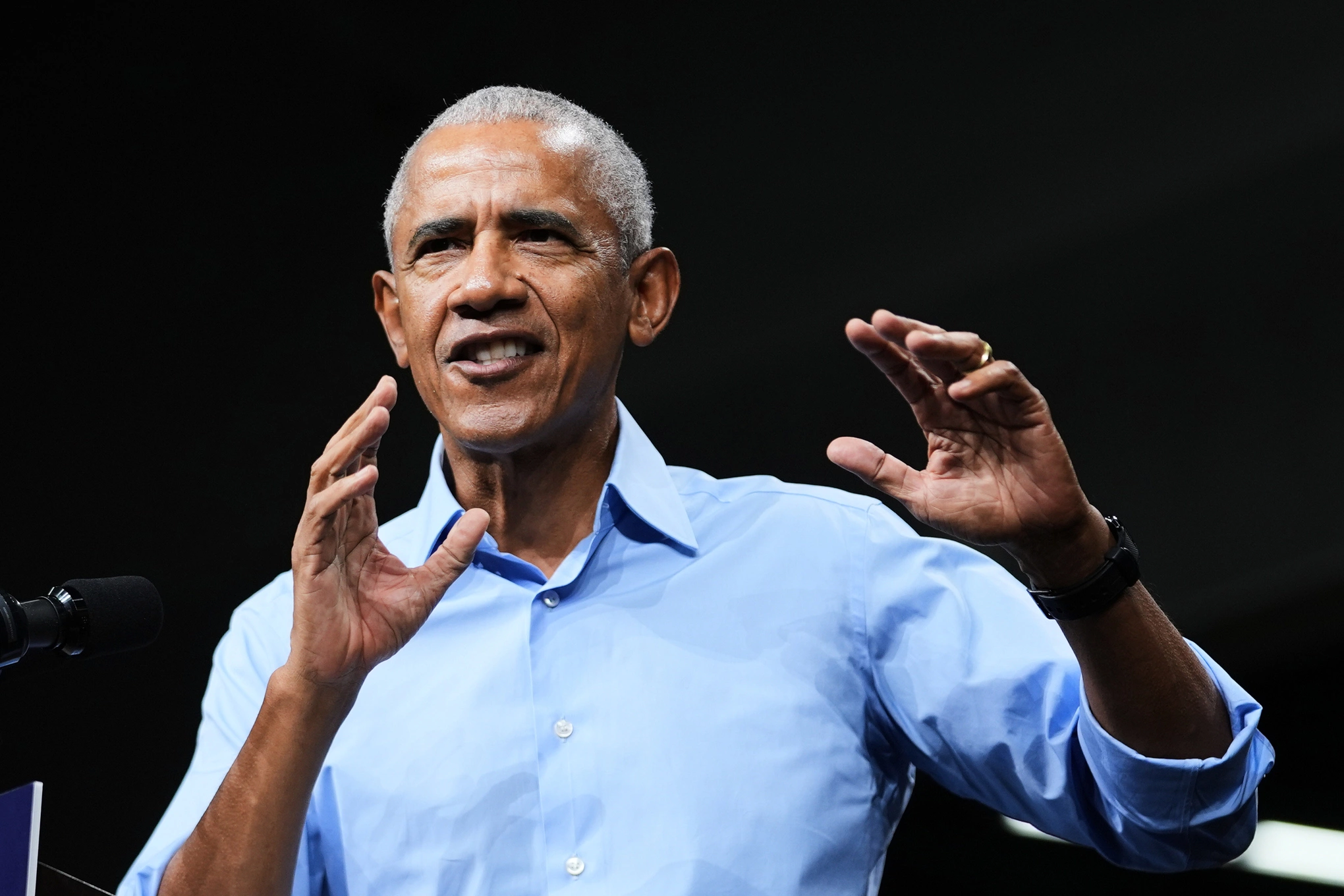
Barack Obama delivered a pointed challenge to Donald Trump’s Iran strategy during a campaign appearance in Cleveland, Ohio, asking a question that cut through months of military announcements, political promises, and competing claims of victory: “Seven months later, how’s that war going?”
The former president was not questioning an isolated military decision or simply criticizing the amount of money Washington had committed to defense, but challenging the reasoning behind a conflict whose consequences were becoming increasingly difficult to contain.
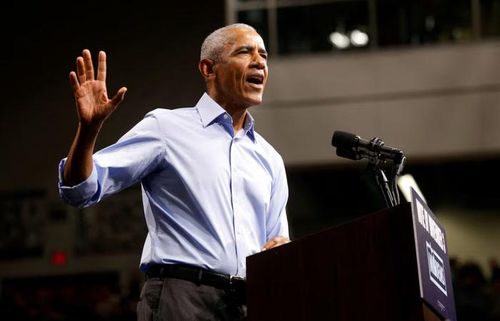
Speaking on October 24, 2026, at a rally supporting Democratic candidates Sherrod Brown and Amy Acton, Obama argued that the administration had abandoned diplomacy that previously constrained Iran’s nuclear program and replaced it with a military campaign carrying enormous strategic and economic risks.
His criticism arrived at a politically sensitive moment, just ten days before the November midterm elections, when voters were increasingly concerned about the conflict, rising energy prices, military casualties, and the administration’s ability to explain what success would actually look like.
Obama’s argument was straightforward but politically consequential: if the original objective was to prevent Iran from developing nuclear weapons, why had Washington abandoned an agreement designed to restrict that program before launching a war that was now creating additional dangers?
He reminded the audience that his administration had negotiated the 2015 Joint Comprehensive Plan of Action, commonly known as the Iran nuclear deal, alongside several international partners.
Under that agreement, Iran accepted restrictions on important parts of its nuclear program and international monitoring arrangements in exchange for relief from certain economic sanctions.
Obama argued that the agreement had achieved an important security objective without requiring American forces to launch military strikes, and he criticized Trump for withdrawing from the arrangement during his first presidency.
His remarks were particularly pointed because the administration had justified its military campaign partly through concerns about Iran’s nuclear ambitions, making the history of the earlier agreement central to the political argument.
The former president was effectively asking whether the United States had discarded a diplomatic mechanism capable of limiting Iran’s nuclear activities only to pursue a military strategy that had created a different set of threats.
That argument does not settle every disagreement about the nuclear agreement, and the 2015 deal was not a permanent resolution of every concern involving Iran’s regional activities, missiles, or future nuclear capabilities.
Some restrictions had expiration dates, and critics argued that the agreement did not adequately address Iran’s ballistic missile development or broader regional influence.
Trump and his supporters had also argued that withdrawing from the agreement was necessary because its limitations were insufficient and because Tehran continued to pose serious security challenges.
Those competing assessments remain central to the debate, but Obama’s broader point concerned the consequences of replacing negotiated restrictions with military force.
He argued that the war had not delivered the clear strategic outcome the administration originally promised, while creating substantial costs for American families, military personnel, allies, and international markets.
The question about how the war was going became more powerful because the conflict had continued far beyond the short campaign initially suggested by Trump.
The United States and Israel began their military strikes against Iran on February 28, 2026, targeting military and nuclear-related facilities as the confrontation escalated into a much broader regional crisis.
Iran responded with attacks against American and allied interests, while the conflict disrupted shipping and increased the risks surrounding one of the world’s most important energy transportation routes.
Obama focused particular attention on the Strait of Hormuz, a narrow maritime passage connecting the Persian Gulf with international shipping routes through which a substantial share of global petroleum supplies normally travels.
He argued that Iran had gained greater leverage over that strategic waterway, creating an outcome that contradicted the administration’s claims that military action had strengthened American security.
His criticism was not limited to military positioning, because he connected the conflict directly to the economic pressures confronting ordinary Americans.
At the Cleveland rally, Obama referred to gasoline prices reaching approximately five dollars per gallon and diesel prices exceeding six dollars, presenting those figures as examples of the financial consequences facing households and businesses.
He acknowledged that presidents do not control every economic factor, but argued that decisions made by the Trump administration had contributed directly to the rising costs confronting consumers.
That distinction became an important part of his political message: national security decisions should not be evaluated exclusively through battlefield announcements when their consequences extend into grocery bills, transportation expenses, and household budgets.
The economic argument became even more significant when the Pentagon’s financial estimates revealed the scale of the military commitment.
According to an estimate provided to Congress, the Iran war had cost American taxpayers approximately $47.1 billion through October 16, 2026.
That figure represented an increase of roughly $3.5 billion from the Pentagon’s estimate through early September, demonstrating how quickly the financial burden had grown during the conflict.
The largest portion of the estimated expense involved replacing munitions, accounting for approximately $29 billion, while operational expenses represented another $11.9 billion.
An additional estimated $6 billion was associated with lost military equipment, although the Pentagon’s accounting did not include the full cost of damage to American bases across the Middle East.
The financial picture therefore remained incomplete, even as the administration faced increasing pressure to explain how much additional funding would be necessary to sustain operations and restore depleted equipment.
Those numbers transformed the debate from a disagreement about political messaging into a serious discussion about military readiness, federal spending, and the opportunity cost of a prolonged conflict.
The price of a war cannot be measured only by the weapons fired or the money already spent, because replacing sophisticated military systems also requires manufacturing capacity, skilled labor, transportation, and years of production.
The depletion of missile-defense interceptors became particularly concerning because those weapons are essential for protecting American personnel, regional allies, and military installations against incoming attacks.
Every interceptor used during the conflict represents a resource that must eventually be replaced, while the production process may compete with other defense priorities around the world.
That creates a difficult strategic calculation for military planners, who must consider not only the current confrontation but also the possibility of future emergencies involving other countries.
The Pentagon’s estimate also revealed that the financial burden was distributed across multiple military services, including the Air Force, Army, Navy, and specialized transportation and support operations.
The Air Force accounted for approximately $7.6 billion in operational costs, while the Army’s reported expenses exceeded two billion dollars and the Navy’s estimate stood at approximately $1.45 billion.
These figures illustrated how a conflict concentrated in one region can absorb resources from across the entire American military establishment.
Obama’s argument therefore reached beyond the immediate question of whether individual strikes had succeeded, asking whether the administration had adequately considered the strategic consequences of its decisions.
The human cost was equally important.
The Pentagon’s official reporting listed 21 American service members killed and 865 wounded in connection with operations related to the conflict, although the casualty total included some deaths not directly caused by combat.
Those figures represented families facing permanent loss, injured personnel requiring medical treatment, and military communities dealing with the consequences of an extended deployment.
For Americans evaluating the administration’s strategy, the human cost raised a question that cannot be answered through military statistics alone: what concrete security objective justifies asking service members to continue carrying these risks?
Supporters of Trump’s approach argue that military pressure can prevent Iran from threatening American forces, destabilizing the region, or developing capabilities that could endanger the United States and its allies.
They also contend that diplomacy without credible military pressure may give Tehran additional time to strengthen its position and avoid meaningful concessions.
Critics counter that military action can produce unpredictable retaliation, weaken diplomatic opportunities, and create new strategic problems even when individual operations achieve their immediate tactical objectives.
The disagreement is not simply between supporters of military strength and supporters of diplomacy, because both sides claim to be pursuing American security through different methods.
The central question is whether the administration can demonstrate that the risks, financial commitments, and human costs are producing a durable improvement in America’s strategic position.
That question became particularly difficult after Obama argued that Iran had gained leverage over the Strait of Hormuz despite the military campaign.
If Tehran can disrupt international shipping and influence the movement of energy supplies, the United States may find itself confronting a new economic and security challenge even after achieving important military objectives.
A prolonged disruption could affect oil prices, shipping insurance, transportation expenses, industrial production, and the financial stability of countries that depend heavily on energy imports.
Those consequences would extend far beyond the United States, potentially affecting major economies in Europe and Asia and creating additional diplomatic pressure on Washington.
For American consumers, the effects could appear indirectly through higher fuel costs, more expensive deliveries, and increased operating expenses for businesses that depend on transportation.
This is why Obama’s criticism resonated beyond the traditional foreign-policy debate: he connected military strategy to the everyday economic concerns that voters experience directly.
The former president also challenged the administration’s claims about the success of its campaign, arguing that the country had not received the decisive result that Americans had been promised.
He pointed to attacks against American bases and allies, the deaths and injuries among service members, and the depletion of important military stockpiles.
His most striking argument concerned the possibility that Iran had emerged with greater influence over the Strait of Hormuz than it possessed before the conflict began.
That assessment remains a political argument rather than an uncontested strategic conclusion, but it identifies a genuine question about whether the war has produced the intended regional balance.
The administration has defended its military actions and continued to present its objectives as essential to American security, while Trump has maintained that the United States has achieved major successes.
However, public confidence in those claims depends partly on whether officials can explain what remains to be accomplished, how long operations may continue, and what conditions would allow American forces to leave.
A military campaign without a clearly communicated endpoint risks creating uncertainty for service members, their families, congressional lawmakers, financial markets, and international partners.
The administration also faces a difficult budgetary challenge because the regular defense spending proposal and the additional funding needed for war-related expenses are not necessarily the same financial commitment.
The proposed fiscal 2027 defense budget carried a headline figure of approximately $1.5 trillion, while separate funding requests were being considered for the Iran conflict and other priorities.
The administration was also seeking congressional approval for a $95 billion package covering the war and additional priorities, according to reporting published by The Associated Press in October.
That package should not be confused with a separate three-billion-dollar proposal, and Obama’s Cleveland remarks were not a documented response to such a specific measure.
The larger spending debate is about whether the administration can justify the total military commitment, explain the additional funding requirements, and demonstrate that the resources will advance clearly defined national objectives.
Congress has an important constitutional role in that discussion because lawmakers control federal appropriations and possess oversight authority over military spending and the executive branch.
The November election results made that oversight question more consequential, as Democrats won control of both chambers and prepared to assume greater influence over congressional investigations and funding negotiations.
The new Congress is scheduled to convene on January 3, 2027, giving lawmakers an opportunity to examine the administration’s military strategy, demand documents, question officials, and debate restrictions on future spending.
Reuters reported on November 12 that Democrats were considering several approaches, including war-powers legislation, funding restrictions, oversight hearings, and investigations into the administration’s decision-making.
Congress cannot necessarily end a military conflict through a single vote, particularly if the president vetoes legislation, but it can create substantial political and financial pressure.
A Reuters/Ipsos poll cited in the report found that 71 percent of Americans supported legislation ending the conflict, including majorities of both Democratic and Republican respondents.
That finding suggested that public concern about the war extended beyond traditional party divisions, even though Americans may disagree sharply about the best way to protect national security.
For Obama, the campaign rally offered an opportunity to argue that the administration had chosen military escalation when diplomacy deserved greater consideration.
For Trump, the challenge is to demonstrate that military action has produced results sufficient to justify the costs and risks, particularly as public attention shifts toward the next phase of the conflict.
Neither side can resolve that disagreement through slogans alone.
The most important evidence will come from the administration’s ability to explain the military objectives, disclose the financial consequences, establish measurable outcomes, and demonstrate a credible plan for preventing renewed escalation.
Americans also deserve to know whether diplomatic channels remain available, what conditions would make negotiations possible, and how the government intends to protect shipping through the Strait of Hormuz.
Those answers matter because a conflict can continue long after its initial military objectives have been declared achieved.
Obama’s question was therefore more than a political attack on Trump, even though it was delivered during a campaign event designed to influence voters.
It challenged the administration to measure success against the original promises that justified military action, rather than relying exclusively on announcements about individual operations or battlefield achievements.
The former president’s argument also reopened a larger debate about the value of diplomacy, the limits of military power, and the responsibility of American leaders to explain the consequences of decisions made in the country’s name.
The 2015 nuclear agreement remains controversial, and its critics have legitimate questions about its limitations, enforcement, and long-term effectiveness.
But its existence provides an important historical comparison because it demonstrated that international negotiations could impose measurable restrictions on Iran’s nuclear program without immediately committing the United States to a major military campaign.
Whether a similar diplomatic framework could work under current conditions is uncertain, particularly after months of military confrontation and the deterioration of trust between Washington and Tehran.
Nevertheless, the possibility of diplomacy cannot be dismissed simply because military operations have already begun.
The question facing American leaders is whether they can identify a realistic political settlement that protects American interests, addresses concerns about Iran’s nuclear activities, and reduces the danger of another prolonged regional conflict.
As the financial estimate approaches fifty billion dollars and Congress prepares for a new phase of oversight, that question will become increasingly difficult for Washington to avoid.
Obama’s challenge now sits within a much larger national debate about the relationship between military power, economic responsibility, and the constitutional role of Congress in decisions involving war.
The ultimate test of Trump’s strategy will not be the forcefulness of his speeches or the number of targets struck, but whether the United States emerges with greater security and a more stable regional environment.
And that brings the debate back to the question Obama placed before the audience in Cleveland: seven months into the conflict, how is the war actually going?
American taxpayers, military families, and lawmakers deserve an answer supported by evidence, a transparent accounting of costs, and a credible explanation of what comes next.
