
A provocative question about political honesty is drawing attention to one of the most controversial distinctions in American law: the difference between lying to Congress and misleading the American public.
Senator John Kennedy of Louisiana has become the central figure in a dramatic online narrative describing an extraordinary confrontation with his Senate colleagues.
According to the circulating account, Kennedy supposedly challenged lawmakers to explain why citizens can face federal prosecution for making false statements to Congress while politicians frequently escape criminal consequences for misleading voters.
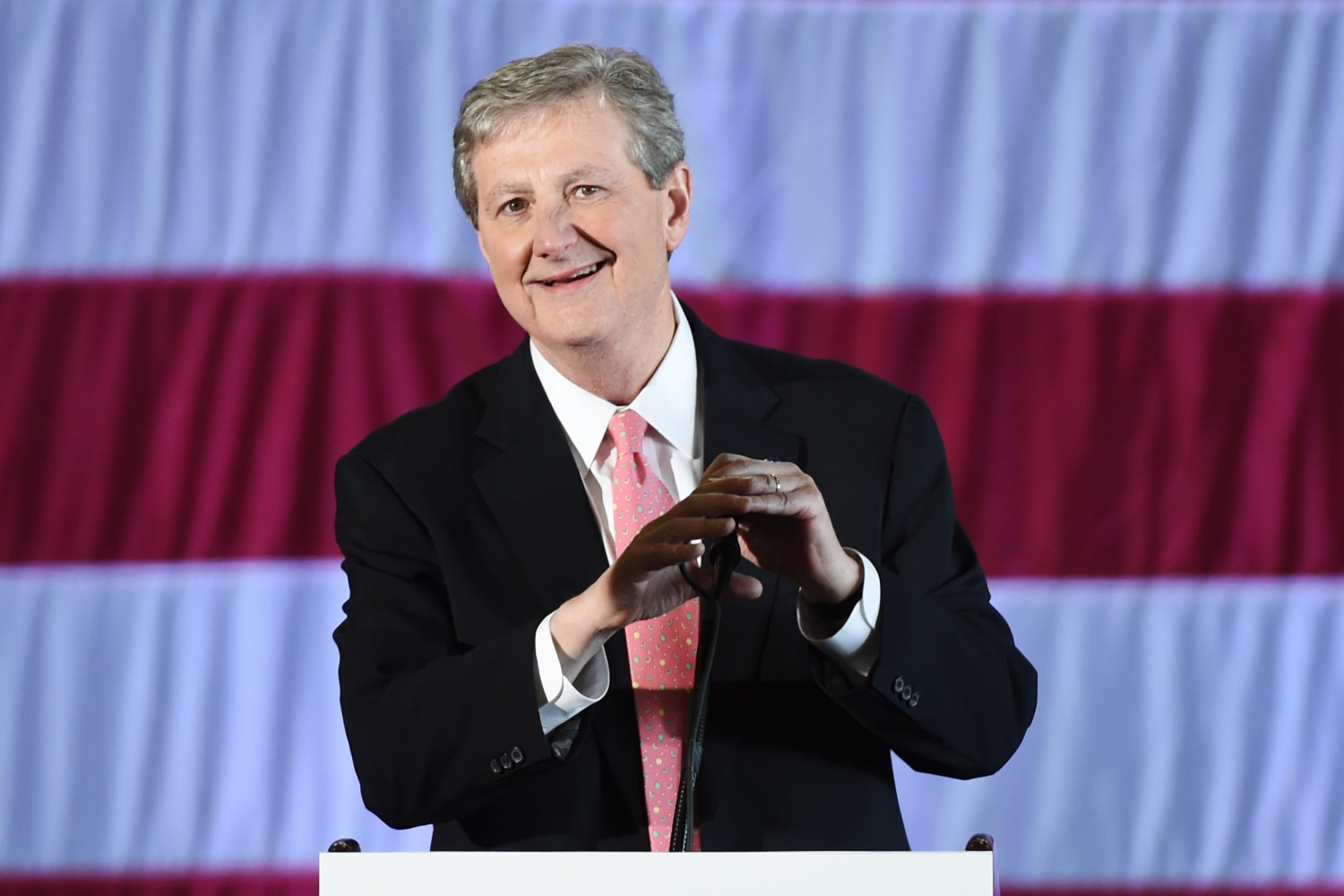
The story credits actor Kevin Sorbo with raising the original question, which has circulated widely across social media.
It then describes Kennedy delivering a carefully worded speech before introducing legislation that would supposedly eliminate congressional protections for dishonest public statements.
However, no authenticated Senate recording or legislative filing confirms that Kennedy delivered the dramatic speech or introduced the specific bill described in the viral account.
The reported silence inside the Senate chamber, Kennedy’s alleged remarks, and the supposed presentation of legislation remain unverified.
Nevertheless, the underlying question involves a genuine legal distinction.
Under federal law, knowingly making certain materially false statements to Congress can result in substantial criminal penalties.
Politicians, meanwhile, generally cannot be imprisoned simply because their public campaign statements are inaccurate or misleading.
That difference reflects constitutional protections, the structure of federal criminal law, and the distinction between government investigations and political speech.
It also creates difficult questions about accountability, public trust, and the boundaries of democratic debate.
Kevin Sorbo’s Question Reignites a Debate About Political Honesty
Kevin Sorbo, known for his acting career and outspoken political commentary, has publicly questioned the standards applied to government officials.
A social media statement attributed to him asks why individuals can face imprisonment for lying to Congress while congressional representatives do not face equivalent punishment for lying to voters.
The question is powerful because it compares two situations that appear similar at first glance.
In both cases, someone communicates information that may be false.
In both cases, the consequences can affect important decisions.
But federal law does not treat these situations identically.
A person providing information during a congressional investigation may be participating in a legally authorized fact-finding process.
Their statements can influence oversight, legislation, or investigations involving possible wrongdoing.
A politician speaking to voters, by contrast, is participating in public political debate.
Such communication receives substantial constitutional protection, even when it includes exaggeration, selective presentation, or disputed factual claims.
The distinction does not mean politicians possess unlimited immunity from every form of dishonesty.
Fraud, bribery, false official filings, obstruction, and other criminal offenses remain subject to applicable laws.
However, making a misleading political argument is not automatically equivalent to providing materially false information during an authorized congressional investigation.
That legal difference is central to understanding Sorbo’s question.
It also explains why creating a criminal prohibition against dishonest political speech would involve considerable constitutional difficulties.
The Five-Year Federal Penalty Is Real
The legal foundation behind the viral argument is Title 18, Section 1001 of the United States Code.
This federal statute prohibits certain knowingly and willfully false statements in matters within federal government jurisdiction.
For ordinary violations, the law authorizes imprisonment for up to five years.
Certain specified offenses carry higher maximum penalties.
The statute covers materially false statements, concealment of material facts under qualifying circumstances, and the use of fraudulent documents.
Importantly, a statement does not always have to be made under oath to violate the statute.
That surprises many people who assume only sworn testimony can result in criminal prosecution.
Federal law distinguishes between perjury and making materially false statements.
Perjury generally involves false statements made under legally specified oath requirements.
Section 1001 can apply without an oath when its other requirements are satisfied.
However, the statute does not criminalize every inaccurate remark made during an encounter with government officials.
Prosecutors must establish the necessary elements of the offense.
Those include knowledge, willfulness, materiality, and the required connection to federal jurisdiction.
Within the legislative branch, the statute is also subject to important limitations.
It generally applies to specified administrative matters and authorized congressional investigations or reviews.
Consequently, the viral claim that any citizen can receive five years in prison for any lie told to Congress oversimplifies the law.
The possibility of prosecution is genuine.
But the circumstances must satisfy specific legal standards.
Why Political Statements Receive Different Treatment
The First Amendment protects freedom of speech, including political expression.
This protection is especially important in discussions involving elections, government officials, and public policy.
Political debate often includes predictions, competing interpretations, criticism, and statements that opponents consider misleading.
Determining whether every disputed assertion qualifies as a criminal falsehood would be extraordinarily difficult.
Consider a lawmaker claiming that a proposed tax policy will create millions of jobs.
An opposing economist might argue that the policy will produce far fewer jobs.
The disagreement does not necessarily establish that the original prediction was knowingly fraudulent.
Similarly, campaign statements frequently concern future actions.
A candidate might promise to support a particular proposal but later vote differently because negotiations produce substantial changes.
Breaking a political promise can create consequences with voters.
It does not automatically constitute a federal crime.
Federal courts have recognized significant constitutional concerns surrounding attempts to punish false statements merely because they are false.
That does not mean deliberately deceptive speech is always protected.

Fraud, defamation, perjury, and other categories of unlawful conduct can be subject to restrictions.
But a criminal law punishing politicians for every misleading public statement would require carefully defined boundaries.
Otherwise, prosecutors could acquire extensive power to investigate ordinary political disagreements.
The danger would extend beyond one party.
Any future administration might attempt to use such authority against its political opponents.
That possibility helps explain why the law distinguishes political accountability from criminal prosecution.
Congress Already Has Special Constitutional Protections
Another important legal issue involves the Constitution’s Speech or Debate Clause.
Article I provides protection for members of Congress engaged in legitimate legislative activity.
The provision is intended to preserve congressional independence from improper interference by the executive and judicial branches.
Courts have interpreted the clause to protect legislative acts, including certain activities directly connected with congressional deliberation.
This protection is significant, but it is not unlimited.
It does not grant members of Congress a general license to commit crimes.
It also does not automatically protect every statement made during a television appearance, campaign event, or social media exchange.
Communications outside the legislative process may receive different legal treatment.
The distinction matters because the viral narrative suggests lawmakers possess a universal right to lie.
That characterization is inaccurate.
Congressional immunity protects specified legislative functions.
It is not a blanket exemption from federal criminal law.
Members of Congress can face prosecution for conduct outside protected legislative activity.
They may also face internal disciplinary proceedings and electoral consequences.
Therefore, the genuine legal debate concerns the boundaries of legislative immunity and public communication.
It is not simply a choice between criminalizing every false statement and permitting unlimited dishonesty.
Kennedy’s Reputation Makes the Viral Story Appear Plausible
John Kennedy has developed a distinctive public reputation through his questioning of government officials and political nominees.
The Louisiana Republican frequently uses short questions, pointed observations, and plain language during hearings.
His exchanges can become widely discussed because they focus attention on statements that might otherwise disappear within lengthy proceedings.
Kennedy has also criticized government spending, administrative decisions, and failures of institutional accountability.
That public record helps explain why the circulating story places him at the center of an argument about congressional honesty.
The imagined confrontation resembles elements of his familiar rhetorical approach.
However, a politician’s established communication style cannot authenticate a particular video or quotation.
The viral account claims that Kennedy removed his glasses, confronted his colleagues, and unveiled proposed legislation.
No verified Senate proceeding has been identified that establishes this sequence.
Nor has an authenticated legislative filing been identified for the described proposal to criminalize congressional lies to the public.
An actual bill would ordinarily have identifiable legislative information.
That information could include a sponsor, introduction date, bill number, text, and committee referral.
A proposal’s existence would not depend solely on a dramatic description circulating online.
Until such records are produced, the alleged legislative announcement should not be treated as a confirmed event.
Can Congress Create Criminal Penalties for Deliberately Misleading Voters?
Congress possesses authority to legislate in areas assigned to the federal government.
However, that authority remains subject to constitutional limitations.
A proposal criminalizing dishonest political statements would immediately raise significant First Amendment questions.
Lawmakers would need to define precisely what conduct the law prohibited.
Would it apply only to knowingly false factual statements?
Would misleading omissions qualify?
How would prosecutors distinguish deliberate deception from mistakes?
Would statements about future economic conditions fall within the law?
Could a politician be prosecuted for repeating inaccurate information received from advisers?
These questions demonstrate why the problem is more complicated than the viral narrative suggests.
A statute that penalizes vague categories of dishonesty could discourage legitimate political debate.
Even politicians who believed their statements were accurate might avoid controversial subjects out of concern about possible prosecution.
The risk would be particularly significant if enforcement decisions were controlled by political opponents.
On the other hand, supporters of stronger accountability may argue that existing consequences are insufficient to deter deliberate public deception.
They may favor improved disclosure requirements, stricter ethics rules, or more effective oversight.
Such reforms would not necessarily require creating a broad new speech crime.
Congress could examine specific situations in which lawmakers provide false official information or violate established disclosure obligations.
It could also consider whether existing ethics procedures provide meaningful accountability.
Those are different legislative questions from granting prosecutors authority to judge the truthfulness of political debate generally.
Congressional Accountability Extends Beyond Criminal Law
Members of Congress are subject to multiple accountability mechanisms.
The House and Senate maintain ethics procedures governing conduct by their members.
These systems address certain conflicts of interest, misuse of office, financial disclosures, and violations of congressional rules.
Both chambers also possess constitutional authority to discipline members.
Serious misconduct can result in formal congressional action under applicable procedures.
Separate federal laws cover conduct such as bribery and certain forms of fraud.
Where legally appropriate, lawmakers may face criminal investigation and prosecution.
There are also political accountability mechanisms.
Voters can evaluate legislative records, campaign promises, and public statements when deciding whether to support an incumbent.
Journalists and independent organizations can compare claims against public data.
Congressional committees can conduct oversight within the limits of their authority.
None of these processes guarantees that every misleading statement will produce meaningful consequences.
They do, however, demonstrate that the legal framework contains more than the two extremes presented by the viral story.
The central policy debate concerns whether these existing mechanisms are sufficiently transparent, consistent, and enforceable.
The Problem of Defining a Political Lie
There is an important difference between a false factual statement and a disputed interpretation.
For example, whether a particular bill passed by a specified margin is generally verifiable.
The official congressional record can establish the result.
By contrast, whether that legislation represents the correct economic strategy is a matter of interpretation and judgment.
Political speeches frequently combine both types of statements.
Some claims can be examined directly against documents and statistics.
Others depend on assumptions, forecasts, and value judgments.
A legal system that treats both categories identically could create serious difficulties.
Even seemingly straightforward numerical claims can involve methodological disagreements.
A politician might refer to employment growth using one statistical period while an opponent uses another.
Both could present accurate figures while offering sharply different interpretations.
Deliberate manipulation is possible.
But establishing intent is different from demonstrating that a statement was incomplete.
A workable accountability system must account for those distinctions.
Otherwise, the threat of prosecution could become a weapon in ordinary political competition.
The question is therefore not simply whether honesty matters.
It is how public institutions can promote honesty without undermining fundamental constitutional protections.
What a Genuine Kennedy Proposal Would Need to Address
If Senator Kennedy introduced legislation addressing dishonest public statements by lawmakers, its actual text would determine its significance.
The proposal would need to identify the conduct being regulated.
It would also need to explain who could enforce the restrictions.
Any criminal penalties would require sufficiently clear definitions and appropriate procedural safeguards.
A bill might instead focus on ethics enforcement or correction of demonstrably false official disclosures.
Those approaches would raise different questions from criminalizing campaign rhetoric.
The legislation would also need to address existing constitutional protections for legislative activities.
Congress cannot simply eliminate a constitutional guarantee through ordinary legislation.
Changing the underlying constitutional text would require the amendment process.
That process involves requirements substantially different from passing a conventional bill.
Therefore, the viral claim that Kennedy could immediately remove Congress’s supposed right to lie through a newly drafted law is legally oversimplified.
The effect of any actual proposal would depend on its terms and constitutional validity.
At present, no verified Kennedy bill matching that description has been established.
Why the Question Continues to Resonate
The popularity of the circulating story reflects an ongoing concern about political credibility.
Americans routinely encounter competing assertions about federal spending, taxes, immigration, healthcare, and national security.
Some disagreements concern genuine differences in policy.
Others involve claims that can be tested against public records.
When elected officials make inaccurate statements, the consequences are not always obvious.
That uncertainty can weaken public confidence in political institutions.
The question associated with Kevin Sorbo draws attention to that concern through a comparison with criminal penalties for false statements.
But the comparison contains important legal differences.
Providing materially false information during an authorized congressional investigation is not the same activity as expressing a political position before voters.
The law treats them differently because they serve different functions and involve different constitutional interests.
That distinction does not make political honesty unimportant.
It means that improving accountability requires more careful analysis than a dramatic confrontation can provide.
Public access to legislative records, financial disclosures, committee proceedings, and official government data can help citizens examine political claims.
Independent reporting and transparent corrections can also contribute to accountability.
The effectiveness of these mechanisms depends on consistent standards and public scrutiny.
The Senate Showdown Remains Unverified, but the Legal Question Is Real
The dramatic account of Kennedy silencing the Senate and unveiling legislation remains unsupported by authenticated congressional records.
There is no verified evidence of the specific speech, the reported chamber-wide reaction, or the described bill.
The federal penalty discussed in the story, however, has a genuine statutory foundation.
Under appropriate circumstances, knowingly making a materially false statement to Congress can carry a prison sentence of up to five years.
The law does not impose the same general criminal penalty on politicians for misleading public campaign statements.
That difference is rooted in the requirements of federal criminal statutes and constitutional protections for political speech.
It also leaves room for continued debate about ethics enforcement and institutional transparency.
The consequential question is not whether Kennedy delivered the theatrical confrontation described online. It is how Congress can strengthen accountability for demonstrably dishonest conduct while preserving the constitutional freedoms that protect political debate.
That issue deserves examination through actual legislation, public records, and constitutional analysis rather than an unverified viral exchange.
