
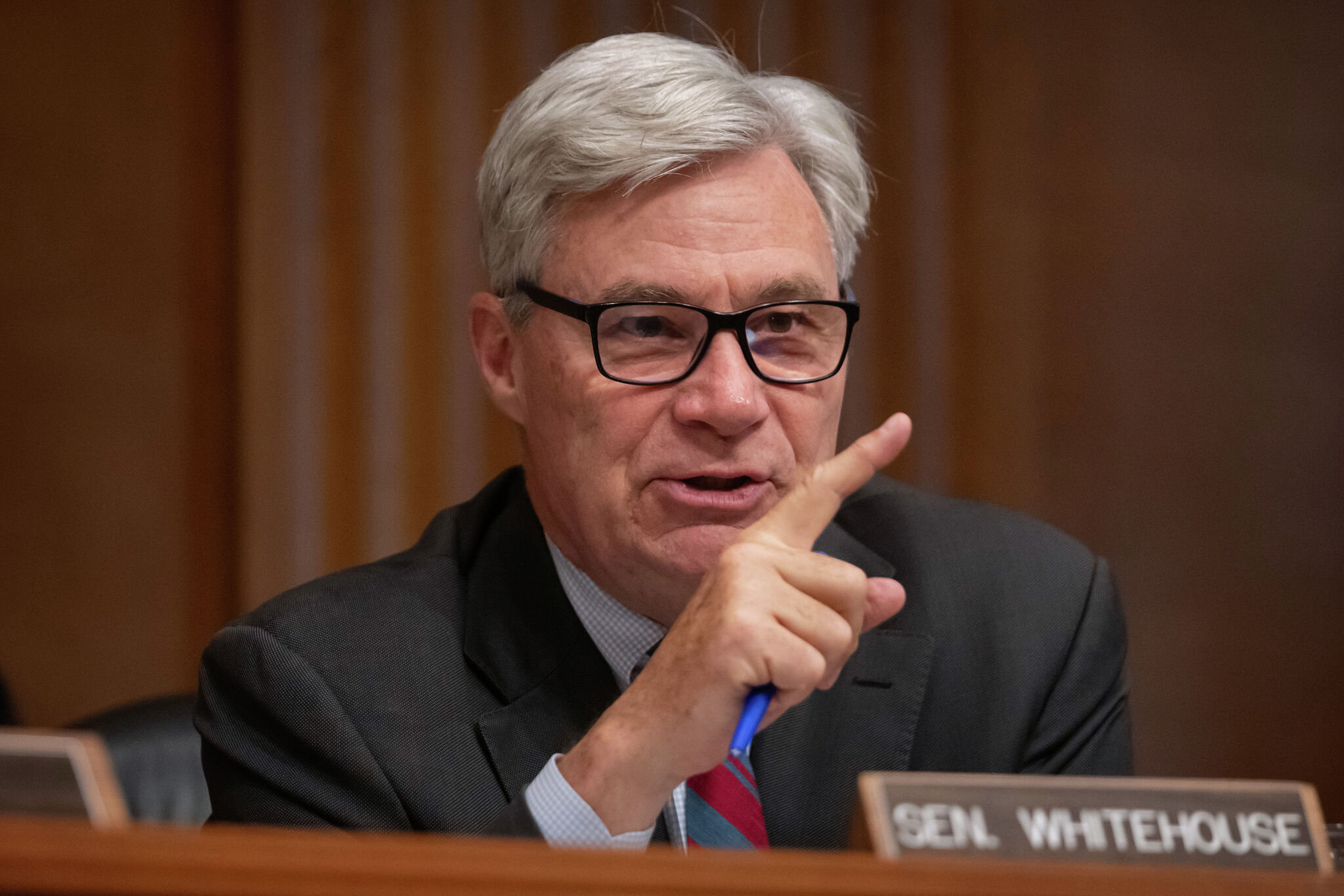
Senator Sheldon White.h.o.u.s.e had barely reached his microphone when an enormous financial diagram appeared on the hearing room’s central screen.
Across the committee table sat Senator R0n Joh.n.s.o.n, who had spent the morning defending the importance of private investment, economic growth, and political participation.

The discussion had begun as an ordinary disagreement about taxation and economic policy.
But White.h.o.u.s.e had prepared something considerably more complicated.
A thick folder rested beside his microphone.
Inside were financial disclosures, organizational charts, political expenditure summaries, and a document describing an offshore account.
White.h.o.u.s.e believed the records raised serious questions about how wealthy donors could influence political debates without appearing directly in public campaign records.
Johnson questioned whether the materials established anything improper.
Neither senator appeared prepared to abandon his position.
Then White.h.o.u.s.e displayed a chart connecting several organizations through a network of financial transactions.
The audience watched as lines stretched between nonprofit groups, political committees, consulting firms, and investment entities.
Johnson leaned forward.
“Senator, are you suggesting that every organization on that screen is involved in illegal activity?”
White.h.o.u.s.e slowly adjusted his glasses.
“No, Senator.”
He paused.
“I’m suggesting we ought to know what the money actually tells us before deciding what it means.”
The chairman requested that he identify the central issue.
White.h.o.u.s.e pointed toward the final box in the diagram.
It contained the name of an offshore financial entity.
And the document beneath it included a transaction that had not appeared in the original public summary.
The confrontation began with a disagreement about whether American economic policy disproportionately benefited wealthy investors.
Johnson argued that investment, entrepreneurship, and private capital were essential to economic growth.
He believed policies discouraging investment could reduce opportunities for workers and businesses.
White.h.o.u.s.e questioned whether political influence was distributed equally when some donors could finance expensive advocacy campaigns.
He argued that the public deserved meaningful information about who paid to influence major policy decisions.
Johnson challenged the assumption that wealthy political participation was automatically corrupt.
White.h.o.u.s.e acknowledged that supporting political causes was not inherently illegal.
But he maintained that lawful spending and transparent spending were not always identical.
The distinction became the foundation of his argument.
White.h.o.u.s.e opened his first document.
It described a hypothetical political advertising campaign focused on corporate tax policy.
The campaign had been financed through several organizations.
One group purchased advertisements.
Another provided research services.
A third contributed funding to support the broader advocacy initiative.
The transactions were presented as a constructed financial example, not authenticated findings about Johnson or his supporters.
White.h.o.u.s.e used the arrangement to examine how funding sources could become difficult to identify.
Johnson questioned the relevance of the example.
“Are you presenting evidence about an actual violation, or explaining how organizations might legally operate?”
White.h.o.u.s.e acknowledged that the diagram illustrated a possible funding structure.
But he argued that the structure raised an important policy question.
Could voters reasonably identify the financial interests supporting major political campaigns?
Johnson responded that disclosure obligations depended on the type of organization and activity involved.
White.h.o.u.s.e agreed.
Then he asked whether existing requirements always provided the information voters wanted.
Johnson replied that political transparency had to be balanced against lawful privacy interests and constitutional protections.
The disagreement was substantive.
White.h.o.u.s.e emphasized public accountability.
Johnson emphasized the importance of distinguishing legitimate political activity from prohibited conduct.
The chairman asked both senators to examine the actual reporting categories.
White.h.o.u.s.e turned to the next document.
It compared direct campaign contributions with independent political expenditures and other advocacy spending.
The distinction mattered.
Money contributed directly to a candidate’s campaign was subject to different rules from qualifying independent expenditures.
Organizations engaging in political advocacy could also operate under different disclosure requirements.
White.h.o.u.s.e argued that these differences sometimes made it difficult to understand the original sources of political messaging.
Johnson responded that different reporting categories existed because the underlying activities were legally distinct.
White.h.o.u.s.e accepted that explanation.
But he questioned whether the public could follow a transaction through several organizations without additional information.
The committee’s financial analyst answered that the result depended on available disclosures and the particular organizations involved.
A transfer between entities did not automatically establish concealment.
Nor did a complicated organizational structure necessarily indicate illegal conduct.
However, incomplete records could make certain financial relationships difficult to examine.
White.h.o.u.s.e pointed toward the diagram.
“That’s the problem I’m trying to identify.”
Johnson leaned toward his microphone.
“Then identify the problem without treating everyone who participates in politics as a suspect.”
White.h.o.u.s.e looked across the table.
“Fair enough.”
He opened another page.
The next document described an illustrative donor who wanted to support a nationwide advocacy campaign.
The donor transferred money to an organization financing political communications.
That organization purchased advertising and consulting services.
The advertisements supported economic policies associated with particular legislative priorities.
White.h.o.u.s.e asked whether the public should know who financed the messaging.
Johnson replied that organizations should comply with applicable disclosure requirements.
White.h.o.u.s.e pressed further.
“What if those requirements don’t reveal the original source?”
Johnson argued that lawmakers could debate changing disclosure rules without accusing individuals of corruption.
The chairman agreed that the distinction was important.
White.h.o.u.s.e then introduced a more complicated arrangement.
The new diagram included an investment company registered outside the United States.
It also showed a domestic organization receiving funds through several intermediary transactions.
The structure immediately attracted attention.
One account was maintained through an offshore financial institution.
White.h.o.u.s.e described the account as a possible source of funding for the hypothetical advocacy operation.
Johnson challenged the presentation.
“Are you saying the account belongs to me?”
White.h.o.u.s.e answered that he was not.
“Are you saying I’ve directed money through it?”
White.h.o.u.s.e again answered no.
Johnson looked toward the chairman.
“Then let’s make that clear before people start drawing conclusions.”
The chairman instructed that the distinction be reflected in the record.
The offshore account was part of the committee’s illustrative financial scenario.
It was not authenticated evidence of an account controlled by Johnson.
That clarification did not end the discussion.
White.h.o.u.s.e still wanted to examine whether an offshore financial relationship could create additional transparency concerns.
He asked the financial analyst whether holding an account abroad was automatically unlawful.
The analyst said it was not.
Individuals and organizations could maintain legitimate foreign accounts, subject to applicable legal and reporting requirements.
The location of an account did not independently establish tax evasion, money laundering, or improper political spending.
White.h.o.u.s.e acknowledged the distinction.
Then he asked whether investigators could encounter difficulties identifying beneficial owners when financial structures involved multiple jurisdictions.
The analyst explained that certain arrangements could complicate tracing ownership.
But the actual difficulty depended on the records available and applicable reporting obligations.
The chairman asked White.h.o.u.s.e to identify what made the account relevant to the political spending example.
White.h.o.u.s.e turned toward a new table.
It contained three payments involving the offshore entity and a domestic financial intermediary.
One payment was labeled as an investment distribution.
Another was categorized as a consulting expense.
The third appeared in a supporting schedule without a detailed description.
White.h.o.u.s.e highlighted the final entry.
The transaction was large enough to attract attention within the illustrative financial records.
But its description did not establish the ultimate purpose of the money.
White.h.o.u.s.e asked whether such an entry warranted additional examination.
The analyst answered that financial investigators would ordinarily examine supporting documentation before drawing conclusions.
An incomplete transaction description could justify requesting clarification.
It did not establish that the payment was unlawful.
Johnson immediately challenged White.h.o.u.s.e.
“Then why put the offshore account on the screen as though you’ve discovered a criminal operation?”
White.h.o.u.s.e replied that the diagram illustrated how financial relationships could become difficult to trace.
Johnson argued that the presentation risked encouraging viewers to infer misconduct without evidence.
White.h.o.u.s.e acknowledged that the chart needed to distinguish verified information from unresolved questions.
The exchange created the first significant turning point.
White.h.o.u.s.e had identified a legitimate transparency concern.
But his presentation could not establish personal wrongdoing simply through visual connections between financial entities.
The chairman requested that staff label the illustrative transactions clearly.
White.h.o.u.s.e agreed.
Then he returned to the final unexplained payment.
He believed the missing description exposed a weakness in the reporting arrangement.
Johnson believed the committee should examine the actual transaction before assuming the funds had supported political activity.
The financial analyst recommended obtaining an invoice, contract, and payment authorization.
Those records could establish what services were purchased.
They could also help determine whether any political reporting obligations applied.
White.h.o.u.s.e accepted the recommendation.
But the next attachment introduced an unexpected complication.
The document contained a supplemental accounting schedule describing the same payment in greater detail.
Its original summary had listed the transaction under general consulting services.
The supplemental schedule identified an investment administration fee.
The payment was connected to managing assets held through the offshore financial structure.
No entry established that the money had been transferred to Johnson.
No record identified his campaign as the recipient.
And no document demonstrated that the transaction funded political advertising.
Johnson turned toward White.h.o.u.s.e.
“So the transaction you highlighted isn’t established as a political contribution.”
White.h.o.u.s.e examined the schedule.
The analyst confirmed that the available description did not support classifying the payment that way.
For several seconds, the hearing room was quiet.
White.h.o.u.s.e then asked whether the original accounting summary had been sufficiently clear.
The analyst answered that the broad description had created ambiguity.
But the supplemental record provided an explanation that changed the transaction’s apparent significance.
The issue was no longer whether the entry proved secret political funding.
It concerned how incomplete financial descriptions could generate misleading interpretations.
Johnson argued that the discovery demonstrated why public accusations required careful verification.
White.h.o.u.s.e agreed that records should be examined in their complete context.
Then he raised a different question.
Even when one suspicious-looking entry turned out to be ordinary, how could regulators and the public distinguish legitimate financial arrangements from improper activity?
The analyst explained that verification required access to relevant records and an understanding of legal reporting standards.
A transaction could not be classified solely by its appearance.
The origin, destination, purpose, and governing rules all mattered.
White.h.o.u.s.e returned to the diagram.
He removed the highlighted line connecting the offshore payment to political advertising.
The corrected chart now separated the verified accounting explanation from the broader advocacy funding example.
That change mattered.
The earlier diagram had suggested a possible relationship that the supporting records did not establish.
The revised diagram reflected the available evidence more accurately.
Johnson asked whether White.h.o.u.s.e would acknowledge that the original implication had been unsupported.
White.h.o.u.s.e answered that the offshore payment had not been shown to finance political communications.
But he maintained that the broader issue of political spending transparency remained unresolved.
Johnson agreed that lawmakers could debate disclosure policy.
He objected to treating wealthy donors as inherently suspect merely because they supported political causes.
White.h.o.u.s.e replied that he was not challenging anyone’s right to participate lawfully.
He was questioning whether the rules provided meaningful information about financial influence.
The chairman asked both senators to consider a practical proposal.
The committee could examine whether certain political spending disclosures needed clearer descriptions of financial relationships.
Such a review would need to respect applicable constitutional protections and distinguish different categories of political activity.
The proposal would not assume that any specific donor had violated the law.
Instead, it would examine the quality of information available to regulators and voters.
White.h.o.u.s.e supported the review.
Johnson expressed concern about burdensome requirements and the potential exposure of lawful private associations.
The disagreement remained.
But the discussion had become more precise.
White.h.o.u.s.e wanted clearer information about political funding.
Johnson wanted safeguards against unjustified accusations and unnecessary disclosure burdens.
The chairman directed the analyst to identify what information would be necessary to evaluate the competing proposals.
The analyst described several considerations.
The committee would need to establish which organizations were covered.
It would need to determine what transactions required disclosure.
It would also need to consider how to distinguish legitimate privacy interests from information relevant to political accountability.
Those questions required legal and policy analysis.
Neither a dramatic diagram nor a single financial entry could resolve them.
White.h.o.u.s.e closed the original folder.
But he had one final question for Johnson.
It concerned the offshore account that had dominated the hearing.
White.h.o.u.s.e turned toward his colleague.
“Senator, if an offshore account appears in a political funding investigation, shouldn’t we establish who owns it before accusing anyone of controlling it?”
Johnson replied that identifying ownership through proper evidence was essential.
White.h.o.u.s.e nodded.
Then he delivered the question that brought the entire confrontation into focus.
“And if we cannot identify the owner, how can anyone responsibly claim to know whose political interests that money serves?”
The room became quiet.
Johnson examined the corrected diagram.
He responded that investigators should avoid conclusions until ownership and transaction details were established.
White.h.o.u.s.e agreed.
The exchange had exposed a problem extending beyond the original hypothetical account.
Financial opacity could make it difficult to establish responsibility.
But the same opacity could also encourage unsupported assumptions about people who had not been connected to a transaction.
Both risks required attention.
The chairman asked the analyst to summarize the evidence presented.
The initial diagram had illustrated a complicated financial structure.
The supplemental schedule had clarified the purpose of the highlighted offshore payment.
The materials did not establish illegal funding involving Johnson.
They also did not demonstrate that a secret account had been used to finance political advertisements.
However, the exercise had identified questions about financial descriptions, beneficial ownership, and political disclosure requirements.
Those questions could be evaluated through a properly designed review.
White.h.o.u.s.e emphasized the importance of transparent reporting.
Johnson emphasized the importance of protecting individuals from allegations unsupported by authenticated records.
The chairman acknowledged both concerns.
Then he proposed that the committee examine reporting standards without treating illustrative transactions as evidence against identifiable officials.
The proposal represented the hearing’s concrete outcome.
The disputed financial chart would be corrected.
The unsupported connection between the offshore account and political advertising would be removed.
And the remaining policy questions would be considered separately.
White.h.o.u.s.e looked toward the revised diagram.
The image was noticeably simpler.
Several lines had disappeared.
The offshore account remained visible.
But it was no longer portrayed as a demonstrated source of political spending.
The correction reduced the visual drama.
It increased the accuracy of the information.
Johnson gathered his notes.
White.h.o.u.s.e returned the financial schedules to his folder.
The chairman prepared to close the hearing.
White.h.o.u.s.e requested one final statement.
“Following the money matters,” he said.
“But following it properly means accepting where the records lead, even when they don’t support the accusation somebody expected.”
Johnson responded that this principle should apply regardless of political affiliation.
White.h.o.u.s.e agreed.
The chairman struck the gavel.
The confrontation ended without establishing a criminal financial scheme.
No authenticated evidence had connected Johnson to the hypothetical offshore account.
No document had demonstrated an illegal payment involving his campaign.
And the most suspicious transaction had received an accounting explanation inconsistent with the original implication.
Nevertheless, the debate had revealed why financial transparency remained a complex policy question.
A legitimate transaction could appear suspicious when viewed without context.
An improper transaction could also be difficult to identify when records were incomplete.
The challenge was distinguishing those possibilities through reliable evidence.
White.h.o.u.s.e’s final question had not proven Johnson guilty of anything.
It had identified the information necessary before anyone could responsibly assign ownership or political responsibility.
The revised diagram remained on the screen as the hearing concluded.
Its missing lines represented allegations that the evidence could not support.
Its remaining entries represented questions still requiring careful examination.
And the most consequential discovery was not an offshore scandal.
It was the difference between tracing a transaction and proving what that transaction meant.
The truth about political money cannot be established by drawing more connections. It requires proving which connections actually exist.
