
“GOVERNOR, YOU CAN’T CALL SOMEBODY HEARTLESS ON MONDAY AND BORROW HIS BULLDOZER ON FRIDAY!”
The words landed in an imagined television studio as Senator John Kennedy leaned toward his microphone.
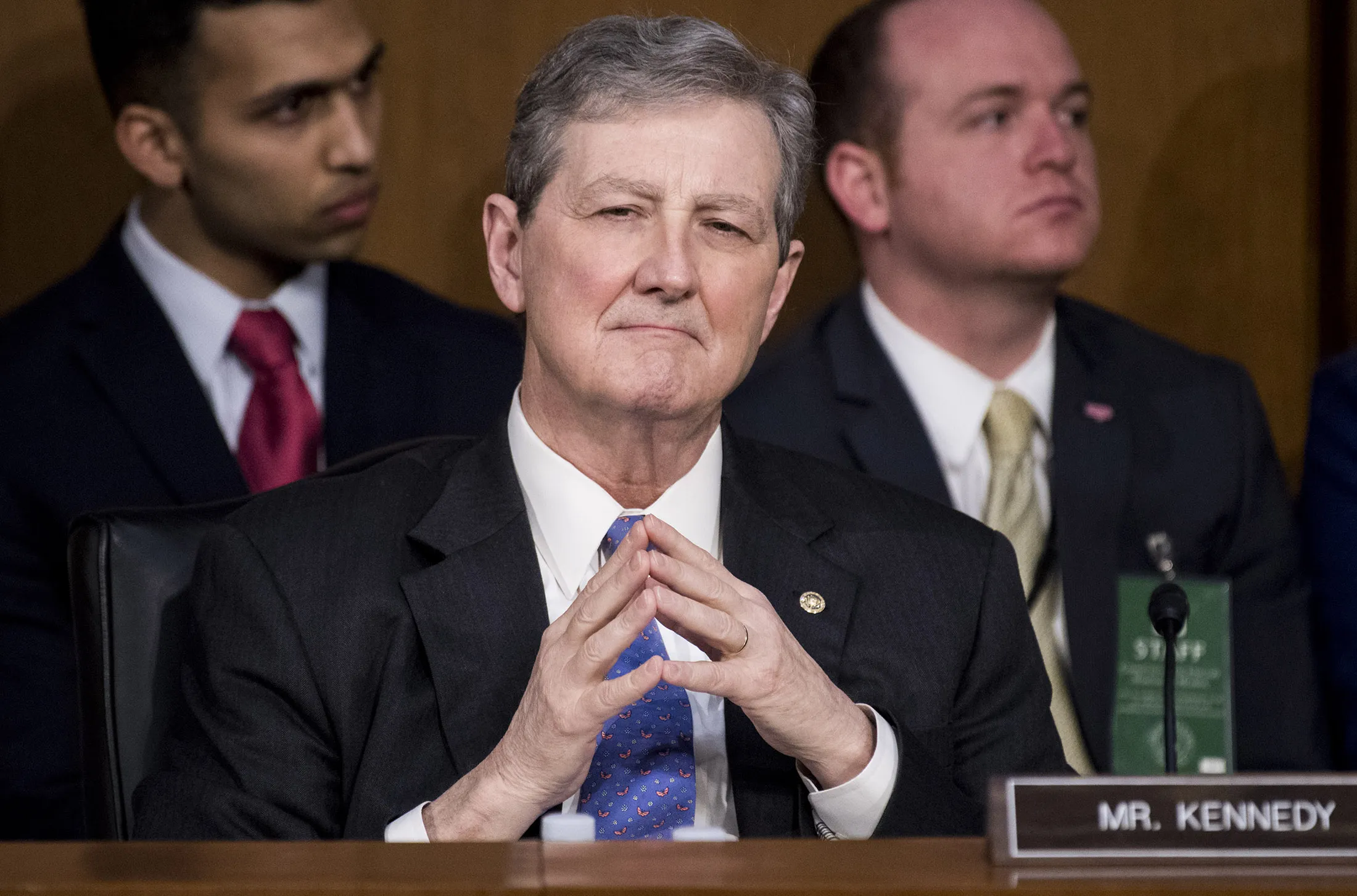
Across the table sat California Governor Gavin Newsom.
Between them lay a stack of printed statements about homelessness, public safety, and the government’s responsibility toward vulnerable people.
The moderator had expected a conventional policy debate.
Kennedy had prepared something different.
He wanted to examine the apparent tension between Newsom’s support for homeless services and his increasingly forceful approach to clearing encampments.
The Louisiana senator adjusted his glasses.
“Governor, I may not be the smartest fellow in this room.”
He paused.
“But I know the difference between helping somebody find a home and making sure nobody can see where they’re sleeping.”
Newsom looked toward the moderator.
Kennedy continued.
“And I’d like to know which one we’re actually talking about.”
THE REAL POLICY SHIFT THAT SPARKED THE CONTROVERSY

California has struggled with a severe homelessness crisis for years.
The problem reflects several overlapping pressures, including high housing costs, limited affordable housing, poverty, and gaps in behavioral healthcare.
Newsom’s administration has invested substantial public resources in housing programs, homelessness prevention, and encampment resolution.
Yet visible encampments have remained a major concern in cities throughout the state.
In June 2024, the United States Supreme Court issued its decision in City of Grants Pass v. Johnson.
The ruling allowed greater enforcement of certain public-camping restrictions without violating the Eighth Amendment under the circumstances addressed by the Court.
The decision changed the legal environment surrounding encampment enforcement.
In July 2024, Newsom issued an executive order directing state agencies to address encampments on state property.
The order also encouraged local governments to adopt approaches consistent with state guidance.
It did not mandate the immediate destruction of every tent in California.
Newsom argued that the state needed to protect public health and safety while connecting unhoused residents with services.
Critics questioned whether enforcement could move people into stable housing or merely displace them.
That unresolved disagreement became the foundation of Kennedy’s fictional challenge.
KENNEDY’S FIRST QUESTION
In the imagined exchange, Kennedy placed a printed statement on the table.
“Governor, do you believe homeless people deserve dignity?”
“Absolutely,” Newsom replied.
“Do you believe they deserve compassion?”
“Of course.”
Kennedy nodded.
“Then help me understand something.”
“If a homeless person deserves compassion when he’s sleeping in a tent, does he stop deserving it when somebody complains about that tent?”
Newsom explained that governments must balance individual needs with public safety.
He emphasized that encampments can expose residents to dangerous conditions.
Kennedy listened.
“I’m not arguing that living on a sidewalk is safe.”
“I’m asking what happens to the person after the sidewalk gets cleared.”
The fictional governor responded that outreach teams and housing programs were intended to provide alternatives.
Kennedy leaned forward.
“Intended to, Governor, or actually doing it?”
THE DIFFERENCE BETWEEN CLEARING A CAMP AND ENDING HOMELESSNESS
The distinction matters.
Removing an encampment can address immediate hazards involving blocked sidewalks, sanitation, fire risks, and access to public spaces.
But the removal itself does not establish that residents have obtained permanent housing.
Some individuals may enter shelters or temporary accommodation.
Others may move to nearby streets, parks, or other unsheltered locations.
The outcomes depend on available services, housing capacity, individual circumstances, and implementation.
Supporters of encampment enforcement argue that governments cannot ignore dangerous conditions in public spaces.
They also emphasize the rights of pedestrians, businesses, and surrounding communities.
Opponents warn that repeated displacement can interrupt healthcare, separate people from outreach workers, and make homelessness harder to resolve.
The policy question is therefore broader than whether encampments should remain untouched.
It concerns what governments must provide before, during, and after enforcement.
THE PRINTED STATEMENTS KENNEDY PLACED ON THE TABLE
In the fictional studio, Kennedy arranged two pages side by side.
The first summarized Newsom’s public commitment to addressing homelessness through housing and supportive services.
The second described California’s 2024 encampment executive order and its subsequent push for stronger local enforcement.
Kennedy tapped the first page.
“Governor, compassion is a mighty fine word.”
Then he tapped the second.
“But it doesn’t tell us whether the person who lost his tent found a bed.”
Newsom explained that enforcement and compassion were not necessarily contradictory.
He argued that leaving people in dangerous encampments could itself be inhumane.
Kennedy acknowledged the argument.
“That’s a fair point.”
“But if we’re going to call a policy compassionate, shouldn’t we measure what happens to the people affected?”
The moderator intervened.
“Senator, are you suggesting the governor’s position is hypocritical?”
Kennedy shook his head.
“I’m suggesting we ought to ask whether the policy matches the promise.”
NEWSOM’S ACTUAL DEFENSE OF ENCAMPMENT ENFORCEMENT
Newsom’s public position has not been limited to protecting encampments from removal.
His administration has argued that unsafe encampments must be addressed while residents are connected with shelter, housing, and services.
The 2024 executive order instructed state agencies to adopt policies addressing encampments on state property.
It emphasized notice and assistance for affected residents.
In May 2025, Newsom released a model ordinance encouraging local governments to restrict persistent public camping and encampments obstructing sidewalks.
The model called for reasonable efforts to identify shelter options before removal.
Newsom argued that allowing dangerous street conditions to continue was not a compassionate response.
Critics maintained that stronger enforcement could worsen displacement if suitable alternatives remained unavailable.
These positions reflect a substantive disagreement over policy outcomes, rather than proof that every change in enforcement represents political hypocrisy.
THE FINAL YES-OR-NO QUESTION
In the imagined confrontation, Kennedy gathered his papers.
“Governor, I want to ask you one final question.”
Newsom waited.
“Suppose a city clears a homeless encampment.”
“The sidewalks are clean.”
“The cameras are gone.”
“The politicians hold their press conference.”
“But the people who lived there are still sleeping outside, just three blocks away.”
Kennedy leaned forward.
“Have we solved homelessness?”
Newsom answered that such an outcome would not constitute a lasting solution.
Kennedy nodded.
“Then there’s our common ground.”
He placed the two documents together.
“Because moving a problem out of sight isn’t the same thing as fixing it.”
The fictional studio fell silent.
The moderator turned toward Newsom, who reiterated the importance of shelter capacity, housing investment, and public safety.
Kennedy delivered his final challenge.
“Governor, yes or no: If government removes a homeless person’s shelter without providing a realistic alternative, can it honestly call that a victory for compassion?”
The question remained at the center of the debate.
THE QUESTION CALIFORNIA STILL FACES
California’s homelessness policies involve difficult trade-offs.
Residents deserve accessible public spaces and protection from hazardous conditions.
People experiencing homelessness deserve humane treatment, due process, and meaningful opportunities to obtain shelter and housing.
Public officials must decide how to balance these responsibilities with limited resources.
The effectiveness of encampment enforcement cannot be established solely by counting cleared sites.
It also requires examining whether affected individuals obtain stable accommodation and appropriate services.
Should governments clear dangerous encampments when sufficient shelter is unavailable?
Should public agencies publish more detailed outcomes for people displaced by enforcement actions?
And should success be measured by cleaner streets, fewer people experiencing homelessness, or both?
These questions apply to officials across the political spectrum.
A policy may improve public safety while still leaving significant humanitarian concerns unresolved.
Another policy may prioritize housing assistance while failing to address immediate hazards.
The challenge is determining which combination of measures produces durable improvements.
Because removing a tent can change the appearance of a street overnight.
But changing the circumstances that forced someone to sleep there requires something far more difficult.
And the most important question is not whether the encampment disappeared.
It is where the people went afterward.
