
John Kennedy and Chuck Schumer Face a December Funding Showdown as Shutdown Fears Grow
Washington is approaching another critical budget deadline, and the political stakes are rising as Republicans and Democrats struggle to agree on how to keep the federal government operating beyond December 11. At the center of the dispute are competing demands over government spending, military operations in Iran and the extent to which Congress should use its funding authority to influence the president’s foreign policy.
The immediate warning came from Republican Senator John Kennedy of Louisiana, who addressed the issue on the Senate floor on November 17. Kennedy argued that the government would shut down on December 11 unless Congress acted, placing responsibility for the next decision on his Democratic colleagues.
His remarks reflected a growing Republican argument that Democrats could trigger a funding crisis if they insisted on attaching restrictions on the administration’s military campaign in Iran to a government spending agreement.

“If they make the budget or the CR contingent upon us cutting and running in Iran, yeah, we’ll have a shutdown,” Kennedy said in a separate public comment reported by Punchbowl News. “But that’s a decision my Democratic colleagues have to make.”
The statement captured the central disagreement now confronting lawmakers. Republicans want Congress to approve the spending measures needed to maintain federal operations, while a group of Democratic senators is demanding that any additional funding agreement restrict the administration’s ability to continue military operations against Iran.
The current deadline was established by a temporary funding measure signed into law in September. That legislation provides federal agencies with funding through December 11, giving lawmakers additional time to negotiate the full-year appropriations bills for fiscal year 2027. If Congress fails to pass new legislation before the deadline, a funding gap could begin the following day, potentially forcing affected government agencies to suspend certain operations.
The dispute has become more complicated because the disagreement over Iran is not limited to Republicans and Democrats. It is also exposing differences within the Democratic Party over how aggressively the party should use its congressional leverage.

Senator Chris Van Hollen of Maryland has emerged as one of the most vocal advocates for attaching restrictions on Iran war spending to the next funding measure. Alongside Senators Michael Bennet, Bernie Sanders and Tammy Duckworth, Van Hollen issued a joint statement on November 12 opposing any year-end spending agreement that would allow the administration to continue the conflict without additional congressional restrictions.
The senators argued that Congress should not approve another short-term funding package while providing billions of dollars that could support continued military operations. They called for language explicitly restricting the use of appropriated funds for the war.
Their position places the December deadline at the center of a broader debate over presidential authority, congressional oversight and the financial costs of military action abroad.
Van Hollen has also argued that Democrats should be prepared to withhold support for a government funding measure if Republicans refuse to accept restrictions on the conflict. In public remarks, he has framed the issue as a question of whether Congress should continue approving money for a military campaign that he and other critics believe should end.
For Republicans, that approach raises the possibility that an international policy dispute could prevent Congress from completing one of its most basic responsibilities: financing the federal government. Kennedy’s warning reflects that concern, with Republicans arguing that funding legislation should not become a vehicle for imposing unrelated political demands on the administration.
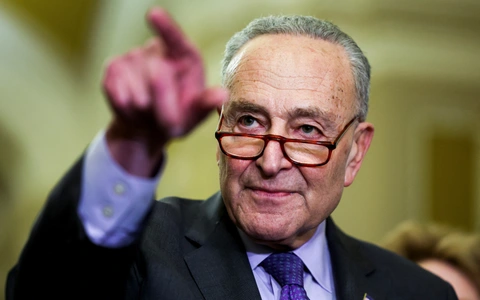
The position of Senate Democratic Leader Chuck Schumer is more complicated than the dramatic version of the dispute circulating online suggests. Schumer has previously described the existing bipartisan continuing resolution as a responsible measure that would keep the government open while negotiations continued. He has also emphasized Democrats’ willingness to work across party lines on a broader budget agreement.
However, Schumer has not publicly adopted the same explicit December shutdown strategy advocated by Van Hollen. Reporting on the negotiations indicates that Democratic leaders are weighing several possible approaches, including a shorter extension that would keep the government operating into the new year and allow the next Congress to take up longer-term spending decisions.
That distinction matters because the Democratic caucus is not united behind a single strategy. Some senators want to use the deadline immediately to force a change in Iran policy. Others are concerned that a shutdown could damage the party’s political position, disrupt federal services and create additional pressure on government employees and military families.
The leadership contest between Schumer and Van Hollen adds another dimension to the negotiations. Van Hollen is challenging Schumer for the position of Senate Democratic leader, arguing that the party needs a more forceful approach. Their disagreement over the December funding deadline has become one of the clearest policy differences in that internal contest.
Schumer must therefore navigate two separate challenges: negotiating with Republicans to prevent a funding lapse and maintaining support within a caucus that is debating how far it should go in confronting the administration over Iran.
The issue is also complicated by the political transition following the November midterm elections. Democrats are preparing to take control of both chambers of Congress in January, giving them a stronger position in future negotiations over federal spending. That prospect has encouraged some lawmakers to favor a short-term funding extension rather than accepting a comprehensive agreement before the end of the year.
Republicans, meanwhile, remain in control during the current lame-duck session and want to use the remaining weeks to advance their spending priorities. The two parties therefore face different incentives, even as both publicly maintain that keeping the government operational is important.
The disagreement over Iran funding could make negotiations especially difficult. Democratic senators argue that Congress should exercise its constitutional authority over federal spending to prevent further financing of military operations they oppose. Republicans counter that restrictions inserted into an essential funding bill could undermine negotiations and make a shutdown more likely.
There are also practical questions that lawmakers must resolve. They need to determine how long a new continuing resolution should last, which spending provisions should be included and whether any language addressing Iran can secure enough support to pass both chambers and receive the president’s signature.
Even a temporary agreement would not necessarily settle the broader dispute. It could simply postpone the confrontation until January, when the new Congress begins operating and Democrats gain greater influence over the legislative agenda.
For now, Kennedy’s warning has placed renewed attention on the approaching deadline, while Van Hollen’s demands have intensified the debate over whether federal funding should be used as leverage to change the administration’s military policy. Schumer faces pressure from both sides as he attempts to preserve room for negotiations without alienating senators who want a tougher response.
December 11 is therefore more than an administrative date on the congressional calendar. It represents a test of whether lawmakers can separate their disagreements over foreign policy from the immediate responsibility of funding government operations.
If they reach an agreement, federal agencies can continue operating while the larger budget debate moves forward. If negotiations collapse, the consequences could extend far beyond the Senate chamber, affecting public services, federal employees and communities that depend on government programs.
The central question remains unresolved: will Congress approve a temporary funding measure without major policy conditions, or will the dispute over Iran become a decisive obstacle to keeping the government open?
