
Senator John Kennedy turned a routine congressional hearing into a heated confrontation when he challenged Homeland Security Secretary Alejandro Mayorkas over millions of migrant encounters at America’s borders.
The Louisiana Republican wanted answers about immigration enforcement, asylum procedures, national security screening, and the Biden administration’s handling of the southern border.
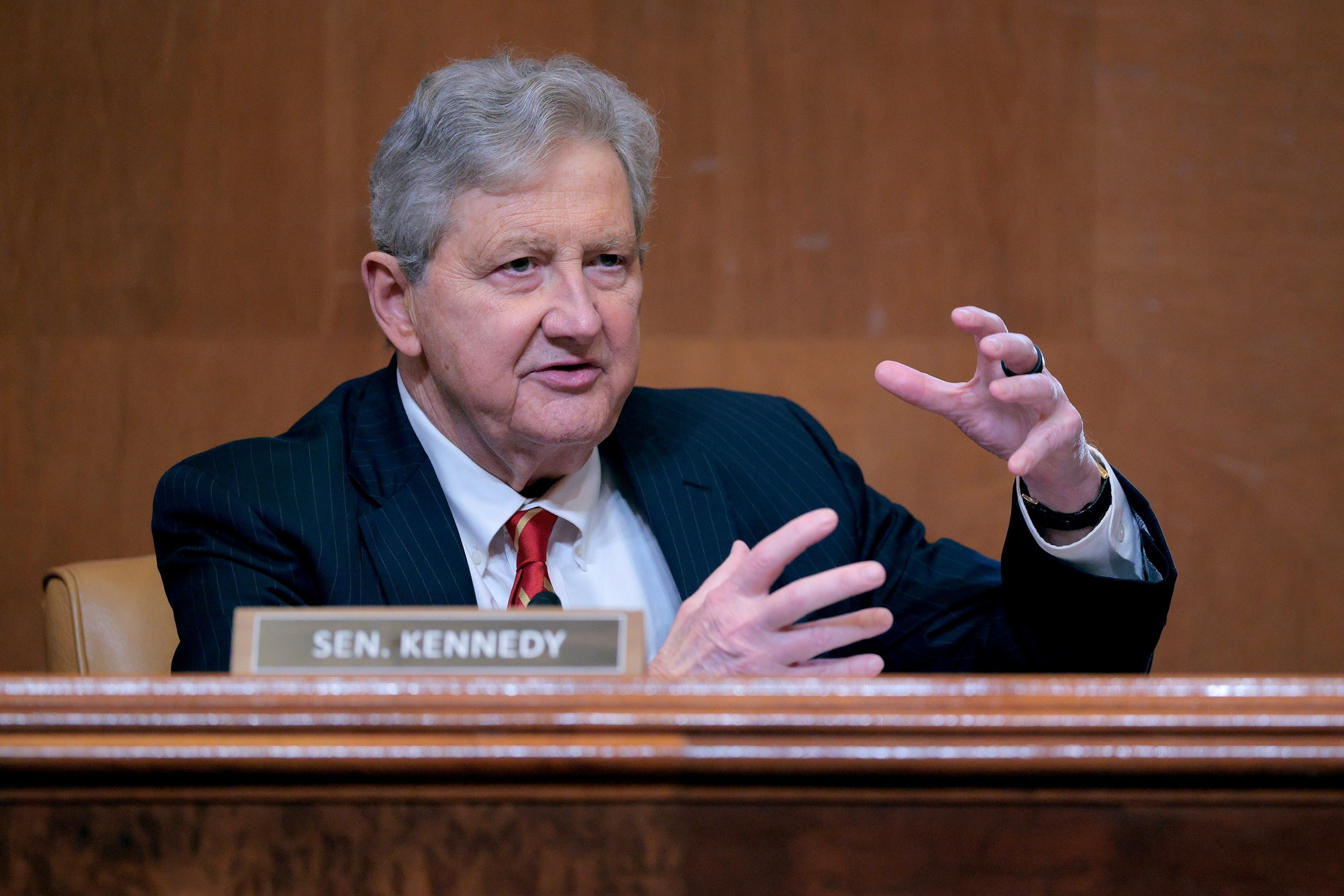
But the exchange quickly became much more contentious.
Kennedy repeatedly pressed Mayorkas to explain the scale of migration during President Joe Biden’s administration and whether federal authorities could adequately screen everyone entering the country.
The secretary defended the department’s enforcement procedures, arguing that officers screened and vetted individuals encountered at the border.
Kennedy remained dissatisfied.
He cited an estimate exceeding eight million and demanded an explanation of why the administration had not adopted a broader safe-third-country asylum approach.
Mayorkas disputed the senator’s interpretation of the figures and challenged his description of the proposed policy.
The confrontation reached its sharpest moment when Kennedy questioned whether the secretary was capable of managing a Costco food court.
The remark immediately drew objections from the committee chair and a pointed response from Mayorkas.
Yet the most consequential disagreement concerned something far more substantial than Kennedy’s sarcasm.
The two officials were describing immigration numbers differently, and that distinction changed what their competing claims could establish.
Kennedy Opens With a Question About Border Security
The confrontation occurred on November 8, 2023, during a Senate Appropriations Committee hearing examining emergency funding requests for the Departments of Homeland Security and Health and Human Services.
The witnesses included Homeland Security Secretary Alejandro Mayorkas and Health and Human Services Secretary Xavier Becerra.
The hearing addressed border security, immigration processing, humanitarian responsibilities, and the federal resources required to manage increasing migration.
When Kennedy received his opportunity to question the witnesses, he immediately directed his attention toward Mayorkas.
His opening questions concerned potential national security threats at the southern border.
Kennedy asked whether the department was aware of any Hamas members entering the United States across that border during Biden’s presidency.
Mayorkas responded that he was unaware of any such individuals crossing or being encountered there.
Kennedy then shifted toward the broader question of immigration screening.
He wanted to know whether federal authorities had vetted everyone included in his estimate of approximately 8.4 million migrant arrivals.
Mayorkas explained that the department screened and vetted people encountered by immigration authorities.
Kennedy repeatedly demanded a more categorical answer.

The distinction became important because border officials cannot personally screen individuals who successfully evade detection.
Mayorkas emphasized the screening procedures applied to those encountered by federal authorities.
Kennedy argued that the administration could not adequately account for everyone entering unlawfully.
The exchange created immediate tension.
The senator wanted an answer about the completeness of immigration enforcement.
The secretary was explaining the operational limits of the government’s screening responsibility.
Both positions raised questions about the scope of the available information.
But the hearing had not yet established that eight million separate individuals had entered and remained inside the United States.
That difference would become central to evaluating Kennedy’s subsequent questions.
The 8.4 Million Figure Becomes the Center of the Clash
Kennedy repeatedly cited an estimate of approximately 8.4 million people when criticizing the administration’s border policies.
He later proposed using a lower figure of 6.6 million, explaining that his larger estimate included people who had avoided apprehension.
The senator argued that the figures demonstrated an unacceptable failure of immigration enforcement.
Mayorkas disputed the way Kennedy characterized the data.
The disagreement concerned the difference between migrant encounters, unlawful entries, releases, and individuals who successfully evaded border authorities.
These categories are not interchangeable.
Customs and Border Protection records an encounter when a person is apprehended, processed, or determined to be inadmissible under relevant enforcement procedures.
One individual can generate multiple encounters by making repeated attempts to cross the border.
That became especially important during the period when Title 42 public health restrictions remained in effect.
The policy permitted many migrants to be expelled without entering the ordinary immigration removal process.
Some individuals subsequently attempted to cross again, generating additional recorded encounters.
As a result, a total exceeding eight million encounters does not necessarily represent eight million distinct people living unlawfully in the country.
Nor does an encounter automatically mean that a person was released into the United States.
Some individuals were removed, expelled, detained, transferred for further processing, or handled through other immigration procedures.
The numbers also do not include every person who successfully entered without detection.
Kennedy’s central concern involved the difficulty of measuring the full scale of unauthorized migration.
Mayorkas maintained that the senator’s figures and conclusions did not accurately describe the department’s activities.
That dispute revealed an important limitation in the political debate.
A single headline number cannot establish how many unique individuals entered unlawfully, received asylum processing, or remained in the country.
Those questions require separate datasets and clearly defined reporting periods.
Kennedy nevertheless continued pressing the administration about its ability to manage a substantial volume of migration.
His next subject was a policy he believed could dramatically reduce asylum claims.
Kennedy Introduces the Safe Third Country Proposal
Kennedy turned his attention toward the concept of a safe-third-country asylum policy.
He asked Mayorkas to explain how such arrangements operate.
The secretary described a system in which an asylum seeker who has passed through another country offering protection may, under applicable rules, be required to pursue protection there.
Kennedy framed the concept as a way to reduce the number of migrants seeking asylum in the United States.
He pointed to several countries and regions that had adopted forms of safe-third-country arrangements.
His argument centered on people who traveled through countries other than their places of origin before reaching the American southern border.
Kennedy suggested that migrants who had already reached a safe country should generally be required to seek asylum there.
He then introduced a chart attributed to Senator John Hoeven.
According to Kennedy’s presentation, approximately 71 percent of the relevant 2023 border encounters involved people who were not Mexican nationals.
He argued that applying a broader safe-third-country requirement could substantially change asylum processing for those individuals.
But Mayorkas challenged that conclusion.
The secretary argued that Kennedy’s explanation omitted important legal and practical conditions governing such arrangements.
A safe-third-country agreement is not simply a rule allowing the United States to return anyone who traveled through another country.
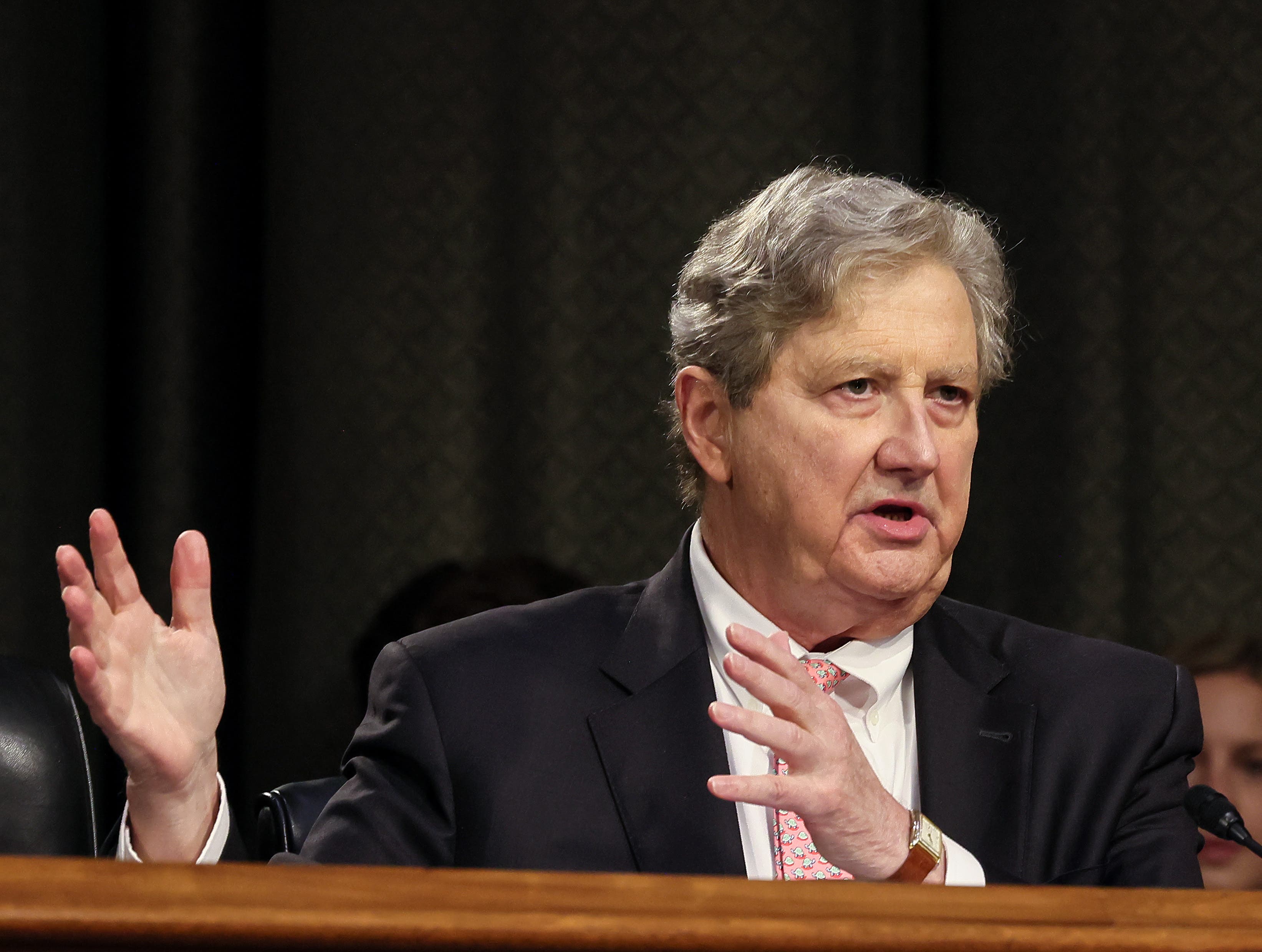
Such arrangements depend on legal authority, international cooperation, and whether the receiving country provides appropriate protections.
The United States also has obligations under domestic immigration law and relevant international protection frameworks.
Mayorkas attempted to explain those requirements.
Kennedy repeatedly interrupted, saying that the secretary was consuming the limited time available for questioning.
The exchange became increasingly confrontational.
Kennedy treated the policy as an available enforcement tool that the administration had failed to use adequately.
Mayorkas disputed the senator’s assumptions and sought to explain why implementation involved additional requirements.
Neither side was willing to abandon its interpretation.
The disagreement had moved beyond the number of migrant encounters.
It now concerned whether Kennedy’s proposed asylum restrictions could be implemented as broadly as he suggested.
The Question Mayorkas Tried to Answer
Kennedy argued that the administration had abandoned important restrictions previously used to manage asylum claims.
He suggested that requiring more applicants to seek protection in transit countries could reduce pressure on American immigration facilities.
Mayorkas responded that safe-third-country arrangements required agreements and appropriate protections.
He pointed to the United States’ relationship with Canada as an example of an existing arrangement.
That response complicated Kennedy’s suggestion that the administration had simply eliminated all such policies.
The United States and Canada had maintained a safe-third-country agreement, and the Biden administration had negotiated changes to its application.
Kennedy continued questioning the secretary about international examples.
He referenced the United Kingdom, Spain, Greece, Norway, Turkey, and other jurisdictions.
Mayorkas did not provide immediate confirmation for every country Kennedy named.
At one point, the secretary questioned why Kennedy was asking questions when he appeared already to possess the answers.
Kennedy interpreted the exchange as further evidence that the administration lacked command of important immigration policy details.
Mayorkas maintained that the senator was mischaracterizing his answers.
The confrontation revealed a significant disagreement about how congressional oversight should operate.
Kennedy wanted concise responses that would allow him to challenge particular policy decisions.
Mayorkas wanted sufficient time to explain the legal and operational context.
Both concerns were visible in the official hearing record.
The senator’s allotted time was limited.
The secretary’s answers involved complex policies that could not always be reduced to simple numerical responses.
The tension increased when Kennedy accused Mayorkas of prolonging his answers to avoid direct questions.
The secretary rejected that characterization.
The disagreement soon drew the attention of committee chair Patty Murray.
She reminded Kennedy that his questioning time had expired.
But the senator continued toward the remark that would become the most widely discussed moment of the exchange.
Kennedy’s Costco Remark Sparks a Heated Response
As the confrontation reached its final moments, Kennedy delivered a harsh assessment of Mayorkas’s handling of immigration policy.
He suggested that the secretary was either incapable of managing a Costco food court or supported an open-border approach.
Kennedy made clear that he favored the latter interpretation.
The remark reflected his argument that the administration’s policies were intentional rather than merely the result of administrative difficulties.
Murray intervened, reminding the senator that his allotted time was over.
Mayorkas rejected both alternatives.
He disputed Kennedy’s characterization of his professional qualifications and his position on border enforcement.
The secretary then criticized the interruptions that had prevented him from completing several answers.
Another Democratic senator, Chris Murphy, addressed the exchange immediately afterward.
Murphy argued that witnesses should be allowed enough time to respond to complicated questions.
He questioned whether interrupting officials after only a few seconds helped the committee examine policy effectively.
Murphy also emphasized that immigration problems could not be attributed exclusively to executive-branch decisions.
Congress, he argued, had failed for decades to reach agreement on comprehensive changes to the immigration system.
That observation introduced another dimension to the confrontation.
The executive branch administers immigration laws, but Congress determines much of the statutory framework under which agencies operate.
Funding, staffing, asylum standards, detention capacity, and immigration court resources all affect enforcement outcomes.
A government agency can face operational problems because of administrative decisions, statutory constraints, insufficient resources, or several factors simultaneously.
Murphy emphasized the importance of increasing asylum processing capacity.
He argued that additional personnel could shorten delays and improve the efficiency of immigration adjudication.
Mayorkas subsequently explained that more asylum officers and support staff could accelerate interviews and case processing.
That response did not resolve Kennedy’s criticism.
It did, however, identify another policy approach that could be evaluated alongside the senator’s proposed restrictions.
The confrontation therefore exposed more than a disagreement about one official’s management abilities.
It illustrated competing priorities involving enforcement, asylum access, government resources, and congressional responsibility.
What the Immigration Numbers Actually Establish
The most important factual question remained whether Kennedy’s figures demonstrated that approximately eight million people had entered the United States unlawfully.
The available government statistics do not support treating the cited encounter totals as a direct count of distinct unauthorized entrants.
Customs and Border Protection reported nearly 2.8 million nationwide encounters during fiscal year 2022.
The total increased to approximately 3.2 million in fiscal year 2023.
Fiscal year 2021 had recorded approximately two million nationwide encounters.
Those figures demonstrate the substantial scale of immigration enforcement activity during the period.
But they cover encounters rather than a confirmed count of people who entered and remained unlawfully.
Some records concern migrants apprehended between official ports of entry.
Others concern individuals processed at official ports, including people seeking humanitarian protection.
Still others involve encounters followed by removal or expulsion.
Repeated encounters can also increase totals without representing additional unique individuals.
Kennedy’s inclusion of estimated undetected border crossings introduced another statistical category.
Such estimates attempt to measure individuals who avoided apprehension.
They are inherently different from documented encounters involving people processed by federal officers.
Combining those categories requires careful explanation to prevent misleading conclusions.
The senator was raising an important question about the government’s ability to account for migration.
However, the total he cited could not, by itself, answer how many people had successfully settled inside the country.
Another unanswered question concerned asylum adjudication.
Kennedy’s exchange with Mayorkas did not produce a comprehensive accounting of applications, missed court appearances, completed removals, and final asylum decisions.
Those outcomes occur at different stages of the immigration process.
They also involve agencies beyond Customs and Border Protection, including immigration courts and other parts of the Department of Homeland Security.
A complete assessment would require information about case outcomes rather than relying exclusively on border encounters.
That distinction matters because encountering a migrant is only the beginning of many immigration proceedings.
Some cases result in removal.
Others involve asylum applications, administrative reviews, or additional legal proceedings.
The effectiveness of immigration policy therefore depends on what happens after the initial encounter, not just how many encounters occur.
The Final Revelation Behind Kennedy’s Senate Confrontation
Kennedy’s questioning became memorable because of his sharp language and repeated challenges to Mayorkas.
The senator demanded answers about national security screening, migration totals, asylum processing, and enforcement priorities.
His proposed safe-third-country approach became the central policy disagreement.
The exchange reached its most confrontational moment when Kennedy questioned Mayorkas’s ability to manage even a relatively simple operation.
Mayorkas rejected the characterization and argued that the senator had prevented him from fully explaining important details.
The official transcript confirms that both men participated in a tense exchange.
It also shows that the most dramatic social media descriptions omit important context.
Kennedy cited approximately 8.4 million before shifting to a lower figure of 6.6 million for part of his argument.
Those numbers were not an established count of eight million distinct migrants admitted illegally.
His argument also depended on assumptions about how broadly safe-third-country restrictions could be applied.
Mayorkas contested those assumptions and pointed toward legal requirements governing international asylum arrangements.
The confrontation did not produce a committee finding that the secretary supported open borders.
Nor did it establish that the proposed policy would automatically eliminate the majority of asylum claims.
What the exchange demonstrated was a fundamental disagreement about how to measure and manage unauthorized migration.
Kennedy emphasized the scale of border encounters and the need for stronger restrictions.
Mayorkas emphasized screening procedures, legal obligations, and the complexity of implementing alternative asylum policies.
Murphy subsequently highlighted the importance of congressional funding and legislative reform.
Together, those arguments revealed why immigration enforcement cannot be evaluated through one number or one exchange.
Border security involves determining who is encountered, who is admitted, who is detained, who is removed, and who receives lawful protection.
Each category presents different legal and administrative questions.
A government may encounter millions of people without allowing all of them to remain.
Conversely, successful border enforcement cannot be measured solely by the number of encounters recorded.
The hearing exposed the need for clearer reporting and more precise definitions.
Those requirements matter regardless of which political party controls the White House.
Kennedy’s questioning raised legitimate oversight questions about migration and government accountability.
Mayorkas’s responses raised important issues concerning the accuracy of statistics and the practical limits of proposed policy changes.
The confrontation ended without a detailed resolution of every question.
But the historical record preserves both the senator’s challenges and the secretary’s objections.
