
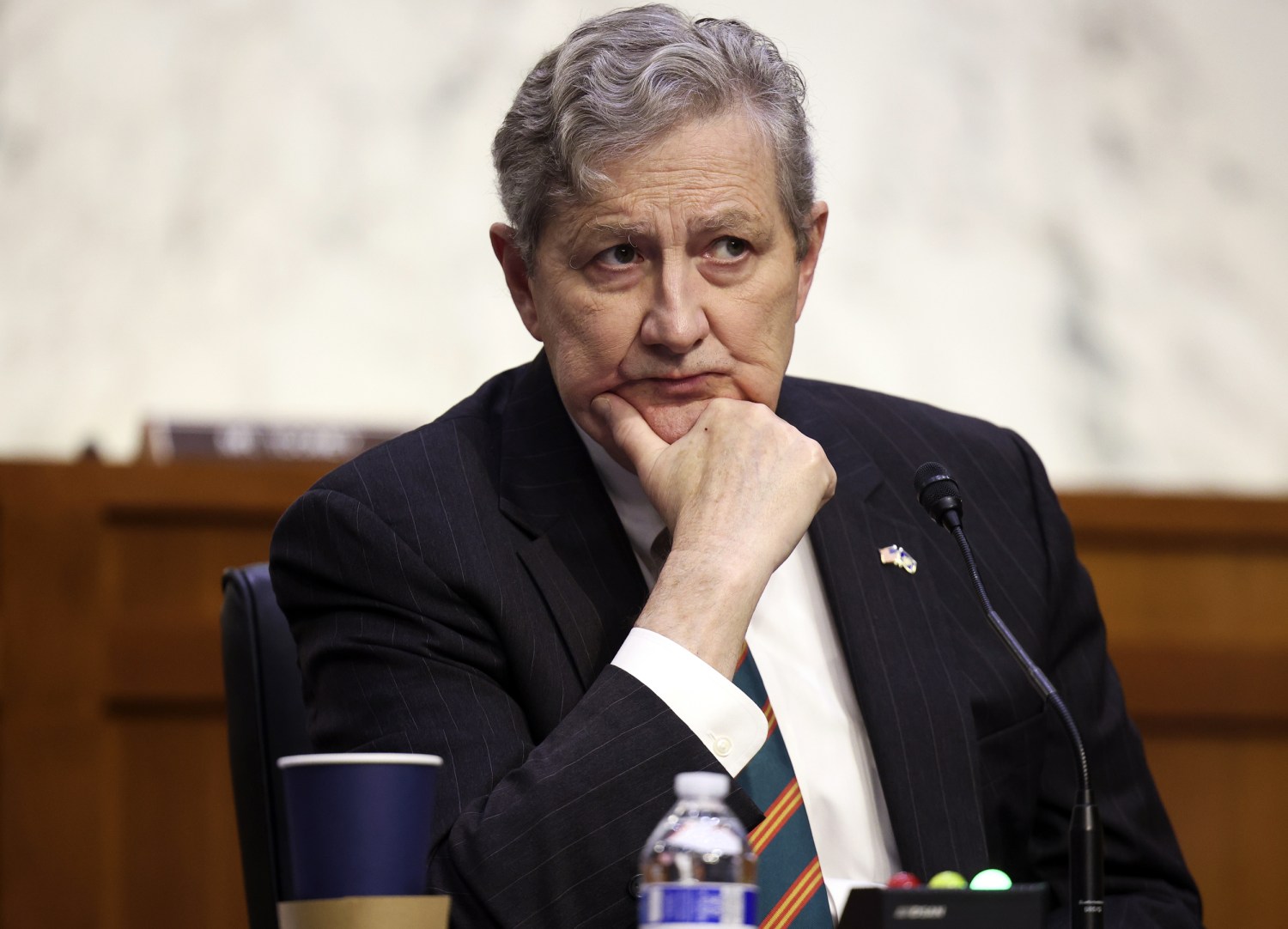
John Ke.n.n.e.d.y was sitting quietly when a discussion about Hollywood celebrities unexpectedly transformed into a confrontation over congressional privilege.
The Louisiana senator had listened as several colleagues delivered lengthy speeches about ethics, economic fairness, and government accountability.
Their remarks emphasized the importance of public trust and the responsibilities elected officials owed ordinary American families.
But Ke.n.n.e.d.y had noticed something missing from the conversation.
A printed social media post rested beneath the documents on his desk.
It concerned actor Ke.v.i.n So.r.b.o, whose outspoken political commentary had frequently generated controversy and national attention.
In this imagined exchange, Sorbo’s online criticism of political double standards had become the subject of an increasingly heated debate.
Several lawmakers dismissed the message as another example of celebrity-driven political outrage.
Others argued that its underlying question deserved serious consideration.
Ke.n.n.e.d.y remained silent until the discussion turned toward whether Hollywood personalities should influence national political conversations.
Then he slowly removed his glasses.
He folded them carefully and placed them beside his microphone.
“Mr. President, I’ve been listening to this conversation for quite some time.”
He paused.
“And I think we’re missing the most interesting part.”
The fictional Senate chamber grew quieter.
Ke.n.n.e.d.y lifted the printed post.
“Everybody seems awfully interested in who said something.”
Then he looked toward the senators seated across the aisle.
“But nobody seems particularly interested in whether the underlying question deserves an answer.”
The presiding officer recognized the senator.
Ke.n.n.e.d.y walked toward the podium carrying a thick folder of congressional ethics materials.
The document collection concerned financial disclosures, securities transactions, and the standards governing members of Congress.
It was an unexpected direction for a discussion that had begun with a Hollywood controversy.
Ke.n.n.e.d.y placed the folder beside the microphone.
“Let’s forget Hollywood for a minute.”
He tapped the cover.
“Let’s talk about Washington.”
A senator seated near the front questioned whether the subject was relevant to the debate.
Ke.n.n.e.d.y nodded.
“Oh, I think it’s extremely relevant.”
He opened the folder.
Inside was a copy of the Stop Trading on Congressional Knowledge Act, commonly known as the STOCK Act.
The legislation became law in 2012.
It affirmed that members of Congress and certain federal officials were not exempt from insider trading prohibitions.
The law also established additional financial disclosure requirements.
Ke.n.n.e.d.y pointed toward the document.
“Now, here’s something that ordinary Americans might find interesting.”
He paused.
“Congress writes laws affecting the stock market, federal spending, taxation, and entire industries.”
He turned another page.
“Meanwhile, questions continue about whether lawmakers should be allowed to trade individual stocks while holding that responsibility.”
The room became attentive.
The issue had little to do with Sorbo’s acting career.
It concerned the financial privileges and ethical responsibilities of elected officials.
Ke.n.n.e.d.y removed a second document.
This one summarized proposals to restrict stock trading by members of Congress.
Various lawmakers had supported measures addressing individual stock ownership, trading restrictions, and blind trusts.
Some proposals also covered spouses or dependent children.
But the precise requirements differed across the legislation.
Ke.n.n.e.d.y looked toward his colleagues.
“Some of us are very good at explaining what everybody else ought to do.”
He paused.
“Apparently, we’re a little slower when the proposed rules apply to ourselves.”
A few senators exchanged glances.
The senator from Louisiana continued.
He acknowledged that securities ownership was not automatically evidence of misconduct.
A member of Congress could hold lawful investments without possessing improper information.
A financial transaction could also be legal while raising broader questions about public confidence.
Those distinctions mattered.
But Ke.n.n.e.d.y argued that public confidence required confronting potential conflicts rather than dismissing every concern as partisan theater.
He opened the next section.
The folder contained descriptions of congressional financial disclosures and periodic transaction reporting obligations.
Under the STOCK Act, covered officials generally must disclose qualifying securities transactions within specified deadlines.
Those requirements were intended to improve transparency.
But disclosure alone did not prohibit every transaction that could create the appearance of a conflict.
Ke.n.n.e.d.y placed the reporting rules on the podium.
“Now, imagine an ordinary American watching Congress debate legislation that could affect a major corporation.”
He paused.
“Then imagine learning that lawmakers can own shares in companies affected by their decisions.”
The chamber remained quiet.
“That doesn’t automatically mean somebody broke the law.”
He raised one finger.
“But it does explain why Americans might have questions.”
The presiding officer asked Ke.n.n.e.d.y to keep his remarks focused on the legislative issue.
Ke.n.n.e.d.y agreed.
Then he reached for another document.
It contained a hypothetical comparison of two American households.
The first belonged to a factory employee trying to build modest retirement savings.
The second described an elected official participating in legislation affecting economic policy.
Both individuals could hold investments.
But the elected official possessed responsibilities and access that the factory employee did not.
Ke.n.n.e.d.y asked whether those differences justified additional ethical safeguards.
The committee analyst explained that public officials were subject to financial disclosure and conflict-of-interest rules.
However, the specific restrictions differed between members of Congress and certain executive branch employees.
Lawmakers also faced constitutional considerations surrounding qualifications, compensation, and legislative responsibilities.
Ke.n.n.e.d.y listened carefully.
Then he returned to his central concern.
“That’s why Congress ought to examine whether the rules adequately protect public confidence.”
A colleague argued that transparency requirements already provided important safeguards.
Ke.n.n.e.d.y acknowledged that disclosure helped voters evaluate potential financial conflicts.
But he questioned whether disclosure always eliminated the underlying appearance of divided interests.
He pointed toward a proposed stock trading restriction.
“Knowing about a potential conflict isn’t necessarily the same as preventing one.”
The argument shifted the chamber’s attention.
The discussion was no longer about whether a Hollywood actor deserved recognition for a political opinion.
It concerned whether Congress held itself to an ethical standard that ordinary citizens could trust.
Ke.n.n.e.d.y opened a fourth document.
This one described the difference between direct stock ownership and diversified investment funds.

The analyst explained that diversified funds generally created different conflict concerns from ownership of individual corporate securities.
Lawmakers considering trading restrictions often examined those distinctions.
Some proposals would allow broad-based mutual funds while restricting transactions involving individual company stocks.
Other proposals contained exemptions for particular investment arrangements.
Ke.n.n.e.d.y nodded.
“Then we’re not talking about banning every American from investing.”
He paused.
“We’re talking about whether people writing laws should face special safeguards when their investments might be affected.”
The chamber remained silent.
The presiding officer recognized another senator.
The senator argued that lawmakers should not be punished merely for entering public service.
Financial restrictions could discourage qualified people from seeking office.
Ke.n.n.e.d.y listened without interrupting.
Then he acknowledged that public service should remain accessible to people from different economic backgrounds.
But he questioned whether that concern resolved every possible conflict of interest.
“Nobody’s saying members of Congress shouldn’t own property or build retirement savings.”
He pointed toward the proposed restrictions.
“The question is whether we’re willing to accept reasonable limitations because of the offices we hold.”
The hypothetical debate became increasingly focused.
The analyst explained that any reform would need clear definitions and workable enforcement provisions.
Lawmakers would also need procedures for addressing existing holdings.
Spousal assets and family financial arrangements could create additional complications.
Ke.n.n.e.d.y acknowledged those challenges.
But he argued that complicated legislation was not necessarily an excuse for avoiding reform.
He then returned to the original social media post.
“Now, let’s remember why this conversation started.”
He lifted the paper.
“An actor said something that irritated people in Washington.”
The document contained a fictional criticism of the political class and its willingness to demand sacrifices from others.
Ke.n.n.e.d.y did not claim that the words were an authenticated statement from Sorbo.
Instead, he used the imagined controversy to examine the broader issue of political double standards.
The senator looked toward his colleagues.
“Some people want to spend the afternoon discussing whether Ke.v.i.n So.r.b.o should have political opinions.”
He paused.
“That seems like a strange priority.”
Another senator challenged the implication that criticizing celebrity commentary was inherently inappropriate.
Ke.n.n.e.d.y agreed that public figures could be questioned about their arguments.
He acknowledged that celebrities did not automatically possess expertise in complicated legislative matters.
But he suggested that dismissing a question because of its messenger could prevent meaningful discussion.
The senator then placed the social media document beneath his ethics folder.
The gesture was deliberate.
He wanted the focus on congressional accountability rather than the celebrity who had prompted the debate.
“Let’s judge the argument by the evidence.”
Ke.n.n.e.d.y opened another page.
It contained a summary of congressional ethics reform efforts introduced during previous sessions.
Some proposals had received bipartisan attention.
Others remained stalled amid disagreements about implementation and enforcement.
The details varied considerably.
But the recurring concern was familiar.
Could lawmakers maintain public confidence while trading securities affected by congressional decisions?
Ke.n.n.e.d.y asked the analyst whether the existing reporting system could identify every potential conflict before a transaction occurred.
The analyst answered that disclosure requirements generally operated according to specified reporting procedures.
They did not necessarily provide advance public notice of every contemplated investment decision.
Ke.n.n.e.d.y nodded.
“Then disclosure has limitations.”
The analyst agreed.
But the analyst also emphasized that trading restrictions would need careful design to avoid unintended consequences.
Ke.n.n.e.d.y accepted that point.
The senator was not claiming that a single law could eliminate every ethical concern.
He was arguing that Congress should examine whether stronger safeguards were justified.
The debate continued until another complication emerged.
A colleague suggested that some proposed restrictions could be difficult to enforce against family members.
Ke.n.n.e.d.y asked the analyst to explain the problem.
The analyst described the challenges of establishing ownership, financial control, and transaction responsibility.
Spouses could maintain separate financial arrangements.
Blind trusts could involve different legal structures.
And investments held through funds or retirement accounts required distinct treatment.
Those issues could complicate enforcement.
Ke.n.n.e.d.y acknowledged the complexity.
Then he asked whether complexity alone justified preserving every existing rule.
The analyst answered that enforcement difficulties should inform legislative design.
They did not automatically determine whether reform should be abandoned.
Ke.n.n.e.d.y looked toward the chamber.
“That’s a useful answer.”
He returned to the podium.
“Maybe we should spend more time writing workable rules and less time questioning whether somebody famous is allowed to criticize us.”
The remark drew attention across the room.
But Ke.n.n.e.d.y still had another document.
This one contained a proposed framework for evaluating congressional trading restrictions.
It identified the investments covered by a proposed ban.
It described possible divestment requirements.
It also outlined reporting obligations and penalties for violations.
The framework was presented as a legislative discussion document rather than enacted law.
Ke.n.n.e.d.y asked whether the proposal could be examined through ordinary committee procedures.
The analyst explained that the appropriate committees could evaluate legislation, obtain testimony, and consider amendments.
The process could address constitutional questions and practical enforcement concerns.
Ke.n.n.e.d.y nodded.
“Then there’s a perfectly reasonable way to handle this.”
He turned toward the senators who had criticized the original Hollywood controversy.
“Instead of debating somebody’s acting career, let’s debate the legislation.”
The chamber became quiet.
The presiding officer requested that Ke.n.n.e.d.y conclude his remarks.
He acknowledged the instruction.
But he asked permission to address one final contradiction.
He returned to the original folder.
The STOCK Act remained visible on the podium.
So did the summaries of proposed trading restrictions.
Ke.n.n.e.d.y explained that public officials regularly demanded accountability from corporations, financial institutions, and individual taxpayers.
Those expectations could serve legitimate purposes.
But Congress also needed to examine its own conduct.
The credibility of an ethical rule depended partly on whether the people enforcing it respected comparable obligations.
That was the question behind the fictional controversy.
Not whether every senator had broken the law.
Not whether every congressional investment represented insider trading.
And not whether a Hollywood actor possessed special authority over public policy.
The issue concerned whether lawmakers were prepared to evaluate rules that directly affected their own financial activities.
Ke.n.n.e.d.y looked toward the chamber.
Then he slowly removed his glasses again.
He placed them beside the documents.
His tone became quieter.
“Folks, we don’t have to agree with everything a celebrity says.”
He paused.
“We don’t even have to like the way the argument was delivered.”
Then he pointed toward the proposed congressional trading restrictions.
“But the American people have every right to ask why these questions keep coming back.”
The presiding officer allowed him to continue.
Ke.n.n.e.d.y explained that voters expected lawmakers to place public responsibilities above private advantage.
Strong ethics rules could help reduce potential conflicts.

They could also protect officials from unsupported allegations.
But reform proposals needed clear legal standards and consistent enforcement.
The analyst confirmed that those considerations were relevant to meaningful legislative reform.
Ke.n.n.e.d.y returned to the final page.
The document contained one unanswered question.
Should members of Congress face stronger restrictions on trading individual securities while serving in office?
The senator acknowledged that different proposals deserved careful evaluation.
He did not claim that every existing law was meaningless.
Nor did he suggest that lawful ownership automatically established corruption.
Instead, he asked lawmakers to confront the possibility that existing safeguards could be improved.
The chamber was silent.
Ke.n.n.e.d.y leaned heavily against the podium.
Then he delivered the final question that ended the fictional confrontation.
“If Congress believes ordinary Americans should trust the rules we write, why are we so reluctant to examine the financial privileges we keep for ourselves?”
The room remained quiet.
The presiding officer thanked the senator.
The hypothetical debate continued with renewed attention to congressional financial ethics.
No secret criminal scandal had been established.
No individual senator had been proven guilty of unlawful trading.
And the imagined social media controversy did not establish an authenticated statement from Ke.v.i.n So.r.b.o.
But the discussion had moved from celebrity commentary toward a specific institutional question.
Congress had enacted disclosure requirements through the STOCK Act.
Lawmakers had also proposed additional restrictions on their own financial transactions.
The merits of those proposals remained subjects for legislative debate.
Some supporters argued that stronger restrictions could reduce conflicts and improve public confidence.
Critics raised questions about constitutional limits, property rights, enforcement costs, and practical implementation.
Those concerns required careful consideration.
But the underlying ethical issue could not be resolved simply by dismissing the person who raised it.
Ke.n.n.e.d.y gathered his documents.
The printed Hollywood post remained beneath the congressional ethics materials.
Its provocative message had served as the starting point.
The actual legislative question had become far more consequential.
Should public officials face additional restrictions when their personal investments intersect with decisions affecting the national economy?
And if such restrictions were appropriate, how should Congress design them fairly?
Those were questions requiring evidence, legislation, and serious institutional debate.
The fictional confrontation had begun with an argument about Hollywood.
It ended with lawmakers examining the standards governing their own financial conduct.
The most important development was not a celebrity’s criticism.
It was the recognition that the substance of an argument deserved examination regardless of who delivered it.
Because the real measure of political accountability is not how fiercely lawmakers defend the rules, but whether they are willing to live under meaningful safeguards themselves.
