

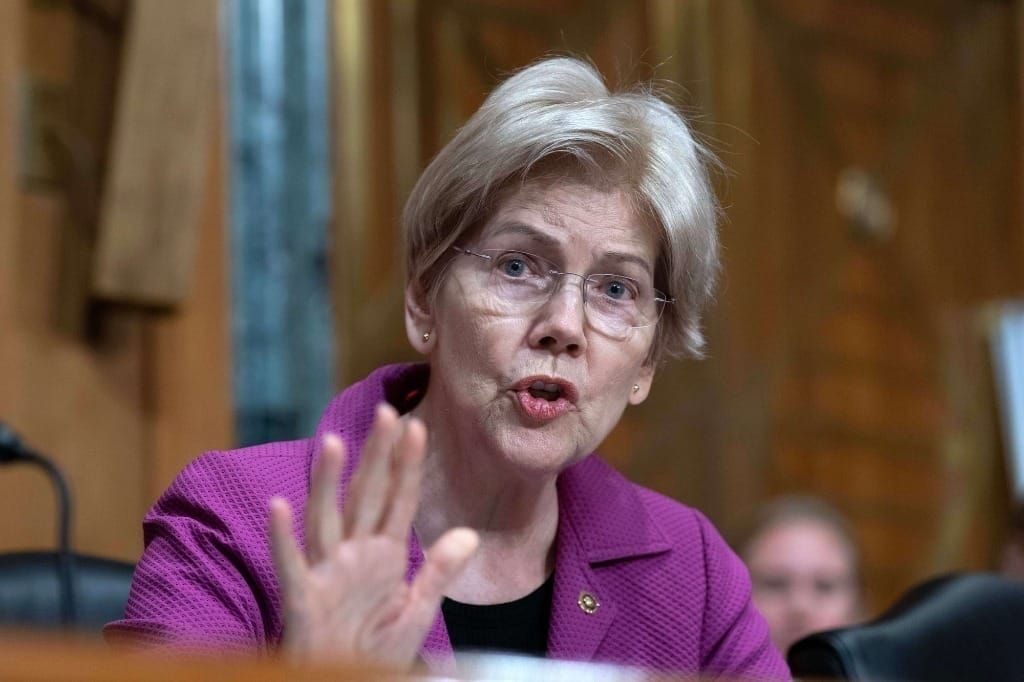
The confrontation began with an insult sharp enough to interrupt an already contentious congressional hearing. Senator Elizabeth Warren looked across the table at Senator John Neely Kennedy and dismissed his questioning as political theater.
In this fictional Capitol Hill drama, Warren accused the Louisiana Republican of behaving like a “populist circus act,” suggesting that his confrontational style prioritized television attention over meaningful financial accountability.
Kennedy remained silent. Instead of responding immediately, he adjusted his glasses, opened a thick folder, and examined several pages marked with financial transaction numbers and corporate ownership details.
The fictional documents contained an extraordinary allegation: a purported $9.24 million financial benefit connected through several intermediaries to a defense contractor following a confidential government briefing in February 2023.
Nothing in this imagined storyline constitutes evidence of actual financial misconduct by Warren. The transactions, confidential briefing, alleged connections, and confrontation are invented elements of a political thriller.
Yet the fictional scenario raised a question with genuine importance for American democracy: how should elected officials respond when serious financial allegations are introduced before their authenticity has been established?
Kennedy looked toward Warren and asked whether public officials should welcome independent scrutiny of financial relationships that could potentially create conflicts of interest.
Warren immediately challenged the premise, arguing that government accountability required reliable evidence rather than complicated charts designed to create suspicion through associations between unrelated organizations.
Kennedy acknowledged that a financial connection did not automatically demonstrate wrongdoing, but insisted that unexplained transactions deserved examination when credible documentation suggested possible conflicts.
The exchange quickly developed into a debate about the difference between legitimate investigation and political accusation, two activities that can appear similar during a heated congressional confrontation.
Warren had built much of her real political career around consumer financial protections, corporate accountability, and proposals aimed at reducing the influence of concentrated economic power.
Kennedy, a former Louisiana state treasurer, has frequently emphasized oversight of government spending and the responsibility of public institutions to explain their financial decisions.
Those genuine political priorities formed the background of the fictional encounter, although neither senator participated in the imaginary hearing described here.
As the hearing continued, Kennedy placed the first fictional document on his desk and described it as a financial summary involving an unnamed defense industry contractor.
The imaginary company had allegedly received substantial government business before an investment-related transaction produced an unusually large financial benefit for a separate holding organization.
Kennedy pointed toward a series of dates, questioning whether the timing of those transactions required a closer examination of potential access to confidential government information.
Warren responded that timing alone could not establish illegal insider trading, particularly when markets reacted to public information, contractual developments, and numerous unrelated economic factors.
She challenged Kennedy to produce authenticated evidence that any confidential information had been improperly disclosed or used to influence investment decisions.
Kennedy answered that determining whether such evidence existed was precisely why independent investigators might need access to original documents rather than relying on summaries circulated through political offices.
The fictional chairman intervened, reminding both senators that accusations concerning financial wrongdoing required careful verification and that no individual should be treated as guilty because an allegation attracted attention.
But Kennedy was preparing another question, one that connected the imagined transaction to a broader discussion about government contractors and financial transparency.
He asked whether the public deserved to know when individuals with potential access to sensitive government information appeared connected to organizations receiving significant financial benefits.
Warren agreed that conflicts of interest warranted scrutiny, but maintained that any investigation must establish actual relationships rather than infer misconduct from incomplete ownership diagrams.
Kennedy then opened the second portion of his fictional folder, displaying a chart showing an imagined sequence of transfers among investment companies, overseas accounts, and a private foundation.
According to the invented narrative, the transactions eventually connected to organizations involved in political spending, creating an appearance of financial complexity that demanded further explanation.
The chart did not establish that Warren owned, controlled, or benefited from those entities, and no authentic Treasury or Securities and Exchange Commission records substantiated such a connection.
Warren seized upon that distinction, asking Kennedy whether he had verified the identities of the account holders and the legal relationships between the organizations.
Kennedy responded that the fictional report identified several unresolved ownership questions and that he wanted investigators to determine whether the entities shared decision-makers or financial beneficiaries.
The dispute intensified when Warren challenged his use of the phrase “money trail,” arguing that the expression could imply misconduct before any underlying transaction had been proven improper.
Kennedy replied that investigators routinely traced financial relationships to understand complex transactions, but acknowledged that tracing money was not equivalent to establishing a criminal offense.
For the first time, the imaginary hearing moved beyond personal accusations and toward the evidentiary standards necessary to evaluate a potentially serious financial allegation.
The chairman asked whether the documents included original transaction confirmations, verified ownership records, or independent analysis capable of distinguishing legitimate investments from prohibited conduct.
Kennedy answered that the folder contained preliminary summaries and requested records, but that the committee would need original documentation before reaching any definitive conclusion.
Warren emphasized that preliminary summaries could be misleading when they omitted the purpose of transfers, the identities of beneficial owners, or the timing of relevant disclosures.
Her objection reflected a legitimate investigative concern: sophisticated financial systems often involve complex structures that may be lawful, commercially justified, and unrelated to government corruption.
Nevertheless, Kennedy continued questioning whether the existence of legitimate financial structures eliminated the need to examine suspicious circumstances involving government contractors and sensitive information.
Warren responded that it did not, but insisted that an investigation should begin with a credible factual basis rather than a public accusation designed to generate political pressure.
The fictional confrontation became increasingly tense because both senators were defending principles that could coexist even while disagreeing about whether Kennedy’s materials justified further examination.
Financial accountability requires investigators to follow credible evidence, but procedural fairness requires them to distinguish documented conduct from speculation or politically convenient interpretations.
The dispute took another turn when Kennedy introduced an invented reference to a confidential February 2023 defense briefing involving a hypothetical $12 billion procurement discussion.
He asked whether access to nonpublic procurement information could create opportunities for improper financial advantage if individuals used that knowledge to make investment decisions.
Warren agreed that misuse of material nonpublic information could raise serious legal concerns, but challenged Kennedy to establish whether his hypothetical briefing involved information relevant to the disputed transactions.
Kennedy acknowledged that the fictional file did not conclusively demonstrate such a connection, but argued that the issue warranted careful examination if authentic records supported the alleged timeline.
Warren countered that the word “if” was doing much of the work in his argument, because the most serious implications depended on facts that had not been established.
The response temporarily shifted the imagined hearing’s momentum, exposing the difference between a dramatic financial theory and evidence capable of supporting a formal finding.
Kennedy listened before turning to another page, this one containing a hypothetical ownership diagram involving several companies with similar names and overlapping administrative service providers.
He asked whether the repeated appearance of those providers suggested coordinated control or merely reflected the widespread use of specialized financial administration firms.
Warren answered that the distinction could not be resolved through a diagram alone, and that corporate records, contracts, and verified ownership information would be necessary.
Kennedy agreed, then asked why such documentation should not be made available through an appropriately authorized investigation when the underlying concerns were sufficiently credible.
The disagreement now centered less on whether financial misconduct was possible and more on whether the particular evidence justified compelling additional records.
A subpoena, Warren argued, should not become a political prop used to make an unsubstantiated allegation appear more credible merely because it was delivered during a televised hearing.
Kennedy responded that congressional investigative authority existed to obtain information relevant to legitimate legislative purposes, but conceded that such authority required proper procedures and justification.
The fictional chairman reminded the committee that an individual senator could not simply create a legally effective subpoena by placing a document on a desk.
Congressional subpoenas depend on the authority and rules of the relevant chamber or committee, and their use can raise important questions about jurisdiction, relevance, and constitutional limitations.
That procedural reality became essential to the fictional storyline when Kennedy opened a separate envelope containing what he described as a proposed subpoena for financial records.
The imagined document requested transaction histories, ownership disclosures, relevant contracts, and communications connected to the hypothetical investment activity described in the earlier summaries.
Warren examined the proposal and questioned whether Kennedy had established a legitimate basis for demanding private financial information from organizations not shown to have engaged in wrongdoing.
Kennedy maintained that the request was intended to resolve uncertainties, but acknowledged that proper authorization would be required before the subpoena could carry legal force.
The exchange illustrated a fundamental principle of congressional oversight: investigative authority can support legitimate inquiries, but it does not eliminate the obligation to respect procedural and constitutional safeguards.
Warren challenged Kennedy to explain why the committee should prioritize this particular fictional allegation over other financial concerns supported by established evidence.
Kennedy replied that lawmakers should evaluate credible allegations consistently, regardless of whether the individuals or organizations involved were politically influential or personally unpopular.
Their argument became more intense when Warren accused him of turning financial complexity into a weapon of political insinuation rather than presenting an independently verified case.
Kennedy responded that politicians also had a responsibility not to dismiss legitimate questions merely because those questions created public controversy or reflected poorly on influential institutions.
The chairman asked both senators to identify what a properly conducted investigation should establish before any public accusation of wrongdoing could be justified.
Warren emphasized authenticated documents, verified ownership, direct evidence of relevant relationships, and a clear explanation of why particular transactions might violate applicable law.
Kennedy emphasized those same elements, adding that investigators should examine whether confidential information had been accessed and whether any resulting financial benefit created a legally significant conflict.
That limited agreement gave the fictional hearing an unexpected direction. Instead of resolving the allegation through rhetorical confrontation, both senators were forced to articulate standards for determining what the evidence actually showed.
But Kennedy had one final document, an imagined internal review containing a detail that complicated his own initial presentation.
The review identified a significant discrepancy between the financial summary’s claimed $9.24 million benefit and the underlying method used to calculate that amount.
According to the fictional analysis, the number combined gains attributed to different transactions, some involving entities whose relationship to the central investment had not been established.
The discovery raised the possibility that the dramatic figure presented earlier might not accurately describe a single transaction, a single beneficiary, or any financial benefit connected to Warren.
Warren immediately challenged Kennedy to explain why a figure with such significant unresolved assumptions had been introduced during a public congressional confrontation.
Kennedy acknowledged that the calculation required independent verification and that the committee should not treat the entire amount as an established improper profit.
The admission changed the fictional hearing because the original accusation could no longer be defended simply by pointing toward the impressive size of the number.
The chairman requested that investigators distinguish documented transfers from estimates, assumptions, and transactions whose relationship to the allegation remained unproven.
Warren argued that this distinction demonstrated the danger of presenting an elaborate financial narrative before authenticating the source materials and validating the calculations.
Kennedy responded that the discrepancy also reinforced the need for reliable original records, allowing investigators to determine which assertions survived examination and which required correction.
The fictional confrontation had reached a critical moment: the same financial records that initially appeared damaging now demonstrated why incomplete information could mislead both investigators and the public.
Kennedy turned to the final page, where the imagined review contained an unresolved question about how financial oversight investigations should handle allegations involving public officials.
Rather than introducing another sensational accusation, he asked Warren whether she would support an independent review whose findings could publicly disprove the allegations as well as substantiate genuine misconduct.
Warren responded that independent investigations should follow credible evidence wherever it led, but should never begin from a presumption of guilt or use politically motivated demands as substitutes for proof.
Kennedy acknowledged the distinction before asking one final question that brought the underlying argument into sharp focus.
“Senator Warren, if transparency can clear an innocent person, why shouldn’t both parties demand the same evidence before making accusations?”
The fictional room fell quiet as the question redirected attention toward the responsibility shared by politicians who introduce allegations and those who challenge them.
Warren answered that demanding evidence before making accusations was precisely the principle she had been defending throughout the exchange.
Kennedy replied that public officials should also remain open to legitimate scrutiny when credible documentation raised questions about their conduct or the institutions they supported.
The exchange did not establish a financial scandal, reveal a hidden fortune, or demonstrate that Warren had received money connected to any defense contractor.
Instead, the imaginary investigation exposed weaknesses in a dramatic allegation and illustrated how financial records can be misinterpreted when complicated relationships are presented without adequate verification.
For American voters, that distinction matters because political accusations involving millions of dollars can spread rapidly through television coverage and social media before independent investigators examine their foundations.
A compelling headline can create the appearance of a scandal even when the underlying documents do not prove that any law was broken.
At the same time, legitimate concerns about conflicts of interest, government contracting, and financial disclosure should not be ignored simply because they arise during partisan disputes.
The appropriate response depends on reliable documentation, independent analysis, established investigative procedures, and an honest willingness to accept conclusions that may contradict political expectations.
Kennedy’s fictional demand for transparency highlighted the importance of examining credible financial concerns, while Warren’s objections emphasized the dangers of allowing unverified allegations to damage reputations.
The confrontation also demonstrated why financial accountability requires more than collecting complicated documents or presenting dramatic transaction diagrams before television cameras.
Investigators must determine who controlled the relevant assets, why transactions occurred, whether confidential information played any role, and whether applicable legal obligations were violated.
They must also be willing to correct errors, discard unsupported assumptions, and distinguish legitimate commercial arrangements from misconduct established through credible evidence.
The imagined chairman concluded the hearing by directing staff to assess whether the hypothetical materials justified any further authorized investigative action.
No final finding of wrongdoing emerged from the fictional confrontation, and the disputed $9.24 million calculation remained unsupported as a verified improper payment.
The proposed subpoena remained a fictional procedural development rather than an authentic congressional order, and the alleged defense briefing had no established connection to actual financial misconduct.
What remained was a political argument about how elected officials should balance aggressive oversight with fairness to individuals whose reputations may be affected by public accusations.
Kennedy had challenged Warren to defend the principle of independent investigation, while Warren had challenged Kennedy to demonstrate that his evidence justified the conclusions suggested by his presentation.
Their imaginary confrontation offered a more complicated outcome than the familiar political spectacle in which one politician supposedly destroys another through a single devastating revelation.
It showed that an allegation can deserve examination without deserving belief, and that skepticism about evidence does not necessarily constitute resistance to accountability.
The central democratic responsibility is to establish what can be verified before transforming suspicion into public judgment.
And as the fictional hearing ended, the final question extended far beyond Kennedy, Warren, or the mysterious financial figure at the center of the imagined case.
When millions of dollars appear in an explosive political allegation, will Washington demand evidence strong enough to establish the truth—or allow the accusation itself to become the verdict?
