
WASHINGTON — A federal investigation involving Representative Ilhan Omar has intensified an already contentious political debate over immigration, national security, and congressional accountability.
The Minnesota Democrat, who was removed from the House Foreign Affairs Committee in 2023, is once again facing intense public scrutiny following a federal search of her Washington residence.
The October 12, 2026 operation marked a significant development in an investigation involving immigration documents submitted when Omar’s family came to the United States.
Federal authorities confirmed that investigators searched her home, while Omar and her representatives strongly denied wrongdoing and criticized the investigation as politically motivated.
The development has also revived discussion about her removal from the House Foreign Affairs Committee and whether she should serve on the influential panel again.
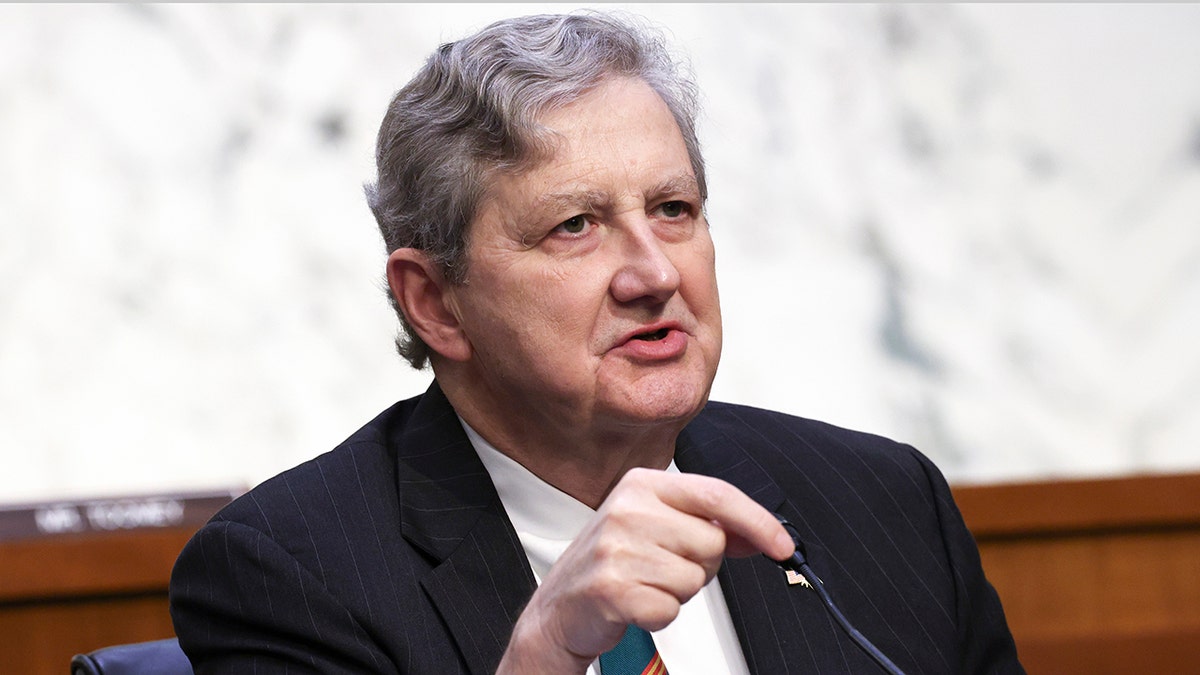
Meanwhile, an online narrative attributes a dramatic response to Republican Senator John Kennedy, describing him as publicly mocking Omar over her committee ambitions.
The account portrays Kennedy confronting Omar’s immigration history and questioning whether she should hold a position involving sensitive foreign policy matters.
However, no verified congressional transcript or reliable recording has been identified establishing that Kennedy delivered the specific remarks attributed to him.
The alleged scene involving security clearance forms, a podium, and a suddenly silent room remains unsubstantiated.
What is established is that the federal search occurred, that Omar disputes the allegations underlying the investigation, and that her committee removal remains a significant political controversy.
Together, these developments raise questions about congressional oversight, immigration investigations, and the boundary between legitimate scrutiny and political retaliation.
The federal search took place early on October 12 at Omar’s residence in Washington, D.C.
Agents from Homeland Security Investigations, the investigative branch of Immigration and Customs Enforcement, participated in the operation.
The Justice Department confirmed the search, according to reporting published that day.
Investigators were examining possible irregularities in immigration documents associated with Omar’s family.
Those records date back to the period when she was a child and her family immigrated to the United States.
The investigation therefore concerns events that allegedly occurred decades before Omar entered national politics.
According to subsequent reporting, federal investigators also sought information from some of her relatives through grand jury subpoenas.
The existence of subpoenas and a search warrant does not establish that a crime occurred.
Such investigative tools can be used to gather evidence, verify claims, and determine whether criminal charges are warranted.
They do not substitute for a trial or establish the guilt of any person under investigation.
Omar has consistently denied wrongdoing.
Following the search, her office described the operation as an abuse of government authority and an example of political targeting.
Omar herself publicly maintained that she had done nothing wrong.
In a subsequent television interview, she characterized the investigation as an attempt to intimidate her because of her political positions.
She also expressed concern about her personal safety following the publicity surrounding the search.
On October 22, reports emerged that Omar intended to leave her Washington residence after the operation attracted widespread attention.
The decision highlighted the personal consequences that can accompany a highly publicized investigation involving an elected official.
The controversy is particularly sensitive because the underlying allegations involve Omar’s immigration history and family background.
Born in Somalia, Omar fled the country’s civil war with her family during childhood.
Her family spent several years in a refugee camp in Kenya before arriving in the United States in 1995.
Omar became a naturalized American citizen in 2000.
She subsequently entered politics and won election to Congress in 2018.
Her election represented a significant milestone in American political representation, particularly for Somali Americans and Muslim women.
Throughout her congressional career, Omar has been an outspoken critic of certain American foreign policy decisions.

She has frequently addressed human rights, military intervention, immigration policy, and the treatment of refugees.
Those positions have attracted support from progressive organizations and criticism from conservative lawmakers.
Her political opponents have also questioned statements she made about Israel and the influence of political lobbying.
Some of those statements were widely condemned as invoking antisemitic stereotypes.
Omar apologized for certain remarks in 2019, while continuing to defend her broader right to criticize government policies.
These controversies eventually became central to the Republican effort to remove her from the House Foreign Affairs Committee.
On February 2, 2023, the Republican-controlled House voted to remove Omar from the committee.
The resolution passed by 218 votes to 211, with one Republican voting present.
Republican leaders argued that Omar’s previous statements made her unsuitable for a position on a committee responsible for important international matters.
They maintained that membership on the panel required careful judgment concerning sensitive diplomatic relationships.
Democratic lawmakers rejected that reasoning and accused Republicans of using committee assignments to punish political opponents.
They also argued that Omar had acknowledged past mistakes and should not be subjected to a disproportionate sanction.
The debate became particularly heated because Democrats had previously supported removing certain Republican lawmakers from committee assignments.
Republicans cited those earlier actions while defending their authority to determine committee membership.
Democrats responded that the circumstances surrounding the previous removals were materially different.
The dispute therefore became part of a broader argument about consistency, accountability, and partisan control of congressional institutions.
Omar defended herself during the House debate and argued that her personal background gave her valuable insight into international affairs.
She emphasized her experience as an immigrant and refugee who had witnessed the consequences of conflict.
Her supporters argued that such experiences could strengthen congressional understanding of humanitarian crises and American foreign policy.
Her critics maintained that personal experience did not eliminate concerns about controversial public statements.
The House ultimately approved the resolution removing her from the committee.
Importantly, that decision did not remove Omar from Congress.
She remained an elected representative and continued performing her congressional responsibilities.
The resolution concerned a particular committee assignment rather than her eligibility to hold elected office.
That distinction remains important when evaluating subsequent claims about her political status.
The 2023 decision also did not constitute a criminal finding or establish any immigration violation.
It was a congressional decision concerning committee membership, based primarily on disputes about her public remarks.
The federal investigation reported in October 2026 concerns a separate set of allegations.
Combining the two controversies into a single claim of proven misconduct would therefore be misleading.
Nevertheless, the search has prompted renewed questions about Omar’s political position and her relationship with Republican critics.
The timing of the operation attracted particular attention because it occurred shortly before the November congressional elections.
Critics of the investigation questioned whether federal law enforcement was being used to place pressure on a political opponent.
Representative Jamie Raskin, a senior Democrat on the House Judiciary Committee, strongly criticized the search.
He argued that the circumstances raised serious concerns about the use of investigative authority against a sitting member of Congress.
Other Democrats also expressed concern about the implications for political independence and the rule of law.
Supporters of the investigation countered that elected officials should not receive immunity from legitimate law enforcement scrutiny.
They argued that potential violations of immigration law should be investigated regardless of the political position held by the individual involved.
These competing arguments concern two principles that must coexist within a constitutional system.
Government officials are subject to the law, but investigative powers must not be used as instruments of political retaliation.
The challenge is determining whether a particular investigation is supported by credible evidence and conducted according to established legal standards.
That determination cannot be made solely from partisan statements or social media commentary.
The existence of a search warrant indicates that investigators obtained judicial authorization for a specific investigative action.
It does not establish that every allegation under examination is accurate.
Nor does it determine whether charges will ultimately be filed.
Those questions depend on the evidence gathered and the decisions of the appropriate legal authorities.
The investigation’s connection to immigration documents has also intensified debate about the legal status of naturalized American citizens.
Naturalization is a formal legal process through which eligible immigrants become citizens of the United States.
Once naturalized, citizens receive important constitutional rights and responsibilities.
They may vote, participate in political life, and seek public office subject to applicable constitutional qualifications.
Members of Congress are not required to have been American citizens from birth.
The Constitution instead establishes minimum periods of citizenship for representatives and senators.
For the House of Representatives, the requirement is at least seven years of American citizenship.
For the Senate, it is at least nine years.
Those requirements differ from the natural-born citizenship provision governing presidential eligibility.
Consequently, Omar’s birthplace does not itself disqualify her from congressional service.
Nor does her status as a naturalized citizen automatically prevent her from serving on the Foreign Affairs Committee.
Any argument concerning her eligibility must therefore distinguish between constitutional qualifications, committee assignments, and allegations of individual misconduct.
These are separate legal and political questions.
A person can satisfy the constitutional qualifications for Congress while facing political criticism concerning a committee assignment.
Similarly, an investigation involving possible misconduct does not automatically remove an elected official from office.
The procedures for determining criminal responsibility are distinct from the political process governing committee membership.
Understanding those distinctions is essential to evaluating the current controversy.
The House Foreign Affairs Committee plays an important role in congressional oversight of American diplomacy and international relations.
Its responsibilities include examining foreign policy initiatives, reviewing legislation, and scrutinizing executive branch decisions.
Committee members may participate in hearings involving diplomats, national security officials, and international policy experts.
They also help shape legislative proposals affecting America’s relationships with other countries.
The committee’s work can therefore involve politically sensitive and strategically important information.
However, committee membership should not be confused with unrestricted access to every classified government document.
Congressional access to sensitive information is governed by institutional rules and applicable security procedures.
The responsibilities of elected lawmakers also differ from those of executive branch employees who undergo traditional security clearance processes.
That distinction matters because the circulating Kennedy narrative describes security clearance forms as the centerpiece of a supposed confrontation.
Without a verified record of the event, those details cannot establish that any particular security concern was formally raised during a hearing.
Nor can they demonstrate that Omar failed a clearance process or violated rules governing classified information.
Such conclusions would require specific documentary evidence.
Kennedy, a Republican senator from Louisiana, is known for his direct questioning and distinctive conversational style.
His public remarks frequently address government accountability, federal spending, and the conduct of public officials.
He has also participated in debates involving immigration enforcement and national security.
Those positions provide a plausible political context for disagreements with Omar.
But political compatibility with a reported statement is not proof that the statement was actually made.
No reliable source has been identified confirming the particular Kennedy speech described in the circulating account.
There is likewise no verified recording of him tapping security forms on a podium while challenging Omar’s committee ambitions.
The distinction between documented political disagreement and invented theatrical detail is essential.
A dramatic account may be widely shared without accurately representing any identifiable congressional proceeding.
In this instance, the verified federal investigation is already a substantial development.
The search of a sitting member of Congress is an unusual and politically consequential event.
It raises questions about investigative independence, the protection of civil liberties, and accountability for public officials.
Those questions deserve examination without adding unsupported descriptions of confrontations between lawmakers.
The same principle applies to claims that Omar recently demanded reinstatement to the Foreign Affairs Committee.
Her opposition to the 2023 removal is well documented.
She has also continued participating in foreign policy discussions despite losing that committee assignment.
However, the particular demand described in the circulating account has not been independently established.
It would therefore be inaccurate to present a recent reinstatement demand as confirmed without identifying the relevant statement or congressional action.
The distinction matters because committee assignments can change across congressional sessions.
Membership depends on party decisions, House procedures, and the composition of Congress.
A lawmaker’s public interest in a committee does not automatically establish that a formal request has been submitted.
Likewise, the existence of a political dispute does not demonstrate that a new committee vote has occurred.
Accurate reporting requires separating historical events from current proposals and unverified claims.
The political debate surrounding Omar also illustrates how immigration history can become central to discussions of national loyalty.
Some critics argue that foreign-born lawmakers should face heightened scrutiny when their political positions involve international conflicts.
Others contend that such scrutiny can become discriminatory when it relies on birthplace rather than specific evidence.
American constitutional principles require careful attention to the distinction between identity and conduct.
Public officials can legitimately be questioned about their policy decisions, financial relationships, and adherence to the law.
But allegations of misconduct should be supported by evidence rather than assumptions based on religion, ethnicity, or immigration background.
Those standards are relevant to officials across the political spectrum.
An American citizen born abroad remains subject to the same legal obligations governing other citizens.
At the same time, that citizen retains the protections afforded by the Constitution.
The federal investigation involving Omar must therefore be assessed according to the evidence and applicable law.
Political disagreement cannot substitute for a criminal finding.
Similarly, public office does not automatically shield an individual from lawful investigation.
The integrity of the process depends on applying those principles consistently.
The controversy also carries implications for congressional oversight of the executive branch.
Members of Congress have responsibilities that may include questioning the actions of federal law enforcement agencies.
When an investigation targets a sitting lawmaker, concerns can arise about institutional independence and potential conflicts.
Those concerns do not automatically invalidate an investigation.
They do, however, increase the importance of transparency, appropriate judicial oversight, and adherence to established procedures.
The public has a legitimate interest in understanding why investigative measures were authorized.
It also has an interest in protecting sensitive information and ensuring that legal proceedings are not compromised.
Balancing those interests can be difficult during a highly publicized political controversy.
Statements from investigators, elected officials, and legal representatives may emphasize different aspects of the same event.
Each claim should be evaluated according to its source and supporting evidence.
For Omar, the central legal question concerns whether the immigration documents under examination contained any material falsehoods.
Investigators must also consider who prepared the documents, what information was available, and whether any relevant legal requirements were violated.
Because the records date to Omar’s childhood, the circumstances surrounding their preparation are particularly important.
A child’s presence in an immigration application does not establish that the child knowingly participated in any alleged wrongdoing.
Any determination of individual responsibility would require evidence concerning the person’s actual conduct and applicable legal standards.
The investigation may ultimately produce additional findings, or authorities may determine that criminal charges are unwarranted.
Neither outcome can be assumed in advance.
The political consequences, however, are already visible.
The search has intensified scrutiny of Omar and renewed disputes over the relationship between immigration enforcement and partisan politics.
Republican critics have questioned her background and public statements.
Democratic defenders have emphasized her rights as an American citizen and warned against politically motivated investigations.
Those positions reflect broader disagreements about immigration policy, law enforcement, and congressional accountability.
The controversy also demonstrates how historical political disputes can be revived by new developments.
Omar’s removal from the Foreign Affairs Committee occurred more than three years before the October 2026 search.
The two events involve different legal and political circumstances.
Nevertheless, both concern public confidence in the conduct and qualifications of an elected representative.
The committee dispute focused on whether Omar’s previous statements were compatible with the responsibilities of a foreign policy assignment.
The immigration investigation concerns possible irregularities in documents associated with her family’s arrival in the United States.
Neither issue should be used as automatic proof of the other.
The appropriate response is to examine the evidence supporting each claim separately.
That approach also helps clarify the significance of Kennedy’s alleged involvement.
A senator may criticize another lawmaker’s policy positions or question the handling of a federal investigation.
Such criticism is part of political debate.
But attributing specific words or actions to a senator requires a reliable source.
Without a transcript, recording, or authenticated statement, the alleged Kennedy confrontation remains unverified.
The public should not be asked to accept an invented scene as proof of a political or legal conclusion.
What remains established is that Omar was removed from the Foreign Affairs Committee in 2023 after a closely divided House vote.
It is also established that federal investigators searched her Washington residence on October 12, 2026.
The search concerned possible immigration-related misconduct, and Omar has denied wrongdoing.
The investigation’s ultimate outcome remains unresolved.
Those facts provide a substantial basis for examining the political and constitutional questions involved.
The first question concerns the standards used to determine congressional committee assignments.
The second concerns the safeguards governing federal investigations of elected officials.
The third concerns how allegations involving immigration records should be evaluated when they relate to events from decades earlier.
Each question deserves independent consideration.
The committee assignment process is political, but it operates within the institutional framework of the House.
Criminal investigations are legal proceedings that require evidence and procedural safeguards.
Public debate can influence perceptions of both processes, but it cannot replace their established rules.
As the controversy continues, new developments may clarify the investigation’s scope and any decisions made by federal prosecutors.
Further statements from Omar, congressional leaders, or investigators may also shape the political response.
Until those developments occur, claims about guilt, secret evidence, or dramatic congressional confrontations should be treated cautiously.
For Omar, the stakes involve her reputation, political responsibilities, and the legal implications of the ongoing inquiry.
For her critics, the controversy raises questions about accountability and the standards expected of elected representatives.
For Congress, it highlights the challenge of maintaining institutional independence amid intense partisan conflict.
And for the public, it underscores the importance of distinguishing verified government action from unsupported political storytelling.
The search of Omar’s home was real, and the political controversy surrounding it is substantial.
The alleged Kennedy confrontation, however, has not been established by reliable evidence.
The central issue is therefore not whether a senator delivered a dramatic insult during a supposed showdown.
It is whether the investigation proceeds fairly, whether credible evidence supports any future charges, and whether congressional institutions apply their standards consistently.
Those questions will remain important long after the latest viral account disappears from social media.
Because the lasting consequences of this controversy will be determined by documented evidence, legal decisions, and congressional action rather than unverified descriptions of a silent room.
