
A solemn Veterans Day ceremony at Arlington National Cemetery took an unexpected turn when a U.S. Army sentinel publicly reprimanded a group accompanying Defense Secretary Pete Hegseth for making noise near the Tomb of the Unknown Soldier.
The soldier’s command was unmistakable: “All visitors will maintain an atmosphere of silence and respect at all times.” Within hours, video of the confrontation was circulating widely, provoking criticism of Hegseth and his senior advisers.
But what happened the following day transformed the controversy. Rather than disciplining the soldier who had publicly corrected his entourage, Hegseth invited him to the Pentagon and presented him with a military commendation.
The extraordinary sequence, unfolding November 11 and 12, 2026, placed Army Specialist Thomas Iglesias at the center of a national discussion about military discipline, leadership, respect, and the responsibilities of senior government officials.
For critics, the original incident raised serious questions about appropriate conduct at one of America’s most sacred military memorials. For Pentagon officials, the soldier’s response demonstrated precisely the standards military personnel are expected to uphold.
The controversy began after a Veterans Day ceremony attended by President Donald Trump, Vice President JD Vance, Hegseth, and other senior administration officials at Arlington National Cemetery in Virginia.
Trump participated in the traditional wreath-laying observance honoring fallen American service members, while military personnel maintained the formal ceremonial duties associated with the Tomb of the Unknown Soldier.
Following the observance, Hegseth and several members of his entourage gathered for photographs on the steps near the memorial, an area where visitors are expected to maintain quiet and respectful behavior.
Video captured by television cameras showed Hegseth standing with his wife, Jennifer, chief of staff Ricky Buria, deputy chief of staff Patrick Weaver, and senior adviser Tami Radabaugh.
As the group finished taking pictures and began moving away, a loud laugh was audible. The recording does not conclusively establish which individual produced the sound.
That distinction became important because some online commentary immediately attributed the laughter directly to Hegseth, although the available footage does not establish that he personally laughed.
What the video unmistakably captured was the response from Iglesias, the Army sentinel responsible for guarding the memorial and enforcing the strict rules governing visitor conduct.
His voice rang across the area as he issued the standard warning requiring everyone nearby to remain silent and respectful, regardless of their position or public prominence.
Hegseth appeared to glance back toward the soldier before continuing up the steps. The brief exchange contained no visible argument, extended confrontation, or indication that the sentinel abandoned his assigned duties.
Nevertheless, the incident quickly attracted attention because it involved the nation’s senior civilian defense official receiving a public reminder about behavior at a memorial dedicated to Americans who died in military service.
The Tomb of the Unknown Soldier occupies a uniquely revered position in American military tradition, representing service members whose remains could not be identified after their deaths.
Located in Arlington National Cemetery, the memorial honors unidentified American war dead and serves as a permanent symbol of sacrifice, national remembrance, and the personal consequences of war.
Its guards belong to the Army’s 3rd U.S. Infantry Regiment, commonly known as the Old Guard, a unit entrusted with some of the military’s most demanding ceremonial responsibilities.
Sentinels maintain a continuous vigil over the tomb, performing carefully regulated movements and enforcing visitor conduct standards during ceremonies, public visits, and periods of reduced activity.
The tradition requires more than precision marching or immaculate uniforms. Guards must also maintain an atmosphere that allows families, veterans, and ordinary visitors to reflect without unnecessary distractions.
For that reason, the soldier’s warning was not an extraordinary disciplinary measure created specifically for Hegseth or his senior staff. It was an established response to disruptive behavior.
Army personnel have previously explained that sentinels routinely remind visitors to remain quiet when conversations, laughter, or other distractions interrupt the solemn atmosphere surrounding the memorial.
In a 2022 Army interview, a member of the tomb guard described such corrections as occurring several times daily, frequently because visitors simply fail to recognize how loudly they are speaking.
That longstanding practice helps explain Iglesias’s response. The sentinel was carrying out a responsibility attached to his assignment rather than making an independent political statement about the defense secretary.
Still, the identity of the visitors involved transformed an otherwise routine enforcement action into a highly visible controversy about whether political leaders should demonstrate exceptional awareness of military traditions.
Hegseth, himself a veteran of military deployments to Iraq and Afghanistan, has repeatedly emphasized discipline, standards, and military professionalism as important priorities during his tenure overseeing the Pentagon.
Critics argued that those stated priorities created a heightened expectation for his conduct, especially during a Veterans Day appearance at a memorial honoring service members who never returned home.
Former Republican Representative Adam Kinzinger became one of the most outspoken critics, describing the incident as “truly abhorrent” and questioning Hegseth’s conduct at the memorial.
Kinzinger, an Air National Guard veteran who became a prominent critic of Trump, argued that behavior inappropriate for an ordinary visitor was particularly troubling when associated with the defense secretary.
He also praised the sentinel for carrying out his responsibilities despite the presence of one of the most powerful officials in the American military establishment.
In comments to CNN, Kinzinger emphasized that the soldier had upheld an important national tradition without making exceptions for rank, political authority, or public visibility.
His criticism reflected a broader concern that ceremonial respect should remain separate from partisan identity, with the same behavioral standards applying to every visitor.
Other observers took a different view, arguing that the brief incident had been exaggerated and that a moment of audible laughter did not necessarily establish deliberate disrespect toward fallen service members.
The footage itself could establish that a warning was delivered, but it could not reliably determine anyone’s private intentions or prove that participants consciously intended to violate memorial rules.
That uncertainty did not prevent the story from spreading rapidly. The combination of a recognizable cabinet official, a visibly disciplined soldier, and a dramatic command made the encounter immediately compelling.
The Pentagon responded on November 11 through chief spokesman Sean Parnell, who defended the department’s commitment to honoring American military personnel while acknowledging the appropriateness of the sentinel’s intervention.
Parnell stated that the secretary and the department had always honored the sacrifices of service members and would continue doing so, rejecting the implication that the incident reflected institutional disrespect.
He also explicitly supported the soldier, saying Iglesias had correctly and respectfully reminded those present to maintain appropriate decorum during the commemorative occasion.
That statement was significant because it acknowledged the legitimacy of the warning without attempting to diminish the sentinel’s responsibility or portray his intervention as improper.
At that stage, the controversy might have ended as another dispute over a viral political video, with critics condemning the behavior and administration officials defending Hegseth’s intentions.
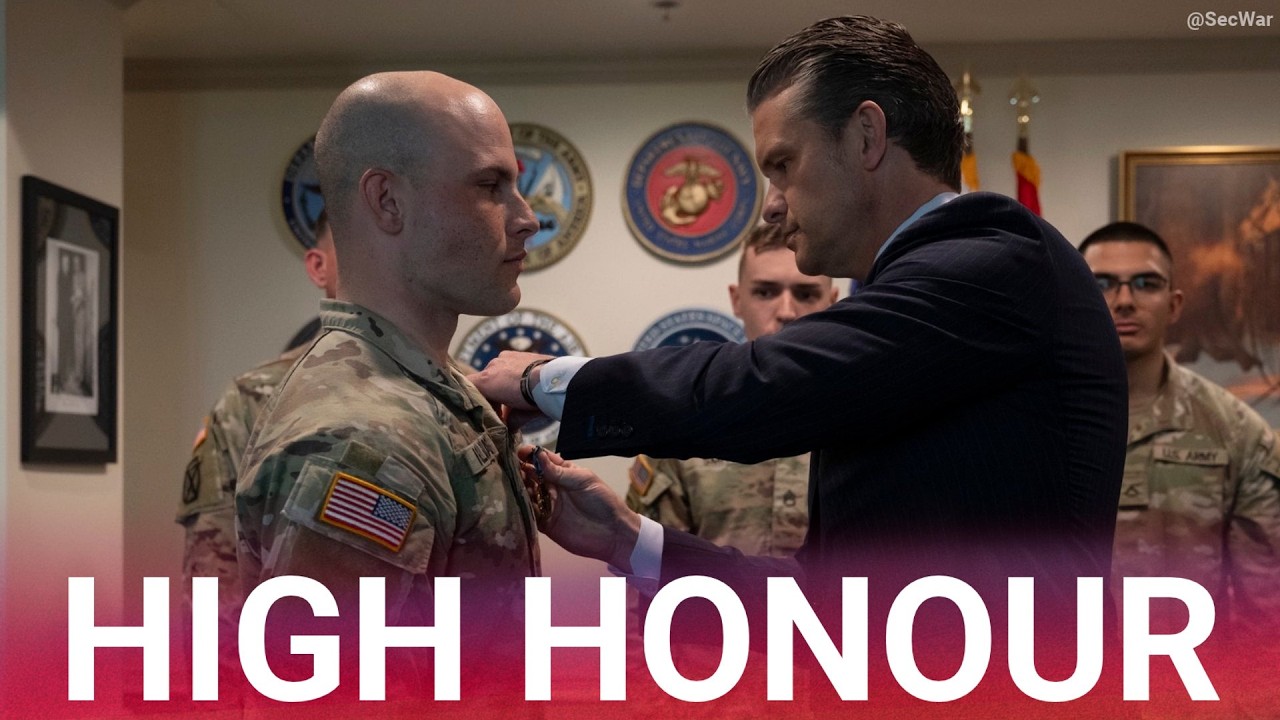
Instead, the next development changed the central narrative. On November 12, Hegseth welcomed members of the Old Guard to the Pentagon and personally recognized Iglesias for his performance.
The defense secretary presented the young soldier with the Joint Service Commendation Medal, a formal military award recognizing meritorious service or achievement under applicable Department of Defense standards.
According to the Pentagon, the recognition specifically concerned Iglesias’s execution of his duties at the Tomb of the Unknown Soldier during the November 11 ceremony.
Photographs published by Hegseth showed him pinning the medal onto the soldier’s uniform, shaking his hand, and standing alongside members of the unit responsible for protecting the memorial.
The public presentation was particularly notable because the Joint Service Commendation Medal is a meaningful military decoration not routinely associated with junior enlisted personnel performing ordinary ceremonial duties.
By granting the award, Hegseth elevated what began as a moment of public embarrassment into an official acknowledgment that enforcing military standards deserved recognition.
His accompanying social media message was concise and direct: “We love soldiers. We love standards. Well done, Specialist.” The statement also encouraged military personnel to continue their service.
Those words offered a markedly different response from the confrontation some critics had anticipated following the widely circulated video of the sentinel’s reprimand.
Rather than challenging Iglesias’s authority, Hegseth publicly endorsed his conduct and presented the interaction as an example of the military professionalism his department intended to encourage.
The decision also reinforced the Pentagon spokesman’s earlier explanation that the sentinel had acted correctly and respectfully, suggesting consistency between the department’s initial response and the subsequent recognition.
Yet the award did not eliminate the underlying disagreement about the entourage’s conduct. Critics could acknowledge the soldier’s recognition while still questioning why the warning became necessary.
Supporters of Hegseth, meanwhile, could point to the commendation as evidence that he respected the soldier’s responsibility and was willing to acknowledge proper enforcement of memorial rules.
The two interpretations are not necessarily mutually exclusive. A senior official can appropriately recognize a soldier’s performance while questions remain about the conduct that prompted the correction.
For Iglesias, the recognition brought unusual national attention to a role normally defined by deliberate anonymity, strict ceremonial precision, and an expectation that personal prominence remains secondary to duty.
The identity of the person receiving the warning was irrelevant to the sentinel’s immediate responsibility. Maintaining the dignity of the memorial was the purpose of the command.
That principle carries significance in military institutions, where authority is organized through formal rank but specific duties can require individuals to enforce rules affecting those above them.
Military discipline depends on clearly defined responsibilities, consistent enforcement, and confidence that personnel performing authorized duties will receive institutional support rather than punishment.
The Arlington encounter offered a highly visible example of that principle because the soldier maintained the established standard while the country’s defense secretary stood within hearing distance.
The episode also unfolded during a politically difficult period for Hegseth, whose leadership had already attracted congressional scrutiny over military operations and decisions made during the Trump administration.
One day before the Arlington incident, House lawmakers rejected an effort to impeach the defense secretary, following allegations concerning his conduct and management of military operations.
The impeachment effort failed in a 211–204 vote, leaving Hegseth in office while underscoring the intensity of congressional disagreement over his leadership.
Supporters of the impeachment effort argued that serious questions remained concerning executive authority and military accountability. Hegseth rejected the accusations and characterized the proceedings as politically motivated.
Those separate disputes provided political context for the reaction to the Arlington video, although they did not establish any direct connection to the sentinel’s warning.
The memorial controversy concerned a much narrower issue: whether visitors accompanying the defense secretary observed established expectations at a solemn military site.
Its public significance came from the contrast between the extraordinary authority of Hegseth’s position and the ordinary, nonnegotiable standard the young soldier was assigned to enforce.
There was also an important difference between the criticism directed toward Hegseth and the documented facts surrounding the encounter, especially regarding who laughed and what motivated the group.
The recording establishes that laughter was heard and that Iglesias immediately responded. It does not justify unsupported claims that Hegseth deliberately mocked fallen soldiers or ordered anyone to behave disrespectfully.
Similarly, the subsequent award is documented, but there is no need to invent a private conversation, emotional exchange, or hidden reprimand to explain why the Pentagon recognized the sentinel.
The public record already contains a substantial and unusual sequence: a ceremonial violation, an immediate correction, national criticism, official acknowledgment, and a military commendation.
For Arlington National Cemetery, the episode highlighted the standards that help preserve the dignity of a place visited by grieving families, military veterans, government officials, and Americans from across the country.
The rules surrounding the tomb are intended to create a shared environment of remembrance rather than distinguish between visitors based on political affiliation, rank, or personal prominence.
When Iglesias issued his command, that obligation applied to everyone present. The subsequent recognition confirmed that the Pentagon considered his enforcement of the rule appropriate.
For Hegseth, awarding the medal created an opportunity to publicly align his actions with his stated emphasis on discipline, even while criticism of the initial incident continued.
For Kinzinger and other critics, the acknowledgment did not erase concerns about the behavior of senior officials during an event dedicated to remembering those who served and died.
The disagreement illustrates why the incident resonated beyond a single moment of laughter. Americans saw the encounter through different perspectives involving leadership, symbolism, responsibility, and institutional standards.
Some focused on whether a cabinet official’s entourage demonstrated sufficient awareness of the setting. Others emphasized the soldier’s professionalism and the defense secretary’s decision to reward it.
Both questions remain relevant because public accountability involves not only how leaders respond after criticism, but also whether their conduct consistently reflects the standards they expect others to follow.
As of November 13, the central developments were established: Iglesias issued the warning on Veterans Day, Pentagon officials defended his conduct, and Hegseth awarded him the Joint Service Commendation Medal the following day.
There was no verified indication that Iglesias faced punishment for correcting the entourage. The documented outcome was recognition for fulfilling his assigned responsibility.
The closing image of the controversy was therefore markedly different from its beginning. A soldier who had publicly reminded senior officials of a solemn rule was subsequently honored by the official he had corrected.
That reversal gave the incident its enduring significance, illustrating how a brief confrontation at a military memorial could become a national discussion about leadership and respect.
Ultimately, the question extends beyond whether Hegseth’s entourage should have been quieter or whether the commendation demonstrated an appropriate response to public criticism.
It concerns a principle embedded in the military tradition Iglesias was protecting: at the Tomb of the Unknown Soldier, remembrance comes before rank, ceremony comes before politics, and the obligation to show respect belongs to everyone.
