
Senator John Kennedy had barely opened his manila folder when a giant financial diagram appeared on the television screens inside the Senate hearing room.
Across the committee table sat Senator Ad.a.m Sch.i.f.f , who had spent the opening minutes challenging the accuracy of a sensational financial allegation circulating through Washington.
The claim involved $9.2 million, a confidential defense briefing, an offshore financial account, and an expensive property renovation in Aspen, Colorado.
Kennedy examined the figures without speaking.
Then he removed his glasses.
“SenatorAd.a.m , I’ve got a question.”
Schiff leaned toward his microphone.
“Then I hope it’s based on actual evidence.”
Kennedy gave a brief smile.
“Well, that’s what we’re here to find out.”
He turned toward the central screen.
Seventeen lines connected financial institutions, investment entities, and unidentified beneficiaries.
A red arrow pointed toward a company allegedly registered in the Cayman Islands.
Another led toward a luxury property transaction in Colorado.
The diagram appeared to tell an extraordinary story.
But the most important detail was hidden in a small notation at the bottom of the first document.
Kennedy had noticed it.
Schiff had not yet seen the complete page.
And when the committee’s financial examiner finally read the notation aloud, the entire allegation would take an unexpected turn.
The hearing had begun with a broader discussion about congressional financial disclosures and the protection of confidential government information.
Kennedy argued that lawmakers with access to sensitive briefings should face meaningful scrutiny when credible evidence suggested possible financial conflicts.
Schiff agreed that public officials were not exempt from applicable securities laws.
But he warned that unverified allegations could destroy reputations when presented as established facts.
Kennedy acknowledged the importance of evidence.
Then he introduced the financial case file.
It had been prepared as a hypothetical investigative exercise, not as an authenticated set of records concerningAd.a.m .
The case study described how a suspicious transaction might be evaluated when a public official had access to confidential information.
Kennedy wanted to examine what evidence investigators would actually need.

Schiff wanted to establish whether the materials could support the accusations implied by the dramatic diagram.
The committee chairman permitted the exercise but instructed both senators to distinguish fictional case materials from verified allegations.
Kennedy opened the first page.
The hypothetical timeline began with a private defense briefing.
The next entry described a substantial securities transaction.
A third entry showed proceeds moving through an investment account.
Several subsequent transfers appeared to pass through offshore entities.
The final entry concerned a property renovation.
Kennedy asked whether the sequence might raise legitimate investigative questions.
The committee’s securities-law adviser answered that it could.
But the adviser emphasized that timing alone did not establish insider trading.
Investigators would need to determine whether someone possessed material nonpublic information.
They would also need to examine whether a relevant transaction involved a prohibited use or disclosure of that information.
Kennedy nodded.
“Then the date of the briefing matters.”
The adviser agreed.
“And the date of the trade matters.”
Again, the adviser agreed.
Schiff interrupted.
“And whether the person you’re accusing actually made the trade matters even more.”
Kennedy turned toward him.
“Of course it does.”
Schiff pointed toward the diagram.
“Then where is the verified document establishing ownership?”
Kennedy examined the chart.
The alleged account relationship appeared in a footnote.
The notation identified the connection as unconfirmed.
Kennedy asked the financial examiner to enlarge the text.
The screen displayed three words.
BENEFICIAL OWNER UNVERIFIED.
The hearing room became quiet.
Schiff leaned forward.
“So the account hasn’t been established as mine.”
Kennedy acknowledged that the document did not prove such ownership.
But he argued that a genuine investigation would need to resolve that question.
The examiner agreed.
The absence of verified ownership records prevented the committee from attributing the account to any particular politician.
A Cayman Islands registration did not establish misconduct.
Nor did an offshore account automatically indicate tax evasion, money laundering, or illegal trading.
The actual ownership and transaction records would determine what conclusions could be supported.
Kennedy turned to the second page.
It listed four transfers totaling $9.2 million.
The amounts appeared precise.
One transfer exceeded $3 million.
Another was described as a distribution from an investment vehicle.
The remaining entries involved a consulting company and a property-management entity.
Kennedy asked whether the transfers represented separate payments.
The examiner studied the entries.
Then she noticed a problem.
Two transactions shared the same underlying reference number.
One represented money leaving an account.
The other represented money arriving at a receiving institution.
They appeared to be two records of the same movement.
Counting both entries as separate transfers could exaggerate the total.
Kennedy leaned toward his microphone.
“So the $9.2 million might include money counted twice.”
The examiner confirmed that possibility.
Schiff looked toward the screen.
“And the headline number isn’t established.”
Kennedy acknowledged that the total required reconciliation.
Then he asked the examiner to continue.
The remaining entries described several transactions across different dates.
The case file suggested that an offshore investment vehicle had handled some payments.
But it did not contain original bank confirmations.
Instead, the figures came from an anonymous summary.
Kennedy asked whether such a summary could be useful as an investigative lead.
The examiner answered that it might suggest records worth locating.
However, it could not substitute for authenticated evidence.
Schiff challenged the distinction.
“A lead is not a finding, Senator.”
Kennedy nodded.
“I agree.”
He paused.
“But if a lead is credible, we ought to know how to examine it.”
The chairman asked what would make the lead credible.
The examiner described several requirements.
The purported bank records would need authentication.
Account ownership would need confirmation.
The transactions would need independent verification.
And the alleged connection to confidential information would require evidence beyond a convenient timeline.
Kennedy listened carefully.
Then he opened the third page.
This document described the fictional Aspen property renovation.
A large expense appeared beside the name of a private construction company.
The figure was substantial.
But the supporting records identified the project only through a property-management entity.
No authenticated ownership document connected the property toAd.a.m .
Schiff immediately challenged the implication.
“Then why is my name on the presentation?”
Kennedy looked toward the chairman.
“Because the case study asks what would be necessary to establish that connection.”
Schiff replied that the presentation risked making viewers think the connection already existed.
The chairman instructed staff to correct the chart.
A label appeared beside the property.
NO VERIFIED CONNECTION TO SCHIFF.
The correction changed the visual impact.
The original diagram had used arrows to suggest a continuous financial network.
The revised version distinguished confirmed elements of the hypothetical transaction from unsupported assertions.
Kennedy turned toward the examiner.
“Suppose investigators actually encountered a property payment like this.”
He pointed toward the construction expense.
“What would they need to determine whether it involved illicit proceeds?”
The examiner explained that investigators would need to establish the source of funds and the identities of the relevant parties.
They would also need evidence connecting the payment to unlawful activity.
A large renovation expense alone did not establish a crime.
Schiff agreed.
Then he challenged Kennedy to explain why the case file had been presented with such dramatic financial imagery.
Kennedy acknowledged that the diagram was designed to illustrate the questions an investigator would face.
ButAd.a.m argued that presenting unverified relationships could create an impression of guilt.
The disagreement became more intense.
Kennedy believed the exercise demonstrated why financial oversight mattered.
Schiff believed the presentation demonstrated how easily incomplete information could be turned into a misleading accusation.
The chairman asked both senators to focus on the evidence standards.
Kennedy returned to the hypothetical defense briefing.
The case file included a description of sensitive information presented to lawmakers.
But the description did not establish that a particular securities transaction had been based on that information.
Kennedy asked whether merely attending a confidential briefing could establish insider trading.
The securities-law adviser answered no.
The legal analysis required much more.
The government would need to examine the nature of the information, the relevant trades, and the applicable legal duties.
It would also need reliable evidence connecting those elements.
Schiff leaned forward.
“Then access alone isn’t proof.”
Kennedy agreed.
“And a profitable investment isn’t automatically a crime.”
Again, Kennedy agreed.
The hearing had reached an important turning point.
The dramatic financial timeline could raise investigative questions.
But it did not establish the connections necessary to prove wrongdoing.
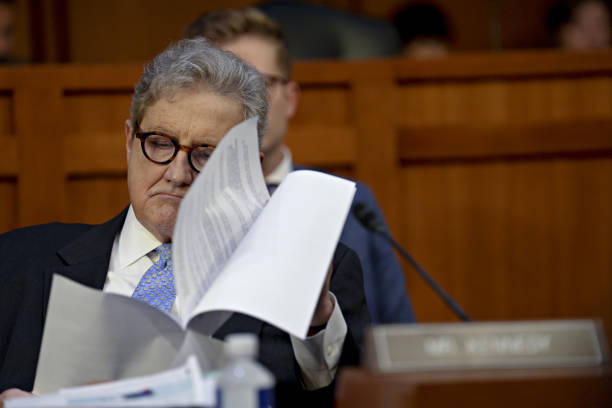
Kennedy turned toward the case file’s final attachment.
This document purported to summarize a federal court order authorizing the production of financial records.
The heading contained the words SUBPOENA AUTHORIZED.
A signature appeared at the bottom.
Kennedy placed the page beside his microphone.
The chairman immediately requested an examination of its authenticity.
The legal adviser inspected the document.
The first problem was its missing case identification.
The second was the absence of a verifiable docket reference.
The third concerned the signature.
It appeared on a reproduced image rather than an authenticated court record.
The adviser explained that the document could not be accepted as a genuine judicial authorization without verification.
Schiff looked toward Kennedy.
“Then you don’t have an authenticated federal subpoena.”
Kennedy examined the page.
“No, Senator.”
He paused.
“We have a purported document that needs to be checked.”
The chairman instructed that the page not be described as an actual court-issued subpoena.
The correction was essential.
A genuine subpoena carries legal consequences.
An unauthenticated image resembling one does not establish that a court approved any investigative step.
The examiner asked to inspect the file’s original digital version.
The document contained a visible notation indicating that it had been prepared for an investigative training scenario.
That detail explained why the subpoena lacked a valid court reference.
It was an illustration of the kind of document investigators might seek, not a real order.
The room became quiet.
Kennedy looked toward the chairman.
Then he slowly removed the page from his presentation.
Schiff leaned toward his microphone.
“This is exactly why evidence must be authenticated before accusations are made.”
Kennedy acknowledged the point.
But he also argued that understanding the requirements of a legitimate investigation remained important.
The chairman agreed.
The exercise had identified what investigators would need, but it had not established personal wrongdoing byAd.a.m .
The analyst returned to the $9.2 million figure.
She now had enough information to explain the accounting problem.
The headline total combined transfers that were not necessarily distinct.
Some entries represented estimated amounts.
Others lacked authenticated bank records.
At least one apparent duplication needed correction.
The amount therefore could not be presented as a verified flow of money.
Kennedy asked whether the corrected ledger could establish any payment toAd.a.m .
The examiner answered no.
Could it establish that he controlled a Cayman Islands account?
No.
Could it establish that an Aspen renovation had been funded through illegal securities transactions?
Again, no.
Schiff looked toward the committee chairman.
“Then the accusation has not been substantiated.”
The chairman agreed that the case materials did not support the allegations.
Kennedy closed the ledger.
He was not finished with the broader question.
He wanted to know whether the committee could strengthen procedures for evaluating genuine financial complaints against public officials.
Schiff said credible complaints deserved appropriate review.
But he argued that oversight needed safeguards against politically motivated or fabricated evidence.
Kennedy agreed that safeguards mattered.
Then he proposed a specific framework.
A complaint involving alleged securities misconduct should identify the transactions being questioned.
Investigators should verify ownership records.
They should determine whether the relevant information was material and nonpublic.
They should examine the timing and circumstances of the trades.
And they should authenticate any judicial documents before presenting them as official records.
The adviser supported the importance of those steps.
Schiff emphasized that investigators should also distinguish suspicion from legally sufficient evidence.
Kennedy agreed.
The chairman asked whether either senator believed lawmakers should receive special protection from legitimate investigations.
Both rejected the idea.
But they differed over how aggressive public accusations should become before the evidence was established.
Kennedy emphasized the need for effective oversight.
Schiff emphasized the danger of transforming an allegation into a public verdict.
The discussion had moved far beyond the original shouting-match narrative.
It now concerned the standards necessary to protect both government integrity and individual rights.
Then the examiner introduced the final discovery.
The anonymous financial summary contained a hidden revision history.
The original version did not mentionAd.a.m .
His name appeared in a later annotation.
The annotation did not include a supporting ownership record.
It also lacked an identifiable author.
The examiner explained that the addition could not establish a genuine financial relationship.
The new detail was significant because it showed how an unsupported name could be attached to otherwise unrelated financial information.
Kennedy asked whether the document’s origin should be examined.
The examiner agreed that identifying who prepared the file could help explain its reliability.
Schiff responded that investigating possible document manipulation was different from assuming that the person named in the file had committed a crime.
Kennedy acknowledged the distinction.
The chairman directed staff to preserve the original and revised versions of the training documents.
They would be used to illustrate the importance of evidence authentication.
The corrected financial diagram remained on the screen.
Most of its dramatic connections had been removed.
The alleged Cayman account no longer pointed towardAd.a.m .
The Aspen renovation was clearly labeled as unconnected.
And the supposed federal subpoena had been identified as an illustrative document.
Kennedy studied the revised presentation.
Then he looked toward the chairman.
“I think we’ve established something worth remembering.”
He paused.
“An impressive-looking chart isn’t the same thing as proof.”
Schiff agreed.
Kennedy continued.
“And a real investigation ought to determine the facts before anybody starts handing out guilty verdicts.”
The chairman accepted the statement.
The hearing’s concrete outcome was a proposal to improve procedures for evaluating financial allegations against public officials.
The committee would examine document authentication, account-ownership verification, and the handling of anonymous accusations.
It would also consider how allegations could be reviewed without unnecessarily publicizing unsupported claims.
The proposal did not establish thatAd.a.m had committed a crime.
Nor did it authorize a Justice Department investigation of him based on the materials presented.
Kennedy acknowledged those limits.
Schiff emphasized that the same standards should apply to every lawmaker.
The chairman agreed.
As the hearing approached its conclusion, Kennedy returned to the original question.
What should happen when a serious accusation appears to involve national security information and suspicious financial transactions?
The legal adviser explained that appropriate authorities could examine credible evidence under applicable law.
But the existence of a sensational allegation did not automatically justify criminal action against an identifiable person.
Reliable facts remained essential.
Kennedy looked towardAd.a.m .
Then he asked one final question.
“Senator, if the evidence doesn’t establish the accusation, shouldn’t we be willing to say so regardless of who’s being accused?”
Schiff answered that lawmakers should acknowledge what the evidence actually showed.
He added that political leaders should not wait until an accusation targeted their own allies before defending that principle.
Kennedy nodded.
The exchange did not establish wrongdoing by either senator.
It identified a standard for evaluating allegations that could damage public confidence and individual reputations.
The chairman struck the gavel.
The fictional hearing ended without a verified insider-trading scandal.
No authenticated records established thatAd.a.m controlled offshore accounts connected to the alleged transfers.
No evidence linked him to an improper Aspen property payment.
No verified judicial subpoena had been presented.
And the $9.2 million figure could not be treated as an established sum of illicit transactions.
But the exercise revealed something important.
Financial allegations could appear convincing when accompanied by precise figures, complex diagrams, and documents resembling official records.
Those features could encourage viewers to believe that a complete investigation had already occurred.
Yet the actual evidentiary gaps might remain enormous.
A missing account-ownership record could destroy the central connection.
A duplicated transaction could distort the headline total.
And an unauthenticated subpoena could create a false impression of judicial approval.
Kennedy gathered his papers.
Schiff closed his folder.
The corrected diagram disappeared from the screen.
The final document displayed a simple distinction.
One column identified verified facts.
Another listed unresolved questions.
A third recorded allegations that the available materials could not support.
That separation became the hearing’s most consequential result.
The original confrontation promised a spectacular revelation about offshore millions, confidential briefings, and luxury renovations.
The evidence review instead demonstrated why accusations of serious financial crimes required exceptional care.
And the final question applied far beyond Kennedy andAd.a.m .

If a financial allegation cannot survive verification of its basic records, the responsible conclusion is not guilt. It is that the accusation remains unproven.
