
Warren Calls Kennedy a National Disgrace—His Fictional Live-TV Response Changes Everything
The television studio fell into an uncomfortable silence as Senator Elizabeth Warren delivered a blistering condemnation of Senator John Neely Kennedy, accusing the Louisiana Republican of turning border security into a weapon of political division.
In this fictional Washington political drama, Warren had appeared on a nationally televised morning program to challenge Kennedy’s proposed immigration enforcement legislation, calling his approach dangerous, unnecessarily punitive, and unworthy of American democratic principles.
But the interview took an unexpected turn when the program’s producers announced that Kennedy, watching from his Capitol Hill office, had requested an opportunity to respond live.
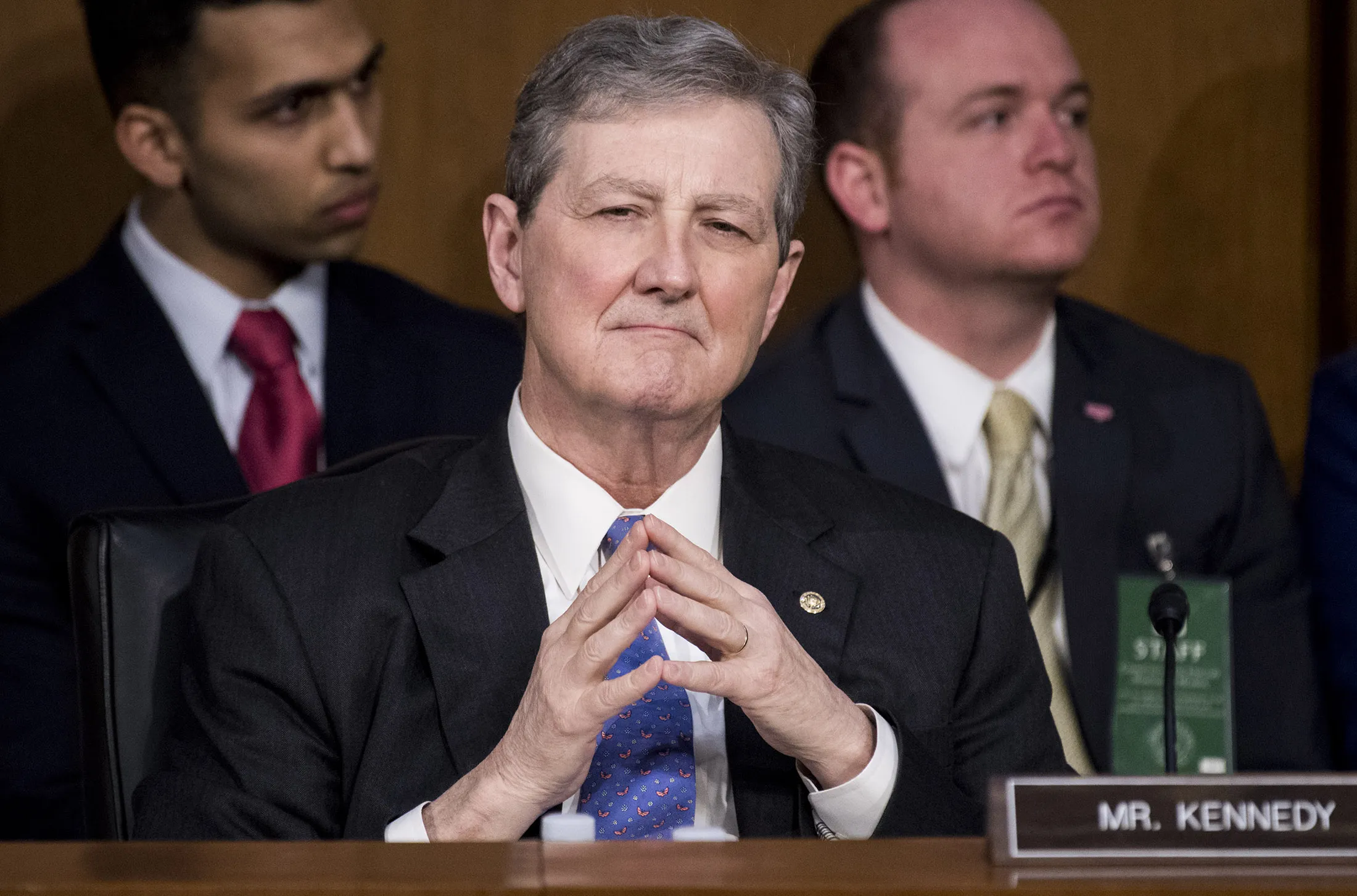
The Republican senator appeared on a split screen, seated behind his desk with several folders arranged before him. He seemed determined to challenge Warren’s criticism without matching its emotional intensity.
What followed was an imagined confrontation involving disputed financial documents, questions about charitable organizations, and a grieving mother’s letter that forced both politicians to confront the human consequences of immigration policy.
The confrontation is fictional, including the television appearance, the alleged financial connections, and the personal letter. Its underlying policy disagreements, however, reflect genuine divisions over border enforcement, constitutional protections, and public accountability.
Warren opened the imagined broadcast by arguing that Kennedy’s proposal placed excessive emphasis on punishment while failing to adequately distinguish serious public safety threats from immigrants seeking stability and opportunity.
She maintained that federal immigration policy should protect American communities without abandoning due process, humanitarian responsibilities, or safeguards against arbitrary government action.
Kennedy’s supporters, she argued, were treating an emotionally complicated issue as though it could be solved through aggressive enforcement alone, overlooking the consequences for families and communities.
The fictional hosts pressed Warren to explain whether stronger border controls could coexist with the protections she advocated, particularly when immigration authorities encountered individuals with serious criminal histories.
Warren answered that effective enforcement and constitutional accountability were not mutually exclusive, insisting that federal authorities should prioritize demonstrable threats while respecting established legal protections.
Her position reflected a genuine component of her political record. In February 2026, Warren joined Senator Chris Coons in introducing legislation seeking independent oversight of federal immigration enforcement agencies.
That proposal emphasized accountability mechanisms for Immigration and Customs Enforcement and Customs and Border Protection, reflecting concerns about misconduct and insufficient oversight.

Kennedy, meanwhile, has publicly emphasized the importance of funding border enforcement agencies and maintaining stronger immigration controls, presenting those priorities as essential components of national security.
Their actual policy differences provided the foundation for the fictional television confrontation, although no verified broadcast establishes that Warren called Kennedy a national disgrace or that he answered her live.
In the imagined studio, Warren’s criticism reached its most confrontational point when she described Kennedy’s legislative approach as a national disgrace and accused him of exploiting public anxiety for political advantage.
One host asked whether the language was unnecessarily personal, but Warren defended the strength of her criticism by emphasizing the importance of protecting vulnerable people from harmful government policies.
Then the producer’s announcement interrupted the discussion. Kennedy was available by telephone and video, and he wanted to respond directly to the accusations made during the interview.
The hosts agreed to connect him, introducing the Louisiana senator as Warren watched the second half of the screen appear beside her.
“Senator Warren,” Kennedy began in the fictional exchange, “I appreciate your passion. But calling somebody names doesn’t tell a mother whether her family is going to be safe tomorrow.”
Warren immediately challenged the framing, arguing that public safety required evidence-based policies rather than broad assumptions connecting immigration status with criminal behavior.
Kennedy acknowledged that immigration violations and violent crimes were not interchangeable, but maintained that lawmakers had an obligation to identify preventable failures in screening, supervision, and enforcement.
He then placed the first document on his desk, describing it as a hypothetical example of an internal administrative report concerning gaps in communication between immigration authorities and local law enforcement.
The report did not establish that Warren had personally caused any failure. Instead, Kennedy used the imagined material to question how federal officials should respond when known information fails to reach the people responsible for public safety.
Warren countered that individual administrative failures should be investigated without using them to justify sweeping policies that might affect thousands of people with no criminal histories.
Kennedy accepted the need for distinctions but asked whether elected officials should demand measurable improvements when enforcement agencies repeatedly identify problems with information sharing.
The exchange quickly became more substantive than the opening insult, revealing two different concerns about the same government system: the risk of inadequate enforcement and the risk of excessive authority.
Warren argued that enforcement institutions required independent oversight precisely because mistakes could have devastating consequences for individuals subjected to detention, removal, or improper treatment.
Kennedy responded that oversight should also examine cases where officials failed to act on credible threats, leaving families exposed to preventable harm.
The fictional hosts attempted to redirect the conversation toward Kennedy’s proposed legislation, asking whether it contained sufficient protections against mistaken detention and other violations of individual rights.
Kennedy replied that safeguards should be evaluated alongside enforcement procedures, rather than treated as competing priorities that could never operate together.
Warren challenged him to explain which authorities would make crucial decisions, what evidence they would require, and what remedies would exist when the government made mistakes.
Kennedy answered that those were legitimate legislative questions and that Congress should address them through clear standards, oversight procedures, and accountability for administrative failures.
Then he opened another folder, introducing a set of hypothetical financial summaries involving organizations receiving public funding to provide immigration-related services.
The documents concerned an invented network of nonprofit contractors, including entities whose organizational structures made it difficult to identify the ultimate recipients of certain administrative payments.
Kennedy emphasized that complicated nonprofit structures did not automatically establish fraud, but argued that taxpayers deserved to know how public money moved through service contracts.
Warren questioned why those materials had been introduced during a discussion about border security, warning that unrelated financial allegations could distract from the substance of the proposed legislation.
Kennedy replied that financial accountability formed part of the broader immigration debate because public resources supported enforcement, detention operations, humanitarian assistance, legal services, and administrative programs.
He asked whether Warren would support independent audits of contractors regardless of whether they worked for enforcement agencies or organizations providing humanitarian services.
Warren answered that government-funded organizations should face appropriate financial scrutiny, but insisted that audits must be based on credible evidence rather than insinuations about politically disfavored groups.
The confrontation grew tense when Kennedy asked how lawmakers could evaluate competing immigration proposals without understanding the full costs and performance of the institutions implementing them.
Warren maintained that transparency should apply across the system, including private detention contractors, federal agencies, charitable organizations, and companies receiving public immigration-related contracts.
That response prevented the exchange from becoming a simple accusation against one political faction. Both politicians had acknowledged that accountability needed to extend beyond their preferred targets.
But Kennedy was preparing to introduce a different kind of evidence, one intended to shift attention away from financial calculations and toward the personal consequences of government failures.
He lifted a letter from the desk, explaining that the fictional correspondence came from a mother named Carla, whose family had experienced an unimaginable tragedy.
Carla was an invented character, and her letter represented a hypothetical example rather than testimony from an identifiable victim or a documented immigration-related crime.
In the fictional letter, Carla described losing her teenage son after a violent encounter involving someone whose prior warning signs had not been adequately assessed by the responsible authorities.
Her grief was not presented as evidence that immigrants generally posed a public safety threat, nor did the scenario establish which government policies would have prevented the tragedy.
Instead, the imagined letter raised questions about what institutions should do when credible information about dangerous behavior is available but fails to produce an effective response.
Kennedy began reading, his tone considerably quieter than it had been during the earlier disagreement over contracts and government oversight.
“My son was not a political argument,” the fictional mother wrote. “He was a child who wanted to graduate, find a job, and take care of his family.”
The imagined studio fell quiet as Kennedy continued with the letter, describing a parent seeking answers about whether authorities could have recognized warning signs before tragedy struck.
Kennedy placed the paper on the desk and asked what lawmakers owed families who believed preventable administrative failures had contributed to the loss of someone they loved.
Warren responded that the grief of victims’ families deserved respect and that government agencies should be examined when serious warning signs were ignored.
But she also insisted that individual tragedies should not be used to assign collective blame to entire communities or justify measures unsupported by evidence.
Kennedy acknowledged the distinction, arguing that the purpose of examining hypothetical failures was not to condemn immigrants as a group, but to identify responsibilities that government institutions could fulfill more effectively.
The exchange exposed a difficult feature of immigration politics: individual stories can communicate the stakes of policy decisions, but cannot establish the overall effectiveness of national legislation.
A family harmed by a preventable failure deserves answers, while individuals wrongly detained or separated from loved ones deserve protections and opportunities to challenge government action.
Neither concern becomes less important because the other exists. The challenge for lawmakers is designing systems capable of addressing both without allowing fear or political loyalty to determine outcomes.
In the fictional interview, Warren returned to the issue of evidence, asking Kennedy whether his proposed enforcement measures had undergone analysis demonstrating that they would prevent the types of failures he described.
Kennedy answered that legislative proposals should face rigorous scrutiny, but argued that policymakers should also explain what they intended to do about weaknesses identified in existing procedures.
Warren suggested that some improvements might require better training, timely information sharing, judicial review, and independent investigation rather than simply expanding detention or enforcement authority.
Kennedy countered that those reforms could be compatible with stronger enforcement, depending on the particular problem and whether existing legal authorities were adequate.
The fictional disagreement reflected a genuine policy question: how should the United States allocate resources between border security operations, immigration case processing, community safety, legal safeguards, and humanitarian responsibilities?
The answer depends on the measurable consequences of particular policies, not merely on which senator delivers the most emotionally compelling argument during a televised confrontation.
Warren’s real criticism of federal immigration operations has included concerns about detention practices, family separation, and the treatment of individuals who have not been convicted of criminal offenses.
Kennedy’s real public statements have repeatedly stressed the importance of border security and adequate funding for agencies charged with enforcing federal immigration laws.
Those positions represent different priorities within a system that must manage national sovereignty, legal process, humanitarian protection, and public safety simultaneously.
As the imagined program continued, the hosts asked whether the disagreement had become unnecessarily personal, especially after Warren’s initial description of Kennedy’s proposal.
Warren maintained that her strongest objections concerned the consequences of policies she considered harmful, not a belief that public safety concerns should be dismissed.
Kennedy replied that criticism was part of democratic government, but warned that personal accusations could prevent lawmakers from examining specific policy deficiencies.
The debate then returned to the hypothetical financial documents, with Warren asking whether Kennedy had identified any verified improper transactions connecting the invented nonprofit entities to actual misconduct.
Kennedy acknowledged that the fictional summaries did not prove criminal activity or establish wrongdoing by Warren, and that independent investigators would need authenticated records before drawing conclusions.
That clarification mattered because accusations involving financial misconduct can damage reputations even when the supporting documents are incomplete, unrelated, or misunderstood.
Warren argued that rigorous verification should come before public insinuations, particularly when charitable organizations perform services that may be essential to vulnerable families.
Kennedy responded that the same requirement applied to allegations against immigration authorities and public officials, emphasizing the importance of examining records rather than relying entirely on political rhetoric.
The discussion had moved a considerable distance from the original accusation, becoming an argument about how democratic institutions should evaluate complicated claims involving both personal tragedy and public money.
In the fictional program’s final minutes, the hosts asked each senator to identify the standard they believed should guide immigration legislation.
Warren emphasized constitutional rights, measurable improvements in public safety, independent oversight, and the necessity of distinguishing actual threats from individuals seeking lawful protection.
Kennedy emphasized enforceable rules, timely information sharing, accountability for administrative failures, and the obligation to respond when credible evidence identifies preventable dangers.
Neither position offered a complete answer to every immigration problem, but both outlined responsibilities that could be examined through legislative language, administrative records, and independent evaluation.
Then Kennedy returned to Carla’s fictional letter, placing it beside the financial documents that had dominated the earlier portion of the interview.
He looked toward the camera and asked a question that linked the competing concerns into a single standard of public responsibility.
“Senator Warren, if a government policy fails a grieving mother, and another policy fails an innocent family, shouldn’t Washington be accountable for both?”
Warren paused before answering, then agreed that failures affecting either group deserved scrutiny, while challenging Kennedy to ensure that proposed remedies did not create new injustices.
Kennedy replied that effective government required learning from every preventable failure, regardless of whether the affected family fit neatly into one party’s political narrative.
The imagined studio became quiet, not because the senators had reached a sweeping agreement, but because the exchange had exposed the limits of personal accusations.
The fictional hosts closed the discussion by noting that immigration legislation could not be evaluated solely through emotional appeals, financial allegations, or promises of stronger enforcement.
It required examining whether proposed provisions were lawful, practical, appropriately funded, and capable of producing measurable improvements without creating unacceptable risks.
For Americans following immigration debates, that distinction matters because public decisions affect people with vastly different experiences, including crime victims, immigrants, border communities, enforcement personnel, and families navigating legal uncertainty.
A policy that addresses one problem may create another if lawmakers fail to consider implementation, judicial safeguards, administrative capacity, or the consequences for people who have committed no wrongdoing.
Similarly, refusing to investigate documented government failures can undermine confidence in institutions responsible for protecting communities and administering immigration laws.
The fictional Warren-Kennedy exchange illustrated how quickly political disagreement can become a competition over whose concerns deserve recognition and whose experiences should shape public policy.
But the most important questions remained practical: which specific reforms would improve public safety, which protections would prevent abuses, and what evidence could demonstrate that either goal had been achieved?
Kennedy’s fictional response to Warren’s opening criticism did not establish financial wrongdoing, prove a hidden scandal, or demonstrate that one legislative approach would resolve America’s immigration challenges.
Warren’s fictional objections likewise did not establish that every enforcement proposal was harmful or that existing procedures required no additional scrutiny.
Instead, their imagined confrontation revealed why responsible political debate requires separating legitimate criticism from personal insinuation, emotionally compelling stories from representative evidence, and policy promises from measurable outcomes.
The final silence on the fictional broadcast was therefore less important than the question that had produced it: could Washington apply the same standard of accountability to every family harmed by government failure?
That question reached beyond either senator’s reputation, challenging the political habit of treating suffering as persuasive only when it reinforces a preferred argument.
For American voters, the lasting issue is not who appeared more confident on television, but whether their elected representatives can defend policies that protect public safety and constitutional rights together.
And in the imagined closing moment, as Kennedy lowered Carla’s letter and Warren prepared her final response, the debate left viewers confronting a difficult question.
When political leaders promise to protect American families, should their success be measured by the force of their accusations—or by the lives and rights their policies actually protect?
