
The television studio was already tense when Representative Ilhan Om.a.r reached into her handbag and placed a small, worn copy of the United States Constitution on the desk.
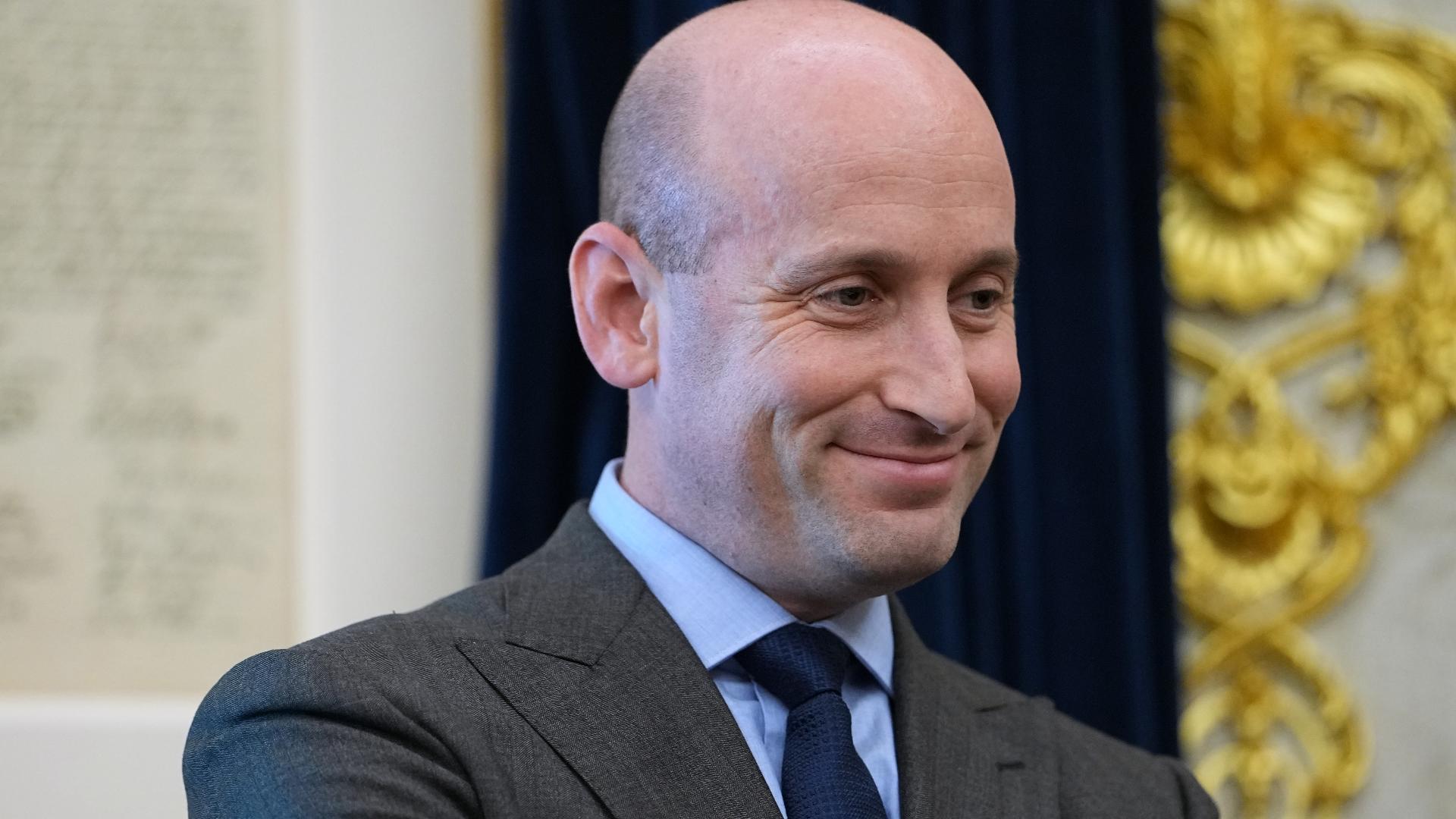
Across from her sat Step.h.e.n Mi.l.l.e.r.
The fictional debate had begun with a controversial proposal to remove a democratically elected New York state assemblyman from the country because of his political statements.
The assemblyman was an American citizen.
That detail was not in dispute.
Yet the proposed punishment had dominated the broadcast for nearly twenty minutes.
Om.a.r had listened as national security, immigration enforcement, and political loyalty became tangled together in an increasingly heated discussion.
Then she leaned toward her microphone.
“Mr. Miller, I have a very simple question.”
Miller looked across the desk.
Om.a.r opened the Constitution.
“Are you proposing to deport somebody because he broke the law, or because you don’t like what he believes?”
The studio became quiet.
Miller began explaining the importance of national security.
Om.a.r did not interrupt.
She waited until he finished.
Then she turned the Constitution toward him.
“National security is important.”
She paused.
“But you still haven’t answered the question.”
The moderator leaned forward.
Om.a.r pointed toward the document.
“Because if an American citizen can lose his place in this country simply for disagreeing with the government, we’ve got a much bigger problem than one politician’s speech.”
The room remained silent.
Then the moderator introduced a legal memorandum prepared for the fictional discussion.
The document appeared to authorize extraordinary immigration enforcement against the assemblyman.
But Om.a.r had already noticed something in its final paragraph.
And that single sentence would change the entire argument.
The broadcast had been organized around a broader disagreement concerning immigration enforcement and constitutional limits.
Miller emphasized the government’s responsibility to protect national security and enforce immigration law.
Om.a.r argued that those responsibilities did not authorize officials to disregard constitutional protections.
Both agreed that credible threats and actual criminal conduct could warrant appropriate investigation.
Their disagreement concerned whether political speech alone could justify deporting an American citizen.
The moderator asked the legal analyst to explain the distinction.
The analyst stated that federal immigration removal procedures generally apply to noncitizens.
A confirmed United States citizen cannot ordinarily be deported under those procedures.
Citizenship does not disappear because someone expresses unpopular political or religious views.
Nor does a government official acquire additional deportation authority by describing those views as dangerous.
Om.a.r nodded.

“Then let’s establish that before we start discussing punishment.”
Miller maintained that political leaders had to take genuine threats seriously.
Om.a.r agreed.
“But a threat requires evidence.”
She looked toward the moderator.
“A political insult is not the same thing as a criminal act.”
The analyst confirmed that the applicable law depended on specific conduct and circumstances.
A person could express controversial opinions without violating criminal law.
And a lawful investigation would require a factual basis rather than generalized suspicion.
Om.a.r turned toward Miller.
“So we’re not debating whether people should be allowed to criticize an assemblyman.”
She paused.
“Of course they should.”
Then she pointed toward the Constitution.
“We’re debating whether the government can turn that criticism into deportation.”
The moderator asked whether the fictional assemblyman’s status as an elected official changed the answer.
The analyst explained that public office did not create immunity from legitimate legal proceedings.
If an official committed a crime, the government could pursue lawful action.
But holding office also did not make a citizen subject to immigration removal because of political disagreement.
Om.a.r looked toward the memorandum.
“Then the important fact isn’t whether he’s popular.”
She raised the page.
“It’s whether the government has lawful authority to do what somebody is demanding.”
The discussion turned toward the Fourteenth Amendment.
Om.a.r opened her pocket Constitution to its citizenship provisions.
The amendment establishes important principles concerning United States citizenship and constitutional protections.
The analyst explained that citizenship acquired through birth or naturalization carries legal significance independent of political popularity.

A naturalized citizen does not become deportable merely because a public official dislikes his opinions.
Miller argued that questions involving fraudulently obtained citizenship could raise different legal issues.
The analyst agreed that specific legal proceedings might exist under limited circumstances.
But such proceedings required an actual legal basis.
The hypothetical assemblyman’s political remarks did not establish citizenship fraud.
Om.a.r leaned toward the microphone.
“Then let’s not pretend we’re discussing a citizenship fraud case when nobody has presented evidence of one.”
The moderator asked whether religious identity could affect the analysis.
The analyst explained that the First Amendment protects religious freedom and imposes limits on government action concerning religious belief.
Religious affiliation did not, by itself, establish criminal conduct or deportability.
Om.a.r nodded.
“That’s why the rules have to apply even when the person being discussed is unpopular.”
She paused.
“Especially then.”
Miller continued arguing that national security threats required vigilance.
Om.a.r acknowledged the responsibility.
Then she raised a distinction.
“Vigilance means examining actual conduct.”
She looked toward him.
“It doesn’t mean giving government officials permission to punish people for their identities.”
The moderator turned toward the legal memorandum.
Its first section described an administrative response to statements characterized as politically extreme.
The second discussed possible enforcement mechanisms.
The third addressed citizenship verification.
Om.a.r pointed toward the first section.
The language suggested that officials should examine whether immigration enforcement could be used against the assemblyman.
She asked the analyst whether such a recommendation had legal force.
The analyst answered that an internal memorandum could not create deportation authority absent under law.
Om.a.r turned toward Miller.
“Then writing something on government letterhead doesn’t make it constitutional.”
The moderator asked whether the document identified an immigration statute authorizing the proposed removal.
The analyst reviewed the material.
No applicable provision had been identified under the stated assumption that the assemblyman was a confirmed American citizen.
Om.a.r nodded.
“That’s the first problem.”
She turned another page.
“The second problem is even more obvious.”
The memorandum treated the assemblyman’s political statements as potentially relevant to immigration enforcement.
But it did not identify a specific criminal offense.
The analyst explained that a person’s speech could sometimes be evidence in a lawful investigation.
However, speech alone was not automatically criminal.
Its significance depended on content, context, and applicable legal standards.
Om.a.r asked whether criticism of the government was sufficient.
The analyst answered no.
She asked whether expressing an unpopular political opinion was sufficient.
Again, the answer was no.
Then she asked whether a public official could lawfully order deportation merely because he considered a citizen’s views offensive.
The analyst answered no.
The moderator looked toward Miller.
In the fictional exchange, Miller maintained that officials should investigate credible national security concerns.
Om.a.r accepted that lawful investigations could occur.
But she asked him to distinguish investigation from punishment.
“Suppose somebody makes a statement you consider deeply objectionable.”
She paused.
“You can criticize it.”
Miller agreed.
“You can challenge it in public.”
He agreed again.
“And if credible evidence establishes a crime, the government can follow the law.”
The analyst confirmed the principle.
Om.a.r leaned forward.
“But what you cannot do is skip every legal requirement and demand that an American be removed from his own country.”
The room became quiet.
The moderator attempted to move toward a broader immigration policy discussion.
Om.a.r raised one finger.
“There is still something in this memorandum we haven’t examined.”
She turned toward the final page.
The language appeared technical.
It described the legal conditions necessary before any immigration removal procedure could begin.
One sentence acknowledged that confirmed United States citizenship would prevent the proposed use of ordinary deportation procedures.
Om.a.r pointed toward the line.
“Would you put that on the screen, please?”
The production team enlarged the paragraph.
The moderator read it aloud.
The memorandum itself recognized that the proposed immigration mechanism would not apply to a confirmed American citizen.
For several seconds, nobody spoke.
Om.a.r looked toward Miller.
“So the document already contains the answer.”
Miller responded that immigration enforcement involved many complicated legal considerations.
Om.a.r agreed that immigration law could be complex.
“But this particular question isn’t complicated.”
She pointed toward the screen.
“The person in this scenario is an American citizen.”
She paused.
“And the proposal is to deport him because someone dislikes his politics.”
The analyst confirmed that the memorandum did not identify lawful grounds for such an action.
The moderator asked whether the assemblyman could instead face political consequences for his statements.
Om.a.r answered that democratic accountability provided several possibilities.
Voters could criticize the assemblyman.
Political opponents could challenge him.
Constituents could organize, protest, or vote for another candidate.
The government could investigate actual legal violations when supported by evidence.
But losing a political argument did not strip someone of citizenship.
The moderator asked whether that principle applied to politicians Om.a.r personally opposed.
She answered yes.
“Constitutional protection cannot depend on who happens to be holding the microphone.”
The analyst agreed that constitutional rights were not contingent on agreement with the speaker’s politics.
Miller maintained that elected officials should not be insulated from criticism.
Om.a.r agreed.
Then she asked a different question.
“Who said anything about insulating him from criticism?”
She gestured toward the Constitution.
“This document doesn’t say Americans get to speak without being challenged.”
She paused.
“It says government power has limits.”
The moderator asked whether the separation between public criticism and government punishment was central to the discussion.
The analyst confirmed that it was.
Political debate could be fierce.
Public officials could condemn statements they considered dangerous.
But coercive state action required legal authority.
The studio grew quieter as the conversation shifted away from rhetoric.
Om.a.r opened another document.
It contained an illustrative list of controversial statements made by fictional public officials across different political movements.
Some involved immigration.
Others concerned religion, national security, and federal authority.
Om.a.r asked whether any official should lose citizenship merely because the administration disagreed with those statements.
The legal analyst answered no.
Miller acknowledged that punishment required legal authority.
Om.a.r nodded.
“Then the rule doesn’t change when the speaker belongs to a different political party.”
The moderator asked whether that standard also applied during national emergencies.
The analyst explained that emergencies could trigger particular legal authorities, but they did not erase all constitutional limits.
Government action still required an applicable legal foundation.
Om.a.r looked toward the screen.
“Then we cannot declare an emergency every time somebody says something politicians don’t want to hear.”
Miller argued that genuine security threats could demand urgent action.
Om.a.r agreed.
Then she asked whether an actual threat had been established in the fictional case file.
The analyst answered that the available material did not establish one.
The document contained political statements and allegations about their meaning.
It did not establish an offense providing a lawful basis for the proposed deportation.
Om.a.r leaned back.
“Then why are we discussing exile as though it’s an available legal remedy?”
The moderator asked Miller to address the narrow question.
Miller responded that his broader concerns involved national security and enforcement.
He acknowledged that any particular government action would have to comply with applicable law.
Om.a.r nodded.
“That is the point.”
She closed the memorandum.
The moderator attempted to summarize the exchange.
The legal issue concerned the proposed removal of a confirmed citizen.
The political issue concerned the assemblyman’s controversial statements.
Those were separate questions.
Criticism of the statements remained lawful.
Deportation without legal authority did not become lawful because the statements were unpopular.
The distinction was central to the fictional confrontation.
Then Om.a.r returned to the pocket Constitution.
She held it between her hands.
“Let me explain why this matters beyond one assemblyman.”
The moderator allowed her to continue.
“Imagine an administration using immigration enforcement as punishment for opinions it dislikes.”
She paused.
“Today the target could be a politician from one party.”
She looked toward Miller.
“Tomorrow it could be somebody from another party.”
The analyst explained that constitutional protections helped prevent officials from exercising unlimited power over political opponents.
Om.a.r continued.
“That’s why citizenship cannot operate like a membership card that government officials cancel whenever someone embarrasses them.”
The moderator asked whether the Constitution guaranteed that citizens could avoid every legal consequence of their conduct.
Om.a.r answered no.
Lawful criminal proceedings, civil remedies, and political accountability could apply under appropriate circumstances.
But those consequences had their own requirements.
They could not be replaced by an improvised deportation demand.
Miller emphasized that public officials should condemn rhetoric they believed threatened the country’s interests.
Om.a.r agreed that public debate was essential.
“But debate is not deportation.”
The moderator repeated the distinction.
A citizen could face criticism.
A citizen could lose an election.
A citizen could be investigated for actual misconduct.
But citizenship could not be revoked or ignored merely because the government disliked political speech.
Om.a.r turned toward the studio audience.
“That’s something a middle school civics class ought to understand.”
A few audience members reacted.
She continued.
“Government officials don’t get unlimited power simply because they believe they’re defending the country.”
The moderator asked whether her criticism was directed at immigration enforcement generally.
Om.a.r answered that the issue was the use of government power without lawful authority.
She distinguished legitimate immigration procedures from an unsupported proposal to deport a citizen.
The analyst confirmed that the legal framework treated citizens and noncitizens differently in important respects.
Neither category could be evaluated solely through political labels.
The facts and applicable statutes mattered.
The discussion had reached a point of agreement about the hypothetical assemblyman’s legal status.
The proposed deportation mechanism was unavailable.
The memorandum’s own language acknowledged that limitation.
And no evidence in the fictional case file established a separate lawful basis to remove his citizenship.
But Om.a.r was not finished.
She turned toward Miller.
“Mr. Miller, I want you to consider something.”
He looked toward her.
She placed the Constitution in the center of the desk.
“This isn’t a document written to guarantee that everyone agrees with you.”
She paused.
“It’s a document that limits what government can do when they don’t.”
The moderator asked whether she had one final question.
Om.a.r nodded.
She turned to the first page of the memorandum.
Then she looked directly at Miller.
“If you can deport an American for disagreeing with you, what exactly makes him an American?”
The room became silent.
The moderator allowed the question to stand.
Miller responded that citizenship and lawful immigration enforcement were governed by constitutional and statutory requirements.
The analyst reiterated that the proposed action could not proceed against the hypothetical citizen on the facts presented.
Om.a.r closed the Constitution.
“Then that’s the answer the public deserved from the beginning.”
The moderator thanked the participants.
But before the cameras switched away, Om.a.r made one final observation.
“People can disagree about borders.”
She paused.
“They can disagree about immigration policy.”
Then she looked toward the memorandum.
“But the government should not invent a deportation power because it dislikes an American’s political beliefs.”
The fictional broadcast concluded without establishing that Miller had actually demanded such a deportation in real life.
Nor did it document a genuine televised confrontation between him and Om.a.r.
The story illustrated a constitutional question through invented dialogue.
The legal principle at its center, however, was straightforward.
A confirmed United States citizen is not subject to ordinary immigration deportation because of unpopular political statements.
The government may investigate genuine misconduct when supported by evidence and legal authority.
It may enforce applicable laws through appropriate procedures.
But political disagreement does not erase citizenship.
The final image on the studio screen showed the critical sentence from the fictional memorandum.
Its own legal analysis acknowledged that the proposed deportation mechanism did not apply to an American citizen.
That sentence mattered more than the heated rhetoric surrounding it.
The question was never whether the assemblyman deserved public approval.
It was whether the government possessed lawful authority to remove him from the country.
Under the assumed facts, it did not.
Om.a.r gathered her papers.
Miller closed his folder.
The pocket Constitution remained in the center of the desk.
And the final question lingered after the fictional broadcast ended.
If citizenship can be taken away for expressing an unpopular political opinion, then constitutional freedom has become a privilege granted by whoever happens to hold power.
