
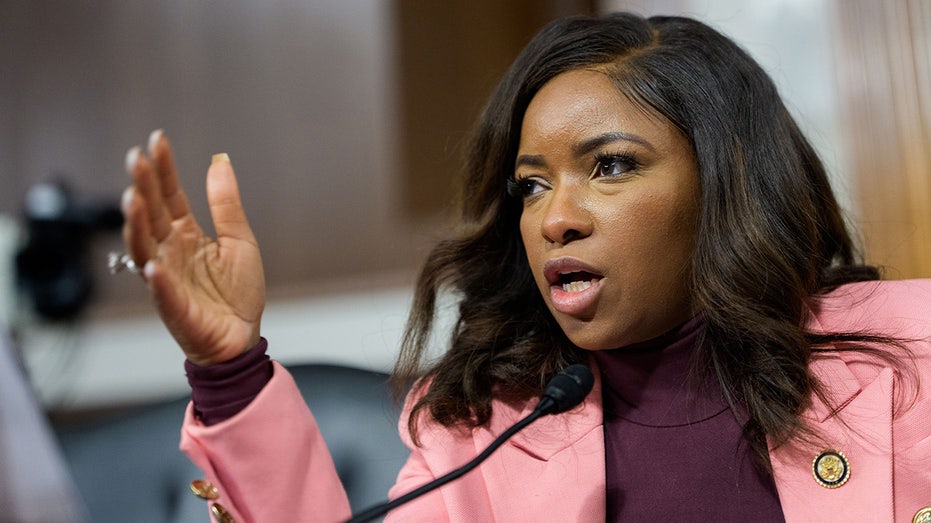
Congresswoman Jasmine Crockett placed two financial reports beside her microphone and looked directly at Senator Ron Johnson.
The confrontation had begun with an argument about tax fairness, wealthy business owners, and the financial pressure facing ordinary Americans.
Johnson defended a business tax deduction he had helped shape during Donald Trump’s 2017 tax overhaul.
Crockett challenged whether that provision delivered disproportionate benefits to wealthy Americans while federal tax enforcement struggled to keep pace.
But she had prepared something more specific than an ordinary political argument.
Her folder contained a comparison of IRS audit rates, congressional tax policy, and the resources available to investigate sophisticated financial arrangements.
Johnson insisted that legitimate business deductions should not be confused with illegal tax evasion.
Crockett acknowledged the distinction.
Then she placed a final chart on the display.
It showed how sharply audit coverage had fallen for some of America’s highest-income taxpayers.
She turned toward Johnson.
“Senator, if billionaires and working families must obey the same tax laws, why would we weaken the investigators responsible for enforcing them?”
The question changed the direction of the exchange.
And the final document contained an even more difficult distinction.
A legal tax break could benefit wealthy Americans without establishing that anyone had cheated.
But weakened enforcement could make genuine violations harder to uncover.
The Tax Break That Put Ron Johnson Under Scrutiny
The confrontation centered on the Tax Cuts and Jobs Act of 2017.
The legislation substantially changed America’s federal tax system.
One provision created a deduction for qualifying income earned through certain pass-through businesses.
These businesses generally report income through their owners rather than paying corporate income tax as separate C corporations.
They include partnerships, S corporations, sole proprietorships, and certain limited liability companies.
Johnson played a significant role in negotiations surrounding the provision.
He initially opposed the Senate’s tax proposal because he believed it placed pass-through businesses at a disadvantage compared with corporations.
His objections contributed to changes benefiting owners of qualifying pass-through businesses.
The resulting deduction became Section 199A of the Internal Revenue Code.
Johnson defended the provision as necessary for small-business competitiveness.
He argued that lowering corporate tax rates without comparable relief for pass-through enterprises would create an uneven playing field.
Crockett challenged the distribution of the benefits.
She pointed toward research showing that wealthy business owners received a substantial share of the deduction’s financial value.
The disagreement was immediate.
Johnson emphasized how many businesses could qualify.
Crockett emphasized where the largest dollar benefits were concentrated.
Both measures described relevant aspects of the policy.
A deduction could be available to millions of businesses while delivering especially large savings to high-income owners.
That distinction became central to Crockett’s challenge.
She opened a 2022 fact-check examining Johnson’s role in the legislation.
PolitiFact reported that analyses found substantial benefits flowing to wealthy Americans.
However, its separate examination also rejected describing the publicly enacted provision as a secret loophole created exclusively for Johnson.
Crockett turned toward the senator.
“Then let’s stop arguing about whether it’s legal.”
She pointed to the distributional analysis.
“Let’s talk about who receives the biggest financial advantages.”
Johnson responded that benefits to wealthy owners did not automatically invalidate relief available to smaller businesses.
Crockett acknowledged that point.
But she wanted to know whether lawmakers had adequately considered alternative ways to target assistance toward businesses with fewer resources.
The exchange had moved from accusations of wrongdoing to a measurable policy disagreement.
The next document would raise a different problem.
Crockett Opens the Financial Records Behind the Wealthy Taxpayer Controversy
Crockett introduced reporting from ProPublica concerning wealthy business owners and the 2017 tax legislation.
The investigation examined how powerful financial interests sought changes to the proposed law.
It also described the substantial benefits some wealthy individuals received from the resulting pass-through deduction.
The report focused partly on Johnson’s role in negotiations.
It raised questions about the influence of affluent business owners and political donors on the provision’s final design.
ProPublica
Johnson challenged the implication that discussing tax policy with business owners established improper conduct.
Crockett agreed that lawmakers could consult businesses and constituents.
But she questioned whether the resulting policy distributed benefits fairly.
That was a different issue from alleging criminal behavior.
A business owner could lawfully use deductions established by Congress.
The existence of those deductions did not establish tax evasion.
Similarly, support for a policy benefiting wealthy taxpayers did not independently prove corruption.
Crockett distinguished those issues.
She wanted lawmakers to examine both the design of the tax system and the government’s ability to enforce it.
Johnson argued that Americans should not face higher taxes simply because their businesses became successful.
Crockett responded that success did not eliminate questions about whether the rules were equitable.
The moderator asked what evidence could distinguish those positions.
Crockett identified the distribution of tax benefits across different income groups.
Johnson emphasized the economic effects on businesses, investment, employment, and competitiveness.
Those were legitimate subjects for policy evaluation.
But Crockett’s next document concerned something separate from tax rates.
It examined whether the IRS had sufficient resources to identify people who violated existing law.
And the numbers were difficult to ignore.
The IRS Audit Numbers Reveal a Major Enforcement Problem
Crockett displayed historical audit coverage rates drawn from IRS reporting.
The agency had repeatedly warned that resource constraints reduced its capacity to examine complicated high-income returns.
Its 2022 Data Book statement identified a substantial decline in audit coverage among taxpayers reporting more than $10 million in total positive income.
The 2012 tax-year rate was 13.6 percent.
For tax year 2018, the corresponding rate was 9.2 percent.
Corporate audit coverage also declined.
The IRS reported that the overall corporate audit rate fell from 1.3 percent to 0.6 percent over the same period.
Partnership audit coverage declined from 0.3 percent to 0.1 percent.

Internal Revenue Service
Crockett questioned what those figures meant for sophisticated financial arrangements.
Complex partnerships and multinational ownership structures could require substantial investigative resources.
A single return might involve numerous entities, transactions, and valuation questions.
Identifying improper deductions could require specialized accountants, attorneys, and financial investigators.
Johnson challenged whether higher audit rates necessarily meant more effective enforcement.
Crockett acknowledged that auditing more returns did not automatically produce better results.
But she argued that an agency lacking adequate expertise could struggle to identify violations involving complicated transactions.
Johnson emphasized that audits also imposed costs on compliant taxpayers.
Crockett agreed that enforcement should be risk-based.
She rejected the suggestion that the appropriate response was simply to reduce investigative capacity.
The discussion now concerned a crucial distinction.
Audit frequency measured how often returns received examination.
It did not directly measure how much tax evasion occurred.
A declining audit rate could reflect resource constraints, changing priorities, or differences in investigative methods.
But persistent staffing and expertise shortages could still weaken enforcement.
Crockett turned toward Johnson.
“How do you prosecute a complicated tax scheme if you don’t have enough investigators to understand it?”
Johnson responded that Congress should focus on effective oversight rather than assuming every funding increase would improve performance.
Crockett accepted the need for oversight.
Then she asked whether cutting resources without a credible replacement plan could make enforcement less effective.
That question prepared the audience for the next document.
The Offshore Trust Question Forces a Necessary Distinction
Crockett introduced an example involving a wealthy taxpayer with assets held through several domestic and foreign entities.
The arrangement included business partnerships, trusts, investment holdings, and cross-border payments.
Some structures could serve legitimate financial and estate-planning purposes.
Others could be used to conceal income, misrepresent ownership, or violate reporting requirements.
Crockett asked how the IRS should distinguish lawful planning from fraudulent conduct.
Johnson argued that the existence of an offshore trust did not establish tax evasion.
Crockett agreed.
She emphasized that investigators needed evidence showing whether legal obligations had been violated.
The moderator asked what that investigation might require.
Crockett identified financial records, beneficial ownership information, transaction histories, and relevant tax filings.
Johnson responded that taxpayer privacy and procedural protections also mattered.
Crockett acknowledged those protections.
But she argued that sophisticated ownership arrangements could create substantial investigative challenges.
The central issue was no longer whether offshore structures were inherently unlawful.
They were not.
The issue was whether federal authorities possessed the expertise necessary to identify illegal uses of those structures.
Johnson maintained that enforcement resources should be targeted efficiently.
Crockett questioned how lawmakers would determine efficiency without reliable information about unexamined high-risk cases.
The disagreement became more concrete.
A taxpayer using a lawful deduction had not necessarily cheated.
A taxpayer concealing taxable income might be violating federal law.
Investigators needed enough information to distinguish those situations accurately.
Crockett then introduced the newest enforcement figures.
They showed that the debate was not limited to historical audit rates.
The IRS had experienced further operational changes affecting its investigative capacity.
And that development would become the central revelation in her final presentation.

The Side-by-Side Audit Chart Changes the Confrontation
Crockett displayed two panels on the screen.
The first summarized historical audit coverage.
The second showed more recent enforcement activity.
The IRS’s April 2026 statistical publication reported that approximately 500,000 tax returns were examined during fiscal year 2025.
That compared with roughly 740,000 in fiscal year 2021.
The publication also reported that individual examination coverage for tax year 2021 was 6.6 percent among taxpayers reporting at least $10 million in total positive income.
Those figures came from different measures and reporting periods.
They could not be treated as one continuous, directly comparable audit-rate series.
Taxpayers reporting more than $10 million in total positive income. Historical IRS comparison for tax years 2012 and 2018.
Crockett emphasized the direction of the historical trend.
She argued that reduced enforcement capacity could create additional opportunities for sophisticated noncompliance.
Johnson questioned whether those figures established that wealthy taxpayers were currently receiving preferential treatment.
Crockett acknowledged they did not prove that conclusion by themselves.
Higher-income taxpayers continued to experience greater audit coverage than many other groups.
The concern involved whether coverage was sufficient to address complex noncompliance effectively.
Then she introduced a separate report.
In April 2026, Reuters reported that IRS enforcement activity had weakened following substantial staffing reductions.
The agency conducted more than 120,000 fewer audits than the previous year.
Enforcement revenue also declined during the reported period.
Treasury officials nevertheless indicated that collections had improved during the opening months of fiscal year 2026.
That qualification mattered.
Recent revenue improvements could coexist with concerns about longer-term investigative capacity.
The results of sophisticated audits often take years to materialize.
Crockett argued that immediate financial indicators might not reveal the full consequences of losing experienced investigators.
Johnson maintained that enforcement should be evaluated through actual performance rather than staffing totals alone.
The disagreement had reached its most consequential point.
Both politicians were now discussing measurable outcomes.
But the final question would concern something more fundamental.
Could lawmakers defend equal application of tax law while supporting policies that might weaken the government’s ability to investigate violations?

The Prosecutor’s Question That Forces an Unexpected Answer
Crockett turned away from the chart.
She placed one final document on the table.
It concerned the distinction between tax avoidance and criminal tax evasion.
Tax avoidance may involve lawful use of deductions, credits, and other provisions.
Tax evasion involves unlawful conduct intended to defeat tax obligations.
The distinction was essential.
A prosecutor could not establish a criminal offense merely by demonstrating that someone benefited from favorable legislation.
Evidence of unlawful conduct and the required mental state would be necessary.
Crockett acknowledged that principle before asking her final question.
Then she looked directly toward Johnson.
“Senator, if a billionaire illegally hides taxable income, should federal prosecutors have the investigators and evidence needed to hold that person accountable?”
Johnson answered that everyone should comply with tax law.
Crockett followed immediately.
“Then why would Congress make those investigations harder?”
The question narrowed the entire debate.
Johnson challenged the assumption that every reduction in IRS spending necessarily weakened effective enforcement.
He argued that lawmakers could demand better management, improved technology, and more selective auditing.
Crockett acknowledged that organizational efficiency mattered.
But she questioned whether policymakers had demonstrated that those alternatives could replace lost investigative capacity.
The moderator returned to the audit data.
The records established that examination activity had declined.
They did not independently establish the motives behind every congressional funding decision.
Nor did they demonstrate that Johnson personally directed IRS resources away from particular wealthy taxpayers.
Those conclusions would require separate evidence.
But the documented reductions raised a legitimate policy question.
How should Congress measure whether tax enforcement remains capable of handling increasingly sophisticated financial arrangements?
Crockett argued that the answer required more than promises of efficiency.
Johnson maintained that additional funding should come with clear performance standards.
Their disagreement remained substantive.
Neither could resolve it by accusing the other of defending criminal behavior.
The final chart established the scale of the enforcement challenge.
It did not establish personal misconduct by Johnson.
The distinction changed the emotional direction of the confrontation.
The question was no longer whether one senator had been exposed as secretly protecting tax cheats.
It was whether Congress could demonstrate that its enforcement decisions preserved the government’s ability to apply tax law consistently.
The Final Consequence That Reaches Beyond Wall Street
The moderator asked what the documents had actually established.
Crockett emphasized the substantial financial benefits wealthy taxpayers could receive through provisions such as the pass-through deduction.
She also pointed toward declines in IRS audit activity and the difficulty of investigating complicated financial structures.
Johnson defended the legitimate purposes of business tax relief.
He argued that policymakers should not equate lawful deductions with criminal misconduct.
Both distinctions mattered.
The pass-through deduction had benefited millions of taxpayers.
Research also showed that wealthy owners received a significant share of its monetary benefits.
Historical IRS figures documented declining audit coverage in several categories.
More recent reporting raised additional concerns about staffing reductions and investigative capacity.
But those findings did not establish that Johnson had personally facilitated offshore tax evasion.
Nor did they prove that every wealthy taxpayer using a complex structure had violated federal law.
The documents supported a more precise examination of policy consequences.
Congress could debate how tax benefits should be distributed.
It could also determine what resources were necessary to enforce the laws already on the books.
Those were related questions, but they were not identical.
Crockett’s strongest challenge concerned enforcement consistency.
If the law applied to everyone, the government needed the practical ability to investigate credible violations across income groups.
Johnson’s response concerned the limits of government enforcement.
An effective system also needed proper oversight, taxpayer protections, and meaningful performance measures.
The central question was whether those objectives could be achieved simultaneously.
A credible accountability framework would examine the number and complexity of audits.
It would measure additional taxes assessed and ultimately collected.
It would evaluate taxpayer compliance costs and the accuracy of enforcement decisions.
And it would distinguish legitimate financial planning from conduct that actually violated the law.
The confrontation ended with those questions unresolved.
Crockett closed her folder.
Johnson maintained his defense of business tax relief and efficient government administration.
The moderator returned to the final chart.
The numbers documented changes in audit coverage and enforcement activity.
Their significance depended on how policymakers interpreted those changes and responded to the risks.
The most consequential finding was not a secret offshore trust controlled by a politician.
It was the documented challenge of enforcing a complicated tax system with limited investigative resources.
The larger policy question remained.
Could the federal government maintain fair and effective tax enforcement while balancing business incentives, taxpayer rights, and fiscal constraints?
Crockett’s final question focused on what happens when the government lacks the capacity to investigate serious wrongdoing.
Johnson’s response focused on how that capacity should be managed.
Neither concern could be answered through an accusation alone.
The public record required a more demanding standard.
A tax system cannot be judged solely by the laws Congress writes. Its fairness also depends on whether those laws can be enforced.
