
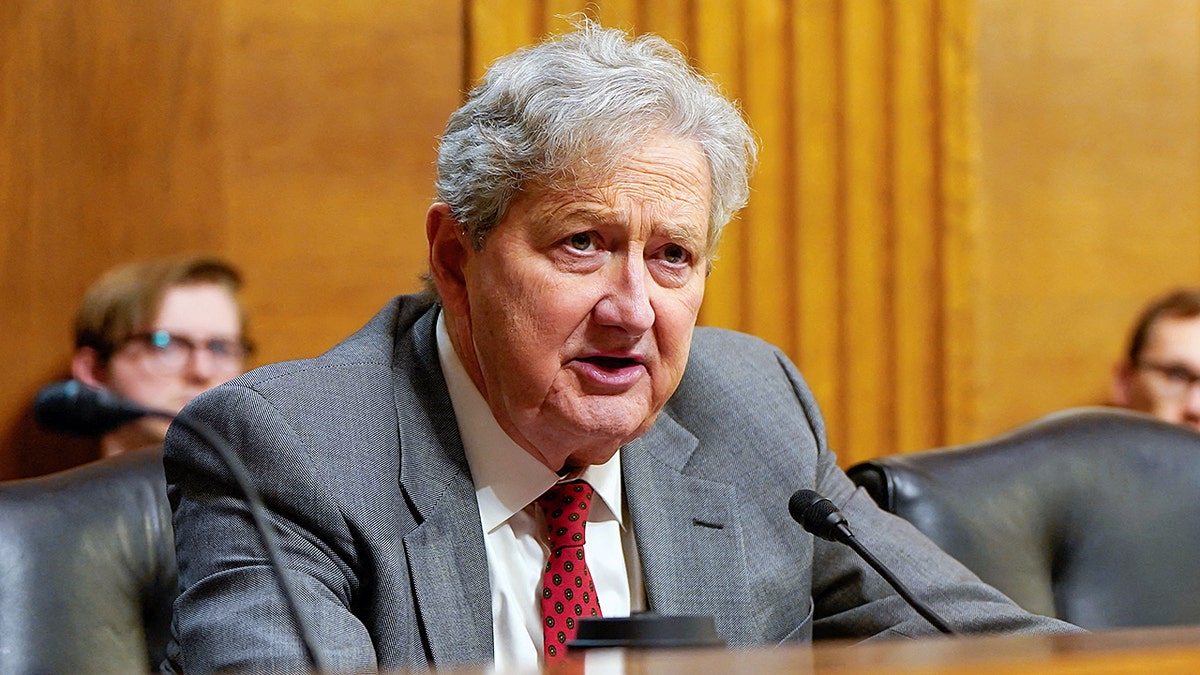
The hearing room fell silent when Senator John Ken.n.e.d.y placed three documents on the desk.
One concerned the MEALS Act.
Another contained a summary of the Feeding Our Future fraud scandal.
The third was marked with a single word.
CITIZENSHIP.
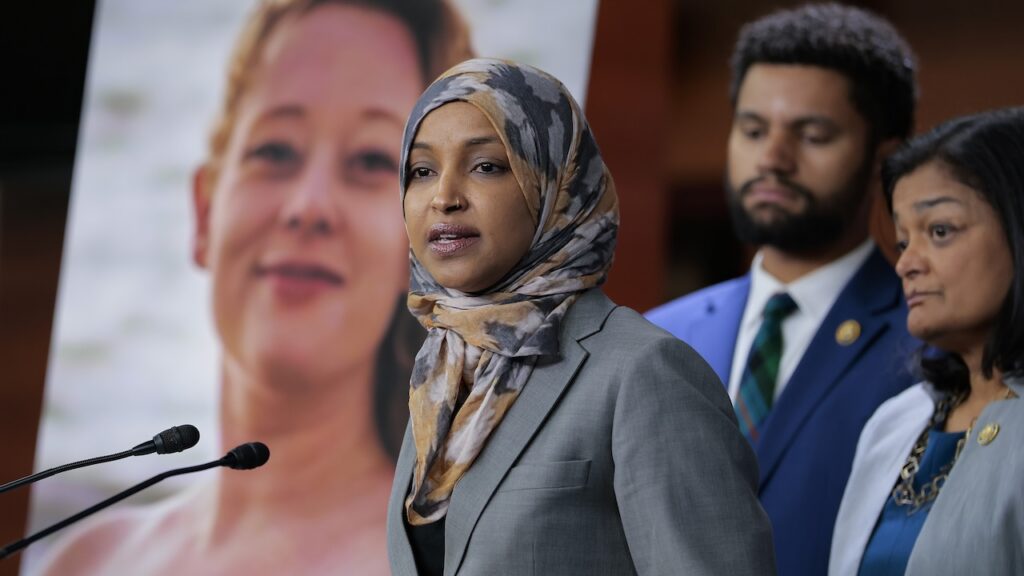
Across the table sat Representative Ilhan Om.a.r.
The fictional congressional hearing had begun with a contentious debate over pandemic-era federal spending, food assistance programs, and the limits of political accountability.
But the atmosphere changed when Ken.n.e.d.y opened the first folder.
“Congresswoman, I want to ask you about something.”
Om.a.r looked toward him.
“Go ahead, Senator.”
Ken.n.e.d.y raised a copy of the legislation.
“You introduced a bill intended to help children receive meals when schools were closed.”
He paused.
“Now, that’s a goal I think most Americans can understand.”
Om.a.r nodded.
Ken.n.e.d.y continued.
“But we also know that criminals exploited pandemic-era food assistance programs.”
He placed the second document beside the first.
“So I’d like to understand what safeguards were in place, what failed, and who was responsible for those failures.”
Om.a.r leaned forward.
“Then let’s discuss the actual facts.”
Ken.n.e.d.y nodded.
“That’s exactly what I intend to do.”
He turned to the first page.
The document described the Maintaining Essential Access to Lunch for Students Act, commonly called the MEALS Act.
Om.a.r introduced it in March 2020 as the COVID-19 pandemic disrupted school operations across the United States.
Its purpose was to give federal officials additional flexibility to maintain access to school meals during closures.
The legislation became part of a much larger national response to the pandemic.
But years later, Minnesota’s Feeding Our Future fraud scandal raised serious questions about how emergency food assistance programs had been administered.
Federal prosecutors described a massive scheme involving fraudulent claims for meals that were never provided.
The money was real.
The criminal prosecutions were real.
And the failures in oversight deserved investigation.
But Ken.n.e.d.y was about to confront a distinction that could change the entire direction of the fictional hearing.
Did a lawmaker who supported emergency food assistance also bear personal responsibility for criminals who exploited the system?
The answer required more than a dramatic headline.
It required evidence.
Ken.n.e.d.y opened the legislative record.
“Congresswoman, you supported giving federal agencies flexibility during an emergency.”
Om.a.r acknowledged that.
She explained that schools had closed, millions of children depended on meal programs, and Congress faced pressure to prevent disruptions in food assistance.
Ken.n.e.d.y accepted that context.
Then he asked whether emergency flexibility could also create opportunities for abuse if oversight systems were inadequate.
Om.a.r answered that any large government program required safeguards.
Ken.n.e.d.y nodded.
“Then perhaps that’s where we should start.”
The committee’s fictional financial analyst described the difference between legislation, agency implementation, state oversight, and individual criminal activity.
Congress could authorize a program or modify its legal framework.
Federal agencies could establish regulations and administrative procedures.
State agencies could carry out oversight responsibilities.
Organizations receiving funds could submit claims for reimbursement.
Criminal conduct could arise when participants intentionally submitted false information or diverted money.
Those stages were connected.
But they were not legally interchangeable.
Ken.n.e.d.y pointed toward the Feeding Our Future summary.
“Then the fact that a politician supported a law doesn’t automatically prove that politician participated in the fraud.”
The analyst answered no.
Om.a.r looked toward the senator.
“That’s the distinction I’ve been asking people to recognize.”

Ken.n.e.d.y nodded.
“But supporting legislation doesn’t eliminate questions about whether Congress understood its risks either.”
The analyst agreed.
Lawmakers could be questioned about policy design, foreseeable weaknesses, and oversight decisions without being accused of personally committing crimes.
The hearing moved toward the first major issue.
In Minnesota, Feeding Our Future and associated operators became the subjects of an extensive federal fraud investigation.
Prosecutors alleged that participants exploited federally funded child-nutrition programs by submitting false meal claims and using fabricated documentation.
The scandal involved hundreds of millions of dollars.
Numerous defendants were charged, and multiple defendants were convicted or pleaded guilty.
Ken.n.e.d.y studied the case summary.
“These weren’t small bookkeeping errors.”
The analyst agreed.
The prosecuted conduct involved intentional fraudulent activity.
But the analyst emphasized that the responsibility established in criminal proceedings concerned the defendants and conduct proven in those cases.
It did not automatically extend to every person who supported pandemic food assistance legislation.
Ken.n.e.d.y looked toward Om.a.r.
“Congresswoman, did you know about this scheme while it was operating?”
In the fictional exchange, Om.a.r reiterated her publicly stated denial of any knowledge of the fraudulent operation.
She maintained that her support for feeding children did not mean she had participated in criminal activity.
Ken.n.e.d.y examined the case file.
Then he asked the analyst whether the materials before the committee established that Om.a.r had personally submitted false meal claims.
The analyst answered no.
“Do they establish that she authorized fraudulent invoices?”
No.
“Do they establish that she received proceeds from the scheme?”
The analyst said the presented records did not establish that either.
Ken.n.e.d.y closed the folder.
“Then we need to be careful about what we’re accusing people of.”
The chairman leaned toward his microphone.
The discussion had reached a critical distinction.
There was a genuine fraud scandal.
There were legitimate questions about how emergency programs had been administered.
And there were political disputes concerning whether the MEALS Act and related federal waivers had weakened important safeguards.
But those questions were not proof of personal fraud by Om.a.r.
Then Ken.n.e.d.y turned to the next document.
It contained a hypothetical spreadsheet comparing the roles of federal lawmakers, program administrators, and private organizations.
One column showed legislative sponsorship.
Another showed administrative oversight.
A third contained examples of fraudulent claims.
The entries were presented side by side.
At first glance, the arrangement appeared to show a continuous chain of responsibility.
Ken.n.e.d.y pointed toward Om.a.r’s name.
“Now, somebody has put your name on this chart next to the fraud figures.”
Om.a.r looked toward the screen.
“Yes.”
Ken.n.e.d.y asked the analyst whether the chart demonstrated a direct financial connection.
The analyst reviewed the entries.
It did not.
The chart established that Om.a.r had introduced relevant legislation.
It separately summarized misconduct committed by participants in the food assistance program.
But it did not provide transaction records showing that she had authorized or received fraudulent payments.
Ken.n.e.d.y nodded.
“Then proximity on a spreadsheet isn’t evidence of a crime.”
The analyst agreed.
Om.a.r responded that political criticism should be based on accurately described records.
Ken.n.e.d.y accepted the point.
But he returned to the oversight issue.
He wanted to know whether emergency flexibility had made the program more vulnerable to fraudulent claims.
The analyst explained that pandemic-era changes altered the operation of federal meal programs.
Some requirements were relaxed or modified to maintain access during widespread disruption.
Those changes created challenges for administrators responsible for confirming that meals were actually delivered.
However, identifying the precise contribution of any individual legal provision required examining the full regulatory framework and implementation history.
Ken.n.e.d.y leaned forward.
“Then it’s possible to ask whether a policy created vulnerabilities without accusing the person who supported it of stealing money.”
The analyst agreed.
Om.a.r said that was a legitimate policy question.
The chairman directed the discussion toward specific safeguards.
The analyst described the importance of verifying meal counts, checking supporting documentation, reviewing participating organizations, and responding to suspicious claims.
Ken.n.e.d.y asked whether fraud prevention should remain important during emergencies.
The analyst answered yes.
But the analyst also acknowledged the tradeoffs agencies faced when schools abruptly closed and children still needed access to food.
Om.a.r emphasized the urgency of maintaining meals for families.
Ken.n.e.d.y emphasized the need for reliable spending controls.
The disagreement concerned how those objectives should be balanced.
Then the senator reached for the folder marked CITIZENSHIP.
The atmosphere became more serious.
The moderator introduced recent reporting concerning federal scrutiny of Om.a.r’s decades-old immigration paperwork.
The investigation had raised questions about whether authorities might pursue action affecting her citizenship.
Om.a.r had denied wrongdoing.
Ken.n.e.d.y looked toward the legal analyst.
“Now, I want to separate two things.”
He placed the citizenship file beside the food assistance documents.
“Does sponsoring the MEALS Act establish that someone’s citizenship was obtained unlawfully?”
The analyst answered no.
The questions were legally distinct.
The Feeding Our Future investigation concerned fraud involving federal food assistance funds.
The immigration inquiry concerned allegations relating to historical immigration documentation.
One did not automatically establish the other.
Ken.n.e.d.y nodded.
“Then putting both controversies in the same headline doesn’t turn them into the same case.”
The chairman agreed that the evidence should be evaluated separately.
Om.a.r argued that public commentary had too often blended unrelated allegations into an impression of proven misconduct.
Ken.n.e.d.y acknowledged that an investigation was not a conviction.
The legal analyst explained that citizenship could not be revoked merely because a political opponent demanded it.
The applicable legal process required specific grounds, evidence, and procedural protections.
A politician’s statements about another official’s background did not substitute for those requirements.
Ken.n.e.d.y looked toward the citizenship folder.
“Then the question is whether the evidence meets the law.”
The analyst agreed.
“Not whether somebody can deliver a memorable television insult.”
Again, the analyst agreed.
The fictional hearing then moved toward the most dramatic document.
A page purportedly contained electronic signatures associated with the administration of a food assistance program.
The names had been presented alongside questionable transactions.
Ken.n.e.d.y placed the page on the desk.
“Congresswoman, let’s examine these signatures.”
Om.a.r studied the document.
“First, we need to establish what they are.”
Ken.n.e.d.y turned toward the analyst.
“Fair enough.”
The analyst examined the record.
The page was an illustrative compilation, not an authenticated government exhibit.
It contained several types of entries.
Some represented legislative sponsorship.
Others represented administrative acknowledgment.
Still others concerned financial authorization by program officials.
The analyst explained that those actions had different meanings.
Sponsoring legislation did not authorize an individual contractor’s payment.
Receiving a program report did not necessarily mean approving an expenditure.
And a politician’s name appearing in a policy document did not prove participation in a fraudulent transaction.
Ken.n.e.d.y looked at the summary.
“Then somebody has mixed several kinds of signatures together.”
The analyst agreed.
Om.a.r pointed toward the page.
“That’s exactly the problem.”
Ken.n.e.d.y asked whether the page established that she had signed fraudulent payment claims.
The analyst answered no.
The fictional document did not establish that allegation.
The chairman requested that the record be corrected.
The signatures were separated according to their actual functions.
The dramatic visual impression began to unravel.
A name appearing on a legislative document was no longer treated as a signature on a fraudulent invoice.
A program acknowledgment was no longer presented as proof of criminal authorization.
And a general policy connection was no longer described as a direct financial transaction.
Ken.n.e.d.y studied the corrected table.
Then he leaned back.
“Well, that’s why we ask questions.”
Om.a.r looked toward him.
“Provided we ask them before announcing conclusions.”
Ken.n.e.d.y nodded.
“That’s a fair point.”
But the senator was not finished.
He returned to the Feeding Our Future case.
The criminal activity involved real failures that demanded serious explanations.
The existence of unsupported allegations against one politician did not erase the misconduct established against actual defendants.
Ken.n.e.d.y asked what reforms could reduce similar risks.
The financial analyst recommended clearer reporting, stronger verification procedures, consistent audits, and timely investigation of suspicious reimbursement claims.
Om.a.r supported protecting programs against fraud.
She also emphasized the importance of preserving access to food assistance for eligible children.
Ken.n.e.d.y argued that fraud prevention and access should be treated as complementary responsibilities.
The chairman asked whether increased oversight could create unnecessary delays.
The analyst explained that poorly designed controls might delay legitimate assistance.
But weak verification could allow fraudulent claims to divert resources.
A well-designed system needed to consider both risks.
Ken.n.e.d.y nodded.
“Then let’s stop pretending we have to choose between feeding children and protecting taxpayers.”
Om.a.r agreed that both goals mattered.
The moderator turned toward the citizenship issue one final time.
She asked whether the committee had presented evidence that the Feeding Our Future fraud case established grounds to revoke Om.a.r’s citizenship.
The legal analyst answered no.
Such a conclusion would require a separate legal analysis based on evidence relating to citizenship eligibility or other legally relevant grounds.
The food assistance allegations presented in the fictional hearing did not establish those requirements.
Ken.n.e.d.y closed the citizenship folder.
“Then those questions belong in their proper proceedings.”
Om.a.r emphasized that allegations should not be treated as proven before a court had evaluated the evidence.
Ken.n.e.d.y agreed that due process mattered.
The committee then examined a final chart.
It separated the discussion into three categories.
The first concerned documented criminal fraud in the Feeding Our Future case.
The second concerned legislative and administrative oversight questions surrounding emergency food assistance.
The third concerned allegations relating to Om.a.r’s immigration history.
The analyst explained that the categories required different evidence.
The first involved criminal prosecutions of participants in the fraud scheme.
The second concerned public policy, agency performance, and legislative accountability.
The third involved questions governed by immigration and citizenship law.
Ken.n.e.d.y examined the revised chart.
“Then a person can reasonably demand answers about all three without pretending they’re one giant proven conspiracy.”
The analyst agreed.
Om.a.r responded that the same principle required public officials to correct false implications when evidence did not support them.
Ken.n.e.d.y acknowledged that.
The chairman asked whether the committee had established that Om.a.r knowingly participated in Feeding Our Future fraud.
The analyst answered no.
Had the hypothetical signatures proven her personal financial involvement?
No.
Had the hearing established that her citizenship was unlawfully obtained?
No.
Ken.n.e.d.y paused.
“Then let’s say that clearly.”
The room remained quiet.
The chairman asked whether legitimate oversight questions remained.
The analyst answered yes.
The Feeding Our Future fraud demonstrated serious failures in program integrity.
Examining the relationships among emergency policies, administrative decisions, oversight practices, and criminal exploitation could help identify weaknesses.
The committee could also consider how future emergency programs should balance speed, access, and verification.
Those questions could be pursued without treating unsupported accusations as established facts.
Ken.n.e.d.y nodded.
“Then that’s the work.”
The moderator asked Om.a.r for her closing response.
She emphasized that supporting emergency food assistance was not evidence of personal fraud.
She argued that public officials should investigate actual misconduct and protect government programs against abuse.
But she also insisted that allegations concerning an individual’s citizenship or criminal responsibility required proof.
Ken.n.e.d.y listened.
Then he closed the last folder.
“Congresswoman, I’m going to keep asking questions about public money.”
Om.a.r answered that Congress had every right to conduct legitimate oversight.
Ken.n.e.d.y continued.
“And you have every right to demand that the questions reflect what the documents actually show.”
The chairman acknowledged the distinction.
Then Ken.n.e.d.y turned toward the central screen.
The corrected signature table remained visible.
He pointed toward the legislative record.
“This shows who sponsored a bill.”
He moved to the administrative entries.
“This shows who carried out certain government functions.”
Then he pointed toward the criminal case summary.
“And these records concern the people accused or convicted of fraud.”
He paused.
“They’re not interchangeable.”
The moderator asked Ken.n.e.d.y for one final question.
He removed his glasses.
Then he looked toward Om.a.r.
“Congresswoman, if we’re serious about finding the truth, shouldn’t we be just as determined to correct a false accusation as we are to uncover a real crime?”
The fictional hearing room fell quiet.
Om.a.r answered that accountability required both.
Ken.n.e.d.y nodded.
The chairman concluded the session.
The confrontation had not produced authenticated fraudulent signatures bearing Om.a.r’s name.
It had not established that she participated in Feeding Our Future fraud.
And it had not demonstrated that her citizenship could lawfully be revoked because of her support for pandemic-era meal legislation.
Instead, the review revealed why three very different questions had become entangled in political debate.
The first concerned an enormous criminal fraud case.
The second concerned the design and oversight of emergency government programs.
The third concerned allegations about the citizenship history of a sitting member of Congress.
Each required its own evidence.
The actual Feeding Our Future prosecutions demonstrated that large-scale fraud occurred.
The MEALS Act controversy raised questions about pandemic policy and oversight.
And the citizenship investigation carried serious legal and political implications.
But the existence of those controversies did not establish a personal criminal connection between them.
Ken.n.e.d.y gathered the documents.
Om.a.r closed her notes.
The chairman directed staff to preserve the corrected distinctions in the fictional committee record.
The hearing had begun with the promise of signatures that would settle everything.
It ended with the realization that a signature’s meaning depended on the document, the transaction, and the authority it represented.
The largest scandal was not necessarily the one suggested by the loudest accusation.
And the most important question was not who had delivered the harshest insult.
It was whether the people making allegations could produce evidence supporting their claims.
The final screen showed the corrected paper trail.
There were real policy questions.
There were genuine criminal prosecutions involving other defendants.
And there were allegations requiring independent legal scrutiny.
But those categories remained separate.
The strongest investigation is not the one that produces the most explosive political headline. It is the one that distinguishes proven fraud, policy responsibility, and unverified accusations before deciding who should be held accountable.
