
“IF AN AMERICAN CAN GO TO PRISON FOR LYING TO CONGRESS, WHAT HAPPENS WHEN CONGRESS LIES TO AMERICA?”

The question echoed through an imagined Senate chamber as Senator John Kennedy stood behind the lectern, holding a single sheet of paper.
He had no elaborate presentation.
No charts covered the walls.
No witnesses waited to be questioned.
Instead, Kennedy wanted his colleagues to confront a question about political accountability and public trust.
The Louisiana senator removed his glasses.
“Folks, I’ve been around long enough to know that Washington has more explanations than a teenager caught sneaking home after midnight.”
A few lawmakers smiled.
Kennedy continued.
“But there’s something about our system that deserves a serious conversation.”
He raised the paper.
“Under federal law, certain deliberate false statements to government investigators can carry a prison sentence of up to five years.”
He paused.
“Yet when politicians make false promises or misleading public statements, the consequences are often political rather than criminal.”
Kennedy looked across the chamber.
“Now, those aren’t legally identical situations.”
“But the difference raises a question worth answering.”
How should a democracy hold its elected representatives accountable for deliberately misleading the people they serve?
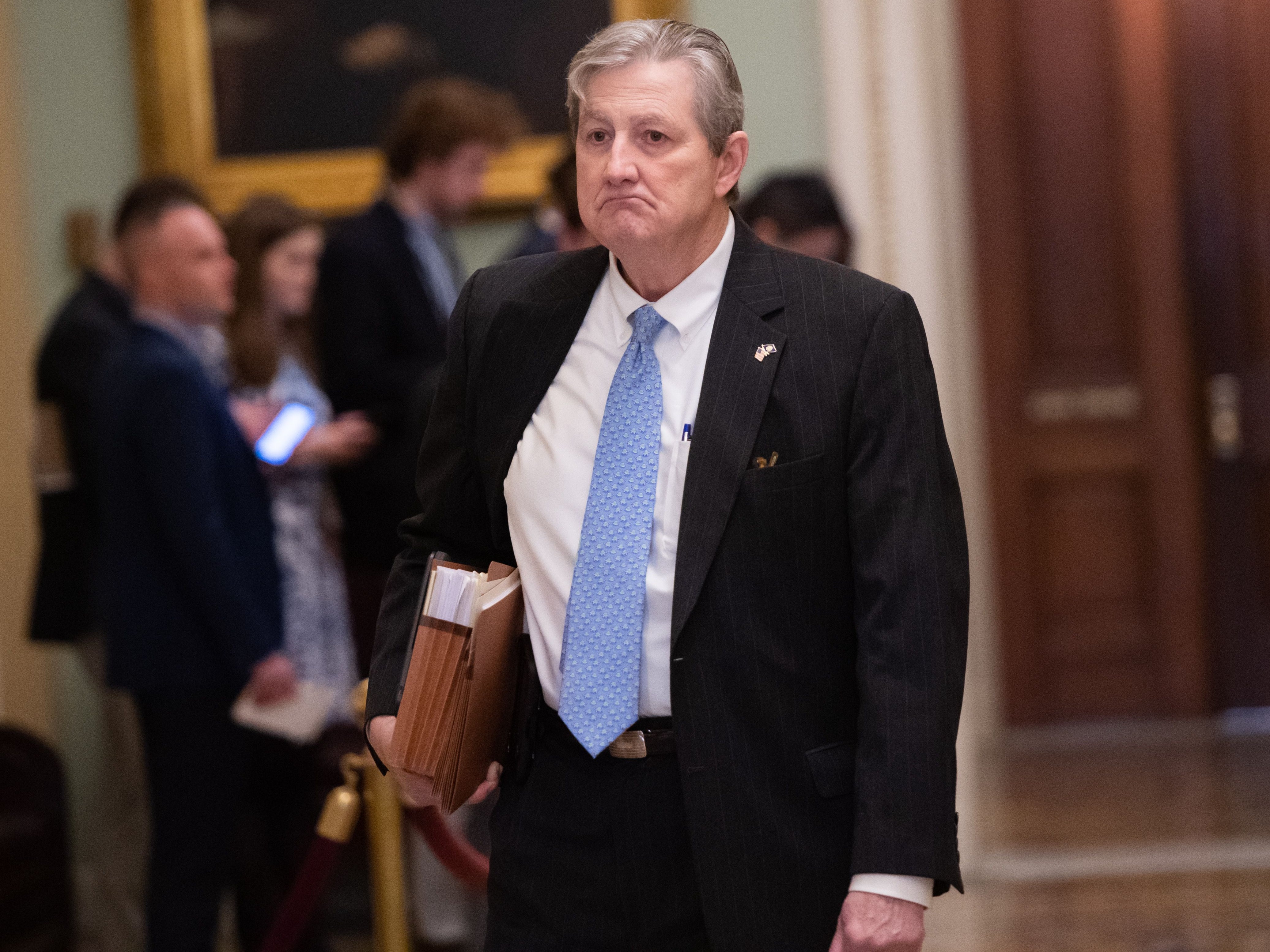
THE QUESTION THAT STARTED THE DEBATE
A provocative question attributed to actor Kevin Sorbo has circulated in political discussions.
It contrasts the criminal penalties for lying to Congress with the absence of a general criminal prohibition against politicians lying to voters.
The comparison is memorable.
But the legal reality is more complicated than the slogan suggests.
Under 18 U.S.C. § 1001, knowingly and willfully making a materially false statement in certain federal matters can constitute a crime.
The statute generally permits imprisonment for up to five years, with higher maximum penalties in specified circumstances.
For congressional matters, its application is limited to defined administrative activities and authorized investigations or reviews.
Not every inaccurate statement made to a member of Congress is a federal crime.
And not every misleading political statement falls outside existing law.
The distinction depends on context, materiality, intent, and the legal duties involved.
KENNEDY’S IMAGINED COUNTRY-LAWYER EXPLANATION
In the fictional speech, Kennedy leaned toward the microphone.
“Suppose a fellow walks into a bank and knowingly lies on a loan application.”
“He may have committed a crime.”
“Suppose that same fellow runs for office and makes a promise he never intends to keep.”
“Now we’ve got a different legal question.”
Kennedy adjusted his glasses.
“You can put a necktie on a mule, but that doesn’t make him a lawyer.”
He waited.
“And you can call every broken political promise a felony, but that doesn’t make it constitutional.”
The senator’s imagined remarks acknowledged a central difficulty.
Political speech receives substantial First Amendment protection.
Campaign promises often concern future events, intentions, and uncertain outcomes.
A promise that goes unfulfilled is not automatically proof of a deliberate lie.
Likewise, a disputed policy claim is not necessarily a criminal false statement.
Nevertheless, intentionally misleading the public can damage democratic trust.
The question is how to address that harm without giving government officials excessive power to police political speech.
WHY CONGRESS HAS SPECIAL CONSTITUTIONAL PROTECTIONS
The Constitution contains a provision known as the Speech or Debate Clause.
It protects members of Congress from being questioned elsewhere about legitimate legislative acts.
The protection helps preserve legislative independence from interference by other branches of government.
It covers activities such as congressional debate, voting, and other conduct integral to the legislative process.
But it does not provide unlimited immunity for everything a lawmaker does.
Political campaigning, public communications outside the legislative sphere, and unrelated criminal conduct are not automatically protected.
Congressional immunity is therefore more limited than the claim that lawmakers can legally do anything without consequences.
The distinction matters because a proposal to criminalize misleading legislative speech would confront significant constitutional obstacles.

THE DOCUMENT KENNEDY PULLED FROM HIS JACKET
In the fictional chamber, Kennedy unfolded the paper.
Its title read:
THE PUBLIC TRUTH AND CONGRESSIONAL ACCOUNTABILITY ACT — DISCUSSION DRAFT
No such Kennedy-sponsored bill is established by this imagined scene.
The document was a fictional proposal designed to illustrate possible reforms.
It called for clearer disclosure standards when lawmakers knowingly submit false information in official administrative filings.
It proposed stronger independent review of financial disclosures and misuse of public resources.
It also encouraged corrections when official public communications contain demonstrably false factual claims.
But the draft stopped short of making every misleading campaign statement a federal crime.
Kennedy explained why.
“Ladies and gentlemen, I don’t want Washington appointing itself the national referee of every political argument.”
He looked toward his colleagues.
“Because whoever controls that whistle might be tempted to blow it only when the other team has the ball.”
The imagined senator proposed transparency and oversight rather than an unrestricted criminal speech law.
THE DIFFERENCE BETWEEN A LIE AND A BROKEN PROMISE
Consider a candidate who promises to reduce taxes.
After winning office, the candidate votes for a tax increase.
Was the original promise a lie?
Possibly, if the candidate knowingly misrepresented an existing intention.
But the vote alone does not establish that.
Economic conditions may have changed.
Legislative negotiations may have failed.
The candidate may have reconsidered the policy.
A criminal prosecution would require a clearly defined offense and legally sufficient evidence.
Now consider a lawmaker who knowingly submits a falsified financial disclosure.
That situation may implicate existing reporting requirements and criminal statutes.
The two examples involve different kinds of statements.
Treating them identically could undermine both legal precision and constitutional protections.
THE REAL CONSEQUENCES OF POLITICAL MISINFORMATION
Misleading political statements can still have substantial consequences.
Voters may make decisions based on inaccurate information.
Public confidence in institutions may decline.
Government agencies may face confusion when officials circulate unsupported claims.
The effects can extend beyond elections.
False factual assertions may influence debates about public health, national security, disaster response, and government spending.
Yet political disagreement itself is not evidence of dishonesty.
Reasonable people can interpret the same policy differently.
They can also disagree about forecasts, priorities, and the meaning of statistical evidence.
An accountability system must distinguish deliberate factual deception from error, uncertainty, opinion, and legitimate disagreement.
THE FINAL CHALLENGE
In Kennedy’s imagined closing remarks, the senator placed the draft legislation on the desk.
He looked toward both sides of the chamber.
“Here’s what troubles me.”
“We spend a great deal of time demanding accountability from the American people.”
“We ought to be willing to examine our own standards with equal seriousness.”
He paused.
“Republicans should answer for what they say.”
“Democrats should answer for what they say.”
“And the standard ought not change depending on who’s holding the microphone.”
The fictional chamber grew quiet.
Then Kennedy delivered his closing question.
“If we cannot trust politicians to tell the truth, how can we trust politicians alone to decide which political statements deserve punishment?”
He folded his glasses.
The imagined speech ended without a vote or a dramatic confession.
Its central dilemma remained unresolved.
THE CONTROVERSIAL QUESTION AMERICA MUST CONFRONT
Political accountability is essential to representative government.
But constitutional protections also prevent authorities from criminalizing speech merely because it is unpopular, disputed, or embarrassing.
Existing federal law already penalizes certain deliberate false statements.
The Speech or Debate Clause protects legitimate legislative activity without creating blanket immunity for all conduct.
The unresolved policy question concerns accountability for misleading public communications that do not violate existing criminal statutes.
Should Congress establish stronger independent fact-checking and correction procedures for official communications?
Would additional disclosure requirements improve public trust, or create new opportunities for partisan enforcement?
And should voters remain the principal judges of political dishonesty, even when misleading statements cause significant public harm?
Those questions apply equally to Republicans, Democrats, and independents.
Any reform would need clear definitions, independent oversight, and constitutional safeguards.
Otherwise, an effort to improve honesty could become another instrument of political conflict.
The central challenge is not simply determining whether politicians should face consequences for dishonesty.
It is designing a system that holds public officials accountable without allowing those same officials to decide which political opinions Americans may express.
Because a democracy needs truthful government.
But it also needs the freedom to challenge the government when its version of the truth is wrong.
