
Senator John Kennedy’s reputation for aggressive questioning has placed him at the center of another viral political controversy, this time involving allegations of fabricated social media posts and congressional ethics.
The Louisiana Republican is accused in a circulating account of confronting legal scholar Jessica Levinson over supposedly manipulated tweets concerning lawmakers’ stock trading activities.
The account describes an unexpected document presentation that allegedly reversed the confrontation, leaving Kennedy unable to respond and exposing serious questions about the credibility of congressional ethics investigations.
But the documented congressional record tells a different story, revealing an earlier confrontation involving Kennedy, ethics attorney Kedric Payne, and disputed social media posts concerning Supreme Court justices.
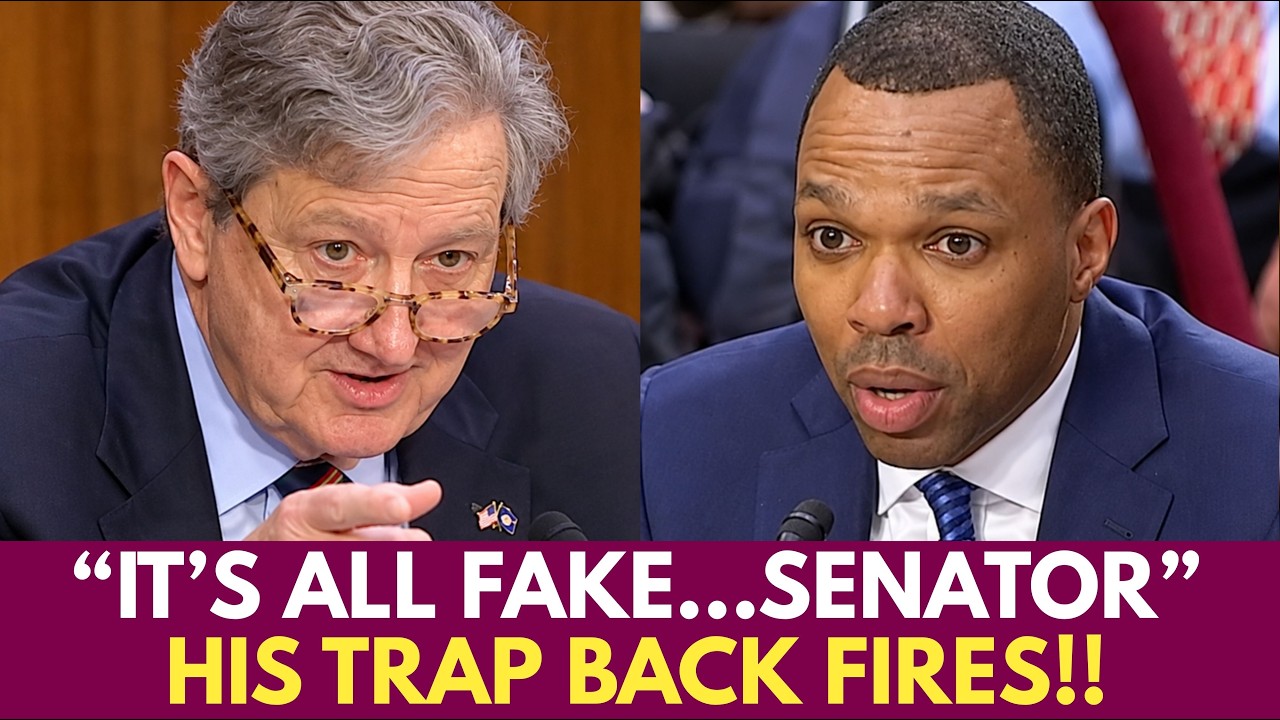
No authenticated hearing transcript establishes that Kennedy accused Levinson of fabricating tweets, received a surprise evidentiary document from her, or became speechless during such an exchange.
The distinction matters because the underlying controversies involve genuine disagreements over government ethics, congressional financial conflicts, and the credibility of witnesses appearing before lawmakers.
Kennedy has repeatedly questioned witnesses about their public statements, arguing that political commentary can help senators evaluate whether expert testimony reflects objective analysis or ideological commitments.
His approach has produced memorable confrontations, particularly when witnesses struggle to recall social media statements or challenge the relevance of questions about their earlier political opinions.
The most closely documented example occurred on May 2, 2023, during a Senate Judiciary Committee hearing examining proposed ethics reforms for the United States Supreme Court.
The hearing brought together legal scholars, former judges, and government ethics specialists to address concerns about judicial disclosure requirements and accountability standards.
Among those witnesses was Kedric Payne, a senior ethics attorney with Campaign Legal Center, whose testimony advocated stronger rules governing the Supreme Court.
Payne argued that the nation’s highest court lacked several formal safeguards already present elsewhere in the federal government, including more developed ethics enforcement procedures.
His testimony came amid growing scrutiny of financial disclosures, privately sponsored travel, and personal relationships involving Supreme Court justices and wealthy individuals.
Kennedy approached the hearing from a different perspective, questioning whether proposed reforms were being advanced consistently or selectively against conservative members of the Court.
The senator challenged Payne about social media posts criticizing Supreme Court justices, seeking to determine whether the witness’s prior commentary undermined his claims of impartiality.
One post suggested that certain justices behaved like political figures whose decisions could be influenced by wealthy interests, prompting Kennedy to demand greater specificity.
Kennedy asked which justices Payne believed were effectively available for purchase, challenging the seriousness of allegations involving judicial integrity.
Payne responded that he did not recall publishing the precise statement Kennedy attributed to him, creating an immediate disagreement about the social media record.
Kennedy then produced material associated with Payne’s online activity, using the printed evidence to challenge the witness’s recollection of his previous statements.
The questioning intensified when Kennedy raised another social media message describing Chief Justice John Roberts in harshly critical terms.
Payne initially denied having reposted the message, suggesting that the senator’s information did not accurately reflect his own online activity.
Kennedy responded skeptically, implying that the social media platform itself would have to be mistaken if the post had not appeared as presented.
The exchange became particularly significant when Payne subsequently clarified that he had, in fact, reposted the disputed statement.
That acknowledgment resolved the immediate factual question concerning the repost, although it did not establish that the witness had deliberately attempted to mislead the committee.
Payne’s written responses to subsequent questions confirmed ownership of the relevant social media account and acknowledged the repost discussed during Kennedy’s questioning.
His clarification demonstrated why documentary evidence can be important when witnesses are asked to recall statements made months or years before a congressional hearing.
Yet the episode did not involve Jessica Levinson, congressional stock trading, or a surprise document revealing that Kennedy had fabricated evidence against a witness.
Those elements belong to the unverified account, while the official record documents a disagreement involving Supreme Court ethics and Payne’s recollection of online commentary.
The distinction is especially important because Levinson is a recognizable legal commentator whose public analysis frequently addresses constitutional law, elections, and government accountability.
Assigning her a confrontation that cannot be established through congressional records risks transforming an actual ethics debate into an invented encounter between identifiable public figures.
Kennedy’s questioning style nevertheless raises a broader issue that is directly relevant to both judicial ethics and congressional financial oversight.
When expert witnesses appear before Congress, lawmakers are entitled to examine the factual foundations of their conclusions and challenge evidence they believe may be unreliable.
That scrutiny can include previous public statements when those statements bear meaningfully on credibility, disclosed conflicts, or the interpretation of disputed evidence.
However, a witness’s political opinions do not automatically invalidate technical expertise, just as a lawmaker’s disagreement with those opinions does not establish dishonesty.
The credibility of a particular claim ultimately depends on the quality of its supporting evidence, the reasoning offered, and whether relevant facts withstand independent examination.
Those principles are particularly important in discussions about congressional stock trading, where allegations of misconduct can seriously affect public confidence in elected officials.
Members of Congress routinely participate in legislative debates involving industries, corporations, taxation, financial regulation, and government spending that can influence investment markets.
Some lawmakers and their spouses also own financial assets whose values may change in response to government decisions, creating potential conflicts between personal interests and public responsibilities.
The STOCK Act of 2012 established disclosure requirements and affirmed that members of Congress are not exempt from applicable prohibitions against insider trading.
Under federal securities law, insider trading allegations generally require evidence involving material nonpublic information, a relevant duty, and conduct satisfying the applicable legal standards.
A profitable stock transaction does not automatically establish unlawful insider trading, even when its timing raises legitimate questions about a lawmaker’s access to sensitive information.
Similarly, a disclosure violation may warrant penalties without proving that the underlying transaction involved illegal use of confidential government information.
These distinctions help explain why ethics advocates have called for stronger preventative restrictions rather than relying exclusively on criminal prosecutions after suspicious transactions occur.
Some reform proposals would prohibit lawmakers from purchasing individual stocks while in office, reducing opportunities for conflicts even when no actual insider trading can be proven.
Other proposals would require divestment or qualified blind trusts, preventing members from retaining direct control over investments affected by their official responsibilities.
Those approaches remain controversial because lawmakers disagree over the scope of restrictions, treatment of family assets, and whether existing disclosure rules are sufficient.
The debate became especially significant in 2026, when Congress considered legislation intended to restrict certain investment transactions by members and their families.
On July 22, the House passed the Stop Insider Trading Act by a vote of 232 to 198, sending the measure to the Senate.
The legislation would prohibit certain purchases of individual stocks by lawmakers, spouses, and dependent children while allowing covered individuals to retain some existing holdings.
Supporters argued that the proposal represented meaningful progress toward reducing financial conflicts and increasing public trust in congressional decision-making.
Critics countered that permitting existing ownership and certain sales would leave significant opportunities for perceived conflicts of interest.
The measure also became entangled with provisions concerning voter identification, leading some Democrats to oppose legislation they argued combined unrelated election restrictions with incomplete ethics reforms.
On September 30, the Senate failed to advance the bill when a procedural vote produced 53 votes in favor and 47 against.
The result fell short of the 60 votes generally required to overcome a Senate filibuster, preventing the measure from proceeding through that legislative stage.
The failed vote illustrated how a policy enjoying broad rhetorical support could still become trapped in disagreements over legislative design and unrelated provisions.
Kennedy himself has advocated stronger restrictions on congressional stock trading, complicating any portrayal of the senator as categorically defending lawmakers’ ability to exploit financial information.
Following the November 2026 midterm elections, Kennedy publicly urged Republicans to address voter dissatisfaction through concrete reforms, including restrictions on stock transactions by members of Congress.
His position does not establish agreement with every reform proposal, but it demonstrates that the senator has publicly supported addressing potential financial conflicts.
That policy record matters when evaluating claims that a purported confrontation with an ethics witness represented a straightforward defense of congressional stock trading abuses.
Without an authenticated transcript, the alleged exchange cannot establish Kennedy’s position on a specific proposal or prove that he sought to protect unlawful financial transactions.
Nor can an unverified description of Levinson presenting documents establish that she exposed misconduct or corrected fabricated evidence during a congressional hearing.
The more substantial question is how lawmakers should evaluate allegations derived from online posts, financial databases, public disclosures, and other materials used during oversight proceedings.
Social media screenshots can provide useful leads, but authenticating them may require original posts, reliable archives, account records, and contextual information establishing what was actually published.
A cropped image may omit relevant qualifications, while a genuine repost can be mistaken for an original statement if the distinction is not clearly explained.
Congressional witnesses and lawmakers therefore share responsibility for accurately characterizing documents before using them to make potentially damaging public accusations.
The Kennedy-Payne hearing demonstrates how a specific social media dispute can be resolved through clarification and written documentation, even when the questioning becomes contentious.
It also demonstrates that such exchanges can distract attention from the policy subject that originally brought witnesses before Congress.
In Payne’s case, the underlying issue involved judicial ethics safeguards and whether Supreme Court justices should operate under stronger formal accountability requirements.
In the broader congressional stock trading debate, the central issue is whether elected officials should retain financial interests that could create conflicts with their government responsibilities.
Both subjects involve institutional trust, but they cannot be treated as interchangeable evidence of the same alleged hearing or personal confrontation.
As of November 13, 2026, the available official material does not verify the claimed Kennedy-Levinson exchange, the alleged fabricated tweets, or the supposed surprise document presentation.
The documented Kennedy-Payne confrontation remains an important example of how the senator uses prior public statements to challenge testimony and question credibility.
The later congressional stock trading debate supplies a separate, substantive controversy involving the adequacy of existing safeguards and disagreements over proposed reforms.
For Americans concerned about government integrity, the practical stakes involve more than whether a senator or witness appeared embarrassed during a televised exchange.
Financial transparency depends on accurate disclosures, clear restrictions, effective enforcement, and the ability to distinguish suspicious conduct from legally established misconduct.
Witness credibility depends on verifiable evidence rather than assumptions about political affiliation, while congressional scrutiny must remain rigorous without substituting confrontation for factual examination.
Kennedy’s questioning illustrates the importance of verifying public statements, but the same requirement applies to sensational accounts describing his own conduct.
The alleged confrontation with Levinson cannot responsibly be presented as fact merely because it resembles other memorable moments from Kennedy’s congressional career.
What remains unresolved is whether Congress can agree on financial safeguards strong enough to address public concerns while preserving fair and consistent legal standards.
The most consequential question is therefore not whether Kennedy was supposedly left speechless, but whether lawmakers can establish ethical rules that make such disputes less necessary.
Until Congress resolves those disagreements, arguments over personal credibility will continue competing with the larger responsibility of protecting public institutions from financial conflicts and improper influence.
