

The holiday recess was approaching, and Washington’s political calendar was running out of room. But Senator Elizabeth Warren had a question that threatened to disrupt the final days of congressional business.
In this fictional Capitol Hill confrontation, Senate leaders were preparing to leave Washington when the Massachusetts Democrat entered a leadership meeting carrying a thick folder of financial documents.
The folder contained three categories of concern: federal fraud losses, corporate tax advantages, and government programs whose financial controls had repeatedly attracted criticism from independent oversight authorities.
Warren placed it on the table and challenged her colleagues to explain why Congress should postpone another debate about protecting taxpayer money while Americans continued struggling with household expenses.
The imagined confrontation was not a documented Senate meeting. Its dialogue, dramatic reactions, and proposed emergency vote were created for this political scenario.
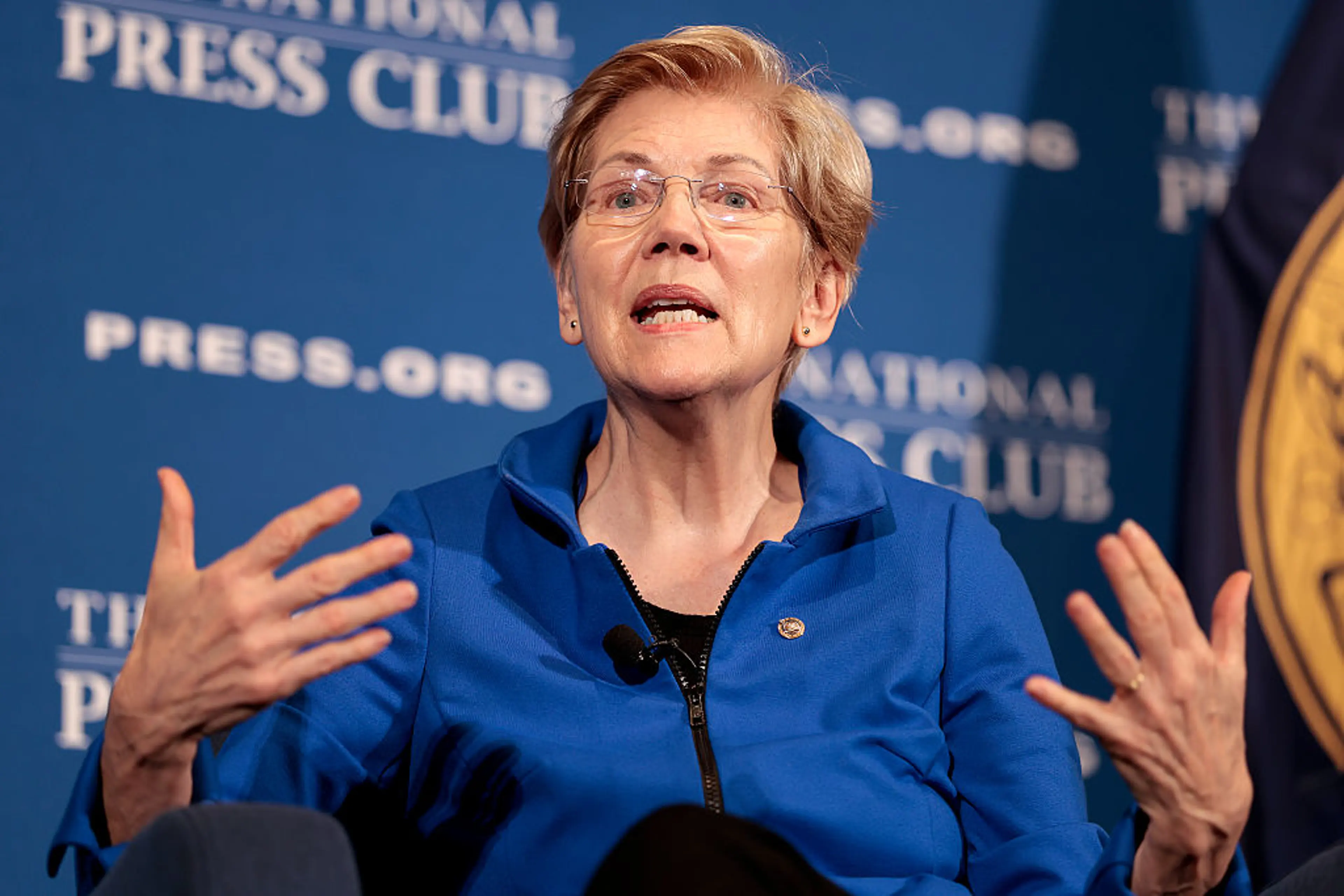
Its underlying financial questions, however, reflected genuine issues involving federal fraud estimates, corporate tax policy, and Warren’s longstanding efforts to strengthen financial accountability.
The controversy began with a figure large enough to command attention: $240 billion, an amount Warren described in the fictional exchange as a warning about the scale of Washington’s financial challenges.
That number was not an authenticated estimate of recoverable funds contained in a specific Warren proposal, nor did it represent a verified amount Congress could immediately eliminate.
It fell within a broader range reported by the Government Accountability Office, which estimated annual federal fraud losses between $233 billion and $521 billion.
The estimate, published in April 2024, relied on information from fiscal years 2018 through 2022 and described losses across a wide range of federal operations.
Those figures concerned estimated fraud, not a single account containing missing money or a precise sum available for recovery through an immediate legislative vote.
Warren acknowledged that distinction in the imagined meeting, arguing that the uncertainty surrounding individual amounts did not diminish the importance of identifying preventable losses.
One fictional senator challenged whether combining fraud estimates, corporate tax provisions, and administrative inefficiencies risked presenting unrelated financial problems as one enormous scandal.
Warren responded that each category required separate analysis, but maintained that Congress had a responsibility to examine all three when considering the integrity of federal finances.’

The exchange quickly moved beyond the dramatic headline, becoming a dispute over whether Washington possessed sufficient information to protect public resources and evaluate legislative priorities.
Warren opened the first section of her folder and introduced the GAO’s findings about the government’s vulnerability to fraudulent claims and transactions.
She asked why federal agencies continued struggling with payment verification, data-sharing limitations, and weaknesses that could allow fraudulent activity to escape detection.
A fictional Republican leader responded that agencies had already strengthened certain controls and that additional requirements could create administrative burdens for legitimate beneficiaries.
Warren acknowledged that risk but argued that protecting eligible recipients and preventing fraud were complementary responsibilities rather than objectives that necessarily contradicted one another.
The discussion became sharper when she asked whether officials should be required to explain unresolved oversight recommendations before requesting additional funding for existing programs.
Another senator questioned whether stronger reporting requirements would reduce losses or merely increase the cost of managing already complicated federal systems.
Warren answered that effective oversight should include measurable performance standards, independent evaluation, and evidence that new safeguards justified their administrative costs.
The fictional leadership meeting now faced an uncomfortable distinction: recognizing that government fraud was substantial did not establish that any particular reform would recover a predictable amount.
Nevertheless, the absence of guaranteed savings did not eliminate the potential value of preventing future losses through appropriately designed improvements.
Warren turned to the next section of her folder, shifting the debate from fraudulent payments toward corporate tax provisions and the treatment of highly profitable businesses.
The Massachusetts senator has long argued that large corporations should face meaningful tax obligations even when sophisticated accounting strategies reduce their taxable income.
Her real legislative work includes support for the corporate alternative minimum tax, designed to establish a minimum tax on the adjusted financial statement income of certain large corporations.
The fifteen-percent corporate alternative minimum tax was created under the Inflation Reduction Act of 2022 and applies to corporations meeting specified income thresholds.
Its implementation has produced disagreements over accounting methods, regulatory guidance, exemptions, and the treatment of certain business expenses.
Warren and other lawmakers have criticized administrative decisions they believe could weaken the law’s intended effects by allowing highly profitable corporations to reduce their minimum-tax obligations.
In September 2025, Warren joined Senator Angus King and other lawmakers in questioning Treasury Department guidance concerning the corporate alternative minimum tax.
They argued that certain regulatory changes could create opportunities for large businesses to avoid obligations Congress intended the minimum tax to impose.
Those objections represented genuine policy disputes, not findings that every corporation benefiting from a tax provision had committed fraud or violated the law.
That distinction became central to the fictional confrontation when Warren placed a document concerning corporate tax preferences beside the federal fraud estimates.
One senator immediately challenged whether legal tax deductions could appropriately be discussed alongside financial crimes committed against government assistance programs.
Warren answered that lawful tax benefits and criminal fraud were separate issues, but argued that both deserved scrutiny when lawmakers evaluated the fairness of federal financial policy.
She maintained that Congress could examine the economic effects of existing tax preferences without automatically accusing corporations using those provisions of wrongdoing.
The imaginary meeting grew more contentious when she questioned whether political leaders were prepared to review tax advantages benefiting economically powerful industries.
A fictional senator responded that tax incentives could encourage investment, employment, research, and expansion, making their effects more complicated than the amount of revenue forgone.
Warren acknowledged that tax incentives could serve legitimate purposes, but argued that lawmakers should establish whether the promised economic benefits justified their costs.
The disagreement reflected a familiar fiscal-policy debate: whether particular tax provisions generate sufficient economic value or primarily reduce government revenue without delivering their stated objectives.
Warren emphasized that evaluating such provisions required information about investment behavior, corporate profits, employment outcomes, and the distribution of financial benefits.
Her fictional opponents countered that eliminating tax preferences without considering their economic consequences could discourage investments that policymakers otherwise wished to encourage.
Neither argument resolved the question, but both demonstrated why serious tax reform requires more than describing every deduction as a loophole or every tax increase as harmful.
The fictional confrontation continued as Warren introduced another document concerning the Internal Revenue Service’s efforts to measure unpaid federal tax liabilities.
In November 2026, Warren and other lawmakers sought information about the IRS tax-gap estimate, questioning delays and the integrity of its underlying methodology.
The tax gap concerns the difference between taxes legally owed and amounts paid voluntarily and on time, including liabilities associated with different forms of noncompliance.
It is not interchangeable with the GAO’s government fraud estimate, and combining those figures without examining their definitions could produce misleading conclusions.
Warren used that distinction to argue that Washington needed more accurate financial reporting before lawmakers could responsibly debate the scale of potential recoveries.
A fictional colleague asked whether she was proposing an immediate $240 billion cut in government spending, additional tax enforcement, or a broader investigation into federal financial management.
Warren responded that the headline figure represented the scale of the challenge, while specific legislation would require separate estimates of savings, costs, and administrative effects.
The answer briefly slowed the confrontation, forcing the imaginary participants to acknowledge that a political demand could not substitute for a fully developed legislative proposal.
But the approaching holiday recess continued dominating the discussion, particularly as senators questioned whether substantial financial reforms could be prepared before the congressional calendar expired.
Warren challenged the assumption that the remaining time should be devoted exclusively to procedural negotiations rather than identifying priorities capable of receiving bipartisan support.
A fictional Republican senator responded that rushing legislation through Congress could create poorly designed provisions whose consequences might exceed their potential benefits.
Warren agreed that procedural safeguards mattered, but insisted that careful preparation should not become a permanent excuse for postponing action.
The conversation shifted toward government contractors, financial institutions, and organizations receiving federal funding, with Warren asking whether all significant recipients should face consistent oversight standards.
The fictional leadership group debated how those standards might operate across defense procurement, healthcare programs, disaster assistance, and federal business support.
Each area presented different risks, and each required procedures tailored to the legal responsibilities and administrative systems governing the relevant payments.
Warren suggested that federal agencies should strengthen data analysis, improve verification of eligibility, and explain how they responded to findings from inspectors general.
One colleague challenged whether improved technology alone could reliably detect fraud, particularly when complex schemes exploited weaknesses in human judgment and institutional coordination.
Warren responded that technology should support trained investigators and competent administrators rather than replace the judgment necessary for identifying misconduct.
The exchange reflected genuine concerns raised by oversight agencies about the importance of data quality, appropriately skilled personnel, and effective fraud-risk management.
Then Warren returned to the question of corporate accountability, asking whether policymakers would support stronger transparency requirements for businesses receiving significant public financial advantages.
A fictional senator cautioned that disclosure obligations needed to protect confidential commercial information and avoid imposing unnecessary compliance costs.
Warren responded that transparency should be appropriately designed, but argued that the public deserved credible explanations of how major government-supported benefits were distributed.
The imaginary discussion became increasingly intense when she asked lawmakers to apply the same standard of accountability to politically influential corporations and ordinary recipients of federal assistance.
Her argument emphasized consistency: financial scrutiny should not become stricter merely because a person or organization lacked wealth or political influence.
A fictional Republican colleague countered that standards should also consider the size and complexity of transactions, rather than assuming identical procedures were appropriate for every recipient.
Warren acknowledged that point, maintaining that different procedures could still follow the same underlying principles of transparency, lawful conduct, and accountability.
The chairman then asked whether the assembled lawmakers were prepared to identify specific measures that could be examined before the approaching recess.
Warren introduced a hypothetical proposal requiring agencies to report unresolved fraud risks, improve coordination among oversight authorities, and publish clearer assessments of corrective measures.
The imagined measure also requested a separate review of corporate tax expenditures and their relationship to the economic objectives Congress originally intended.
Those provisions were fictional and did not represent an introduced Warren bill or an actual Senate vote scheduled for November 2026.
The leadership group questioned whether such legislation could advance quickly enough to receive meaningful committee review and a responsible fiscal analysis.
Warren replied that Congress should distinguish the need for careful evaluation from the political convenience of avoiding difficult decisions.
The fictional argument then shifted toward the people whose names appeared in Warren’s final set of documents, producing the dramatic moment anticipated by the circulating headline.
Rather than revealing a secret list of criminals, the folder identified public officials and agencies connected to documented debates over financial accountability.
Among the names were Senators Angus King and Sheldon Whitehouse, who have worked with Warren on questions involving corporate taxation and enforcement of financial obligations.
Senator Chris Van Hollen also appeared in the materials because of his public involvement in efforts to strengthen scrutiny of tax arrangements benefiting wealthy individuals and businesses.
Their inclusion reflected documented legislative cooperation, not allegations that they had personally engaged in wrongdoing or possessed concealed financial information.
The folder also referenced the Government Accountability Office, the Treasury Department, and the Internal Revenue Service, institutions responsible for different aspects of government financial management.
Warren asked whether Congress was prepared to demand clear responses from the institutions responsible for identifying fraud risks, administering tax law, and overseeing public expenditures.
One fictional senator challenged whether naming agencies and colleagues could reasonably be presented as a revelation when their public work was already documented.
Warren acknowledged that the information was public, but argued that the significance lay in whether lawmakers would act on the questions those records raised.
The fictional chairman asked her to identify the single objective that should guide any immediate legislative discussion.
Warren paused, placed the final page on the table, and directed her closing argument toward the responsibility shared by both political parties.
“If Washington can find money for powerful interests, why can’t it find the determination to protect every dollar Americans have already entrusted to it?”
The question brought the imagined meeting to a temporary silence, redirecting the confrontation from party affiliation toward the broader obligation to administer public resources responsibly.
A fictional Republican leader responded that safeguarding taxpayer money was a legitimate objective, but warned that successful reform required credible estimates and workable legislative language.
Warren agreed that implementation mattered, while maintaining that financial accountability should remain a legislative priority regardless of which party controlled Congress.
The imagined meeting concluded without an emergency $240 billion vote, a confirmed recovery of missing money, or evidence that named senators had concealed criminal misconduct.
Its dramatic exchange illustrated the difference between demanding financial accountability and demonstrating that a specific legislative proposal could produce a particular amount of savings.
The real GAO fraud estimates remain substantial, but they describe statistical assessments of federal losses rather than amounts guaranteed to be recovered through new legislation.
Likewise, disagreements over corporate tax provisions concern economic policy and legal compliance, not automatic evidence of criminal conduct by the companies receiving those benefits.
The IRS tax gap represents another distinct financial issue, requiring separate examination of unpaid liabilities, enforcement capacity, and the potential effects of policy changes.
For American taxpayers, those distinctions matter because public debate becomes misleading when unrelated financial categories are combined into an apparently precise figure.
A credible reform effort should identify specific problems, explain the mechanisms intended to address them, and provide realistic estimates of financial and administrative consequences.
It should also consider how stronger verification requirements affect legitimate recipients, including families and businesses that depend on timely government decisions.
Warren’s fictional confrontation emphasized the importance of examining powerful economic interests, but the same principles of accountability apply to government agencies and the programs they administer.
Her opponents’ concerns about costs and procedural safeguards also deserved evaluation, particularly when reforms might create new obligations for institutions already facing complicated administrative challenges.
The imaginary holiday showdown therefore ended without a definitive political victory, leaving the underlying questions open for legislative scrutiny.
It demonstrated that an emotionally powerful demand for action can draw attention to serious problems without establishing that those problems share a single solution.
The broader challenge facing Congress is whether lawmakers can translate credible oversight findings into effective policies while resisting the temptation to exaggerate potential savings.
Government fraud, tax noncompliance, and questionable tax preferences each require appropriate investigation, clear definitions, and evidence-based decisions.
The fact that billions of dollars are involved makes careful analysis more important, not less, because poorly supported financial claims can create expectations that no realistic reform can fulfill.
For working Americans struggling with housing, healthcare, food, and transportation expenses, the stakes include both responsible taxation and the effective delivery of government services.
Those households benefit when public institutions manage resources competently, correct documented failures, and explain the results of policies enacted in their name.
The fictional confrontation ended with Warren closing her folder as the approaching holiday recess continued creating pressure on lawmakers to finish their work.
The decisive question was not whether one dramatic speech could force Washington to recover $240 billion before senators departed for the holidays.
It was whether elected officials could agree on credible standards for protecting public money, examining corporate tax policy, and evaluating the results of government programs.
And as the imaginary meeting came to an end, Warren’s challenge remained relevant beyond the fictional scene: when Washington identifies serious financial weaknesses, what will it take for Congress to turn those findings into measurable reform?
